


Listen to the article
India’s Air Quality Crisis Deepens as Officials Downplay Pollution Concerns
Recent remarks by two high-ranking Indian officials have inflamed public frustration as residents accuse policymakers of deliberately minimizing the severity of the nation’s air quality crisis.
Environment Minister Bhupender Yadav sparked controversy when he told Parliament that New Delhi had experienced 200 days of good air quality this year. Pollution experts and opposition leaders immediately criticized the statement, pointing out that Yadav’s calculation conveniently excluded data from the capital’s most polluted months.
Days later, Delhi Chief Minister Rekha Gupta further angered residents by comparing air quality index readings to temperature measurements, suggesting the problem could be solved simply by spraying water. Her comments prompted public backlash, with crowds at a subsequent event jeering and chanting “AQI” in reference to the city’s dangerously poor air quality levels.
These statements come after Gupta approved a controversial cloud seeding program earlier this year, claiming it would generate rain to reduce pollution levels despite limited scientific evidence supporting its effectiveness in Delhi’s climate conditions.
“Instead of doing cloud seeding, I hope the government will wake up and take some real action,” said Anita, a 73-year-old New Delhi resident. “It’s a shame.”
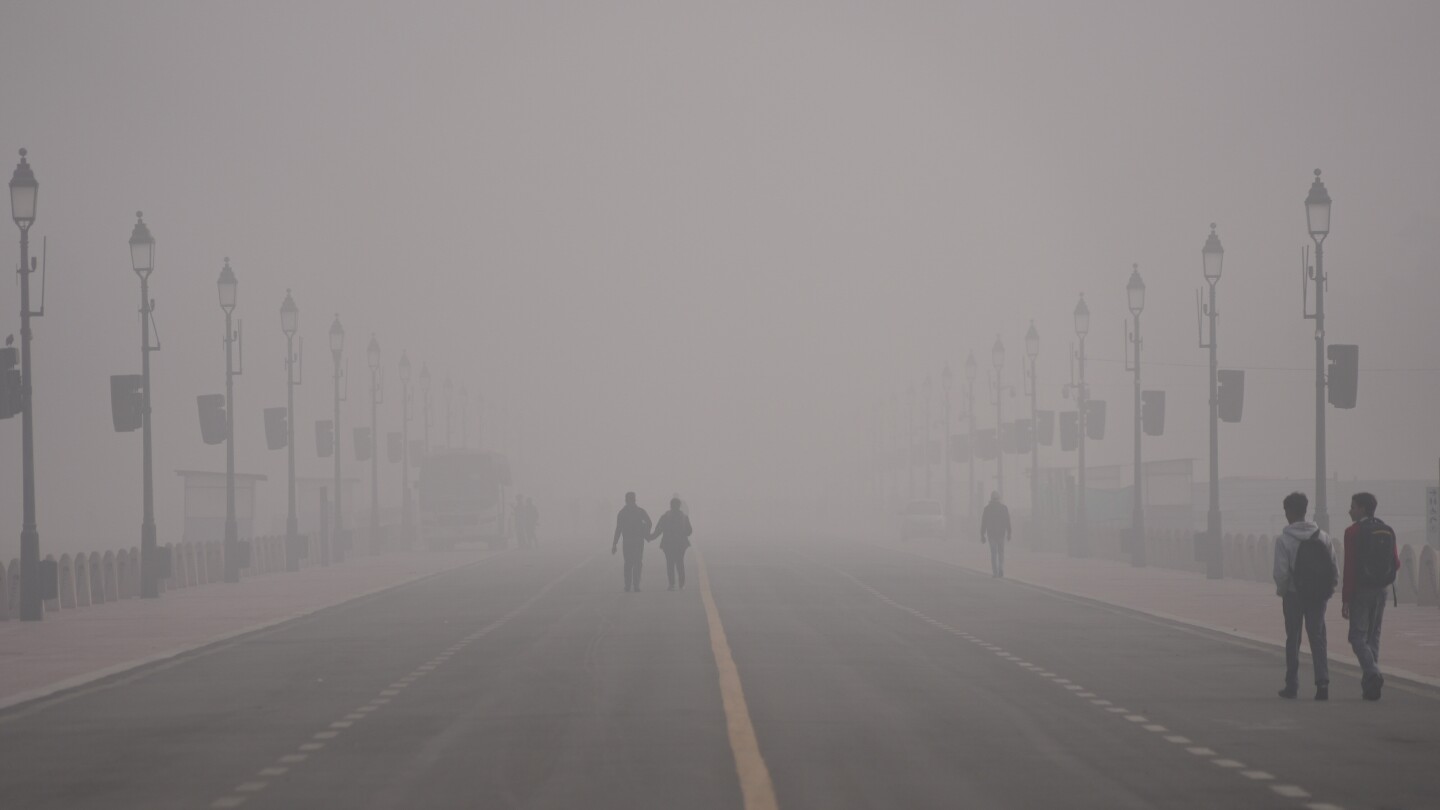
For millions living in Delhi and surrounding regions currently blanketed in toxic smog, these incidents represent the latest examples of official denial regarding the true extent of India’s pollution crisis.
Environmental experts note that India’s air quality measurement standards are significantly more lenient than those used in countries like the United States. The country’s acceptable pollution thresholds also fall well short of World Health Organization guidelines, allowing officials to classify as “moderate” what would be considered hazardous levels elsewhere.
“We are making huge investments in air quality monitoring. When we are expanding, it also becomes an imperative that we should be focusing on the quality,” said Anumita Roychowdhury, executive director at the Centre for Science and Environment, a New Delhi-based think tank.
India’s pollution monitoring infrastructure consists of a nationwide network of monitors, sensors, and satellite data. While the system collects valuable information, experts say there are far too few monitoring stations to provide accurate, neighborhood-level air quality assessments.
In 2019, India launched the National Clean Air Program, establishing targets to reduce pollution by up to 40% in 131 cities by 2026. The initiative has directed millions of dollars toward monitoring equipment and dust-control measures, including water-spraying machines that target pollution from road traffic, construction, and desert winds.
However, air pollution specialists argue the program has largely neglected the primary sources of contamination: industrial emissions and vehicle exhaust. A 2024 report by the Centre for Science and Environment found that 64% of program funds went toward reducing dust, while only 12% addressed vehicle pollution and less than 1% targeted industrial emissions. Other major pollution sources—crop stubble burning, wood and cow dung used as cooking fuel, and garbage incineration—also remain inadequately addressed.
The health consequences are devastating. A 2023 Lancet study linked prolonged exposure to India’s polluted air to approximately 1.5 million additional deaths annually compared to scenarios where WHO air quality standards would be met. Yet earlier this month, Junior Health Minister Prataprao Jadhav claimed there is no conclusive data establishing a direct correlation between air pollution and mortality in India.
“Deaths related to air pollution are not being counted. And the reason why it’s not being counted is because there are no systematic mechanisms to do so,” explained Shweta Narayan, campaign lead at the Global Climate and Health Alliance.
Narayan emphasized that while pollution affects everyone, it poses particularly severe risks to vulnerable populations. “As a consequence of exposure to air pollution, we see a lot of preterm births, miscarriages, low birth weight. Exposure at this stage has a lifelong consequence,” she noted.
Earlier this month, New Delhi residents took the unusual step of organizing street protests against the worsening air quality, demanding immediate government action.
“We do not know whether citizens will be able to link air pollution to elections, but perhaps that’s where India is moving toward,” said environmentalist Vimlendu Jha. “Citizens are fed up.”
Jha criticized authorities for prioritizing public relations over substantive policy responses. “There’s more headline and image management than pollution management,” he said, adding that political leaders have normalized dangerous pollution levels. “The first thing that the government needs to do is to be honest about the problem that we have. The right diagnosis is extremely critical.”
For residents like Satish Sharma, a 60-year-old auto rickshaw driver, the impacts are already unbearable. Sharma has reduced his working hours as his health deteriorated in recent weeks due to air pollution.
“Everyone feels the pollution. People are not able to work or even breathe,” he said. “I want to tell the government to please do something about this pollution. Otherwise, people will move away from here.”
Fact Checker
Verify the accuracy of this article using The Disinformation Commission analysis and real-time sources.

12 Comments
It’s concerning that officials are making misleading comparisons to downplay the severity of India’s air quality crisis. Transparent, accurate data is crucial.
Yes, the public deserves honesty from their leaders on this critical environmental issue.
Troubling to hear officials downplaying India’s air quality crisis. Reliable data is crucial to address these serious environmental challenges effectively.
Agreed. Minimizing the problem does a disservice to the public and prevents meaningful action.
Comparing air quality to temperature is a strange and inappropriate analogy. Residents are right to be frustrated by the lack of meaningful action.
Agreed, that comparison is nonsensical and does not address the real challenges India faces.
The cloud seeding program sounds like a dubious quick fix. Policymakers need to take a holistic, evidence-based approach to tackling pollution in India.
Absolutely. Relying on unproven methods while ignoring the root causes is counterproductive.
It’s discouraging to see officials downplaying the severity of India’s air pollution crisis. Reliable data and transparent policymaking are needed.
Absolutely. Residents deserve leaders who take this issue seriously and work to find real solutions.
Spraying water to address air pollution? That seems like an ineffective gimmick. India needs substantive, evidence-based policies to tackle this crisis.
Agreed, that suggestion is concerning and demonstrates a lack of understanding of the problem.