


Listen to the article
The United Nations Security Council is set to convene a high-level meeting Wednesday to address the fragile ceasefire in Gaza and Israel’s expanding operations in the West Bank, as diplomatic efforts increasingly focus on President Donald Trump’s upcoming inaugural Board of Peace meeting.
Originally scheduled for Thursday, the UN meeting was moved up after Trump announced his newly formed Board of Peace would meet the same day, creating scheduling conflicts for diplomats expected to attend both events, according to The Associated Press.
Foreign ministers from the United Kingdom, Israel, Jordan, Egypt, and Indonesia are anticipated at the monthly Middle East meeting of the 15-member Security Council. Several Arab and Islamic nations requested the session last week to discuss Gaza and Israel’s expansion of settlements in the West Bank before some of their leaders head to Washington.
The diplomatic developments come as Trump announced Monday that member states of his Board of Peace have pledged more than $5 billion toward humanitarian aid and reconstruction efforts in Gaza. Participating countries have also committed thousands of personnel to an international stabilization force and local policing efforts aimed at maintaining security in the enclave.
In outlining his initiative, Trump emphasized that Hamas must adhere to what he described as a commitment to “full and immediate demilitarization,” positioning the effort as part of a broader strategy toward achieving regional stability.
The Gaza situation remains precarious despite the ceasefire. Palestinians in Gaza City were recently seen shopping for food beneath destroyed buildings at the Zawiya market during the first days of Ramadan, highlighting the ongoing humanitarian challenges facing the territory’s residents despite diplomatic progress.
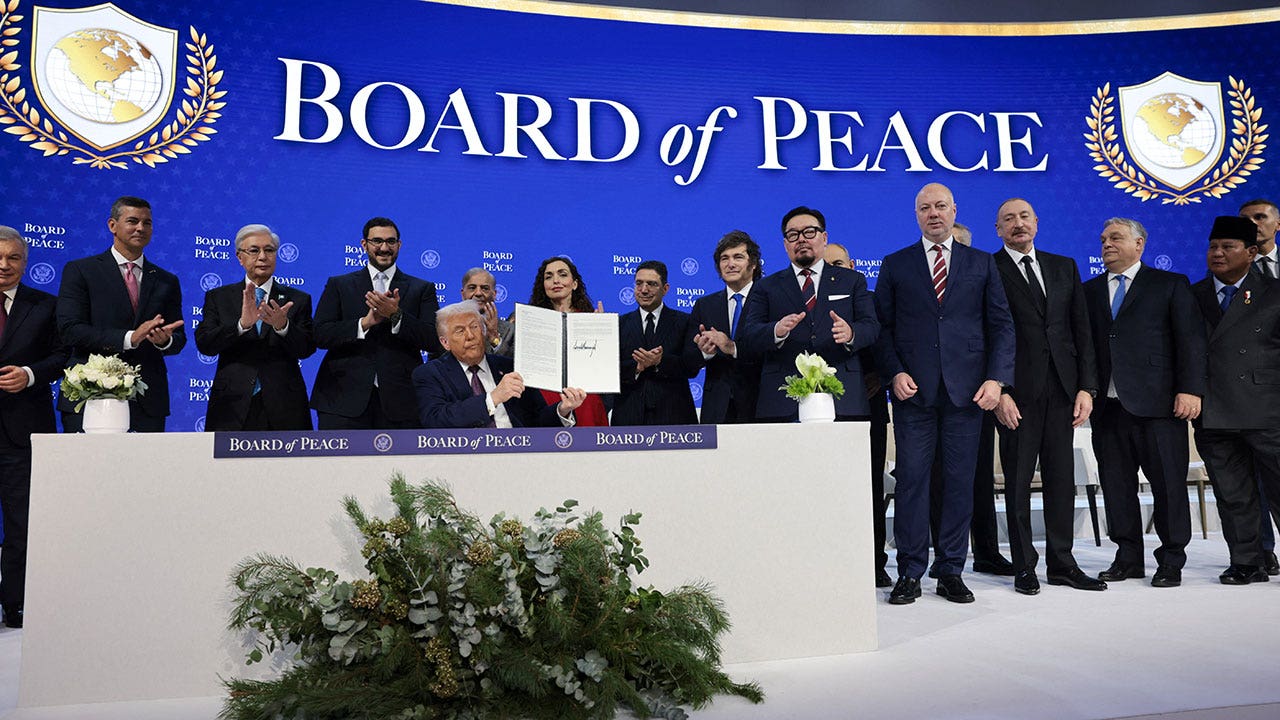
Israel formally joined the Board of Peace on February 11, ahead of Prime Minister Benjamin Netanyahu’s meeting with Trump at the White House. Netanyahu was notably absent from the initial ceremony held in Davos, Switzerland, in late January, where leaders from 17 countries signed the founding charter alongside Trump. The signatories included presidents and senior government officials from Latin America, Europe, the Middle East, and Central and Southeast Asia.
Netanyahu later agreed to join the initiative after initially expressing concerns about the board’s composition, particularly regarding the roles of Qatar and Turkey. Both nations have historically maintained ties with Hamas, raising questions about their potential influence on the peace process.
The White House has extended invitations to numerous other countries to participate in the peace initiative, including Russia, Belarus, France, Germany, Vietnam, Finland, Ukraine, Ireland, Greece, and China. However, not all nations have embraced the effort, with Poland and Italy declining to join the board.
The dual-track diplomatic initiatives—the UN Security Council meeting and Trump’s Board of Peace—represent different approaches to addressing the complex Middle East conflict. While the UN operates within its established multilateral framework, Trump’s initiative represents a more personalized diplomatic approach that has attracted significant international buy-in despite some notable abstentions.
The pledged $5 billion in aid for Gaza marks a substantial financial commitment toward reconstruction, though the implementation will face considerable challenges given the territory’s devastation and complex governance situation. The commitment of security personnel also raises questions about how an international force would operate in the politically sensitive region.
As both meetings approach, the international community remains focused on whether these diplomatic efforts can translate into sustainable progress for a region that has experienced decades of conflict. The coming days will test whether the parallel diplomatic tracks can complement each other or whether they might create competing visions for peace in the Middle East.
Fact Checker
Verify the accuracy of this article using The Disinformation Commission analysis and real-time sources.

13 Comments
The diplomatic maneuvering around the scheduling of these events highlights the complex dynamics at play. I hope the various stakeholders can find a way to constructively engage and make progress.
Advancing the Gaza and West Bank session before the Board of Peace meeting seems like a prudent move to ensure these critical issues remain at the forefront of the international dialogue.
It’s encouraging to see the UN Security Council and the new Board of Peace both focusing on the situation in Gaza and the West Bank. Resolving these longstanding conflicts will require a coordinated international effort.
This seems like a pivotal moment in the ongoing efforts to address the Israeli-Palestinian conflict. The interplay between the UN and the Board of Peace will be crucial to watch.
The commitment of substantial financial and military resources is a promising sign, but the real test will be whether the various parties can find a path forward that all sides can accept.
This UN meeting seems like an important step to address the ongoing tensions in Gaza and the West Bank. I’m curious to see if the Board of Peace can make any meaningful progress on these complex regional issues.
The $5 billion in aid and deployment of an international force are promising developments, but the long-standing conflict will require sustained diplomatic efforts to resolve.
I’m glad to see the UN Security Council taking proactive steps to address the fragile ceasefire and Israeli settlement expansion in the West Bank. This will be an important test for the new Board of Peace.
The commitment of $5 billion in aid and an international stabilization force is a positive sign, but the real challenge will be translating that into meaningful progress on the ground.
This is a delicate and complex situation, and I’m glad to see the international community engaging through both the UN Security Council and the new Board of Peace. Sustained dialogue and compromise will be essential.
The shifting of the UN Security Council meeting to accommodate the Board of Peace inaugural highlights the high-stakes nature of these diplomatic proceedings. I hope all parties involved can find a way to make progress.
The timing of this UN Security Council meeting right before the Board of Peace inaugural is intriguing. I wonder if the council will try to set the agenda or frame the discussion for the new US-led initiative.
It will be interesting to see how the different diplomatic players, including Israel, Jordan, Egypt, and others, engage with the Board of Peace and its proposed solutions.