


Listen to the article
Umberto Bossi, the firebrand founder of Italy’s Northern League who transformed the country’s political landscape with his populist rhetoric and regional autonomy agenda, died Thursday at the age of 84, his party announced.
The news of Bossi’s passing prompted an outpouring of tributes from across Italy’s political spectrum. President Sergio Mattarella honored him as “a passionate political leader and sincere democrat,” while Prime Minister Giorgia Meloni acknowledged his “fundamental contribution” to creating Italy’s first modern center-right coalition government.
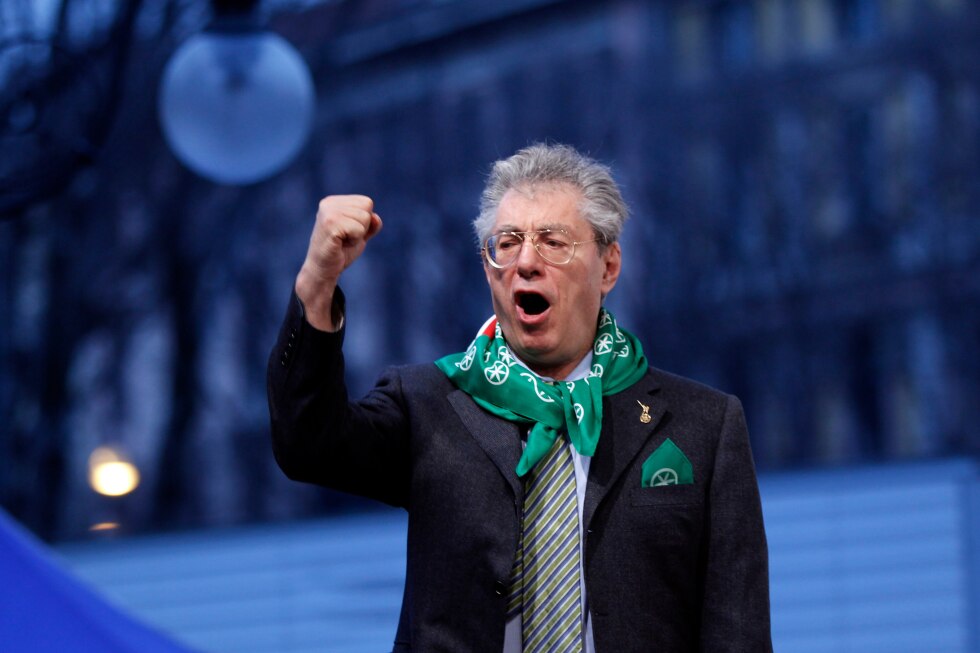
Known affectionately as “Il Senatùr” (the Senator in Lombard dialect), Bossi emerged from humble beginnings to become one of the most influential and controversial figures in contemporary Italian politics. His combative style and unapologetic regionalism resonated deeply with voters in Italy’s prosperous north who felt overtaxed and underserved by the central government in Rome.
Bossi’s political career began in earnest in 1987 when he was elected to Italy’s Senate. His memorable slogan “Roma ladrona” (Thieving Rome) encapsulated his scathing critique of what he viewed as a corrupt and bloated central state. This messaging proved particularly effective in the wake of the “Tangentopoli” corruption scandals that devastated Italy’s traditional political parties in the early 1990s.
Born on September 19, 1941, in the small industrial town of Cassano Magnago in Lombardy, Bossi channeled the frustrations of northern taxpayers into a potent political movement. Under his leadership, the Northern League evolved from a fringe regional party into a significant national force that would help reshape Italy’s political framework in the post-Cold War era.
Throughout his career, Bossi maintained a complex relationship with media magnate Silvio Berlusconi, forming crucial alliances that brought the League into government while occasionally engaging in bitter public feuds. He served twice as a minister in Berlusconi-led cabinets, focusing on institutional reforms and pushing for greater federalism—a cornerstone of his political vision.
“Bossi understood before many others the importance of territorial identity in politics,” noted political analyst Giovanni Orsina of Luiss University in Rome. “He tapped into real economic and social tensions between Italy’s industrialized north and the less developed south at a time when traditional parties were collapsing.”
His deliberately informal style—epitomized by an iconic 1994 photograph showing him in a white tank top in stark contrast to Berlusconi’s tailored suits—reinforced his image as a straight-talking “man of the people.” This approach helped him connect with voters disenchanted by traditional politics and presaged the rise of populist movements across Europe.
A severe stroke in 2004 significantly impaired Bossi’s health, though he remained politically active for years afterward. His leadership of the League ended in 2012 amid a scandal involving the misappropriation of party funds, though he retained the honorary title of “founding father.”
His relationship with Matteo Salvini, who took over the party leadership and subsequently rebranded it as “Lega” (dropping the “Northern” qualifier to pursue a more nationalist agenda), was notoriously strained. Bossi frequently criticized Salvini’s pivot away from the party’s original regionalist focus toward anti-immigration and Euroskeptic positions.
Despite these tensions, Salvini posted an emotional tribute on social media platform X: “I was 17 when I met you and you changed my life… Ciao, Capo (Bye, Boss).”
Bossi leaves behind a complex legacy that continues to shape Italian politics. His supporters remember him as a visionary who gave voice to legitimate regional concerns, while critics view him as a divisive figure whose rhetoric occasionally veered into xenophobia. What remains undisputed is his profound impact on Italy’s political system and his role in bringing regional identity to the forefront of national debate.
He is survived by his wife, Sicilian-born Manuela Marrone, and four sons: Riccardo from his first marriage to Gigliola Guidali, and Renzo, Roberto, and Sirio from his second marriage.
Fact Checker
Verify the accuracy of this article using The Disinformation Commission analysis and real-time sources.

14 Comments
Bossi’s slogan ‘Roma ladrona’ encapsulated the feelings of many in the prosperous north who felt underserved by the central government. This populist message was central to the League’s rise under his leadership.
Bossi’s passing represents the end of an era in Italian politics. It will be fascinating to see how the League and its successors navigate the post-Bossi landscape.
Bossi’s political career spanned decades, during which he transformed the Northern League into a major force in Italian politics. His passing is a significant moment, regardless of one’s views on his legacy.
It will be interesting to see how the League and Italian politics more broadly evolve in the post-Bossi era.
Umberto Bossi’s combative style and focus on regional autonomy were both praised and criticized over his long career. His legacy will likely continue to shape debates over Italy’s political future.
Umberto Bossi was a divisive but influential figure in Italian politics. His populist rhetoric and focus on regional autonomy resonated with many in the prosperous north who felt underserved by the central government. His passing marks the end of an era.
Bossi’s legacy is a complex one, with both supporters and critics. His impact on Italy’s political landscape will be long-studied by historians.
Bossi’s slogan ‘Roma ladrona’ (Thieving Rome) captured the grievances of many in the north who felt overtaxed and underrepresented. This populist message was central to the League’s rise and Bossi’s lasting impact.
While Bossi was a polarizing figure, his impact on Italian politics is undeniable. His brand of populist regionalism laid the groundwork for the modern Northern League and the center-right coalition.
Bossi’s combative style and unapologetic regionalism were key to the rise of the Northern League. While controversial, he played a pivotal role in shaping Italy’s modern center-right coalition politics.
Tributes from across the political spectrum suggest Bossi’s influence went beyond partisan lines. His passing represents a significant moment in contemporary Italian history.
Bossi’s combative style and unapologetic regionalism were key factors in the Northern League’s rise. His passing marks a significant moment in Italy’s turbulent modern political history.
Umberto Bossi was a pivotal figure in contemporary Italian politics, for better or worse. His legacy will continue to shape debates over the country’s regional and national identity.
Bossi emerged from humble beginnings to become one of Italy’s most influential and controversial political figures. His passing marks the end of an era in the country’s turbulent modern politics.