


Listen to the article
The United Kingdom and China have begun strengthening diplomatic ties as the two nations seek a more nuanced relationship, even as U.S. President Donald Trump discourages American allies from expanding trade with Beijing.
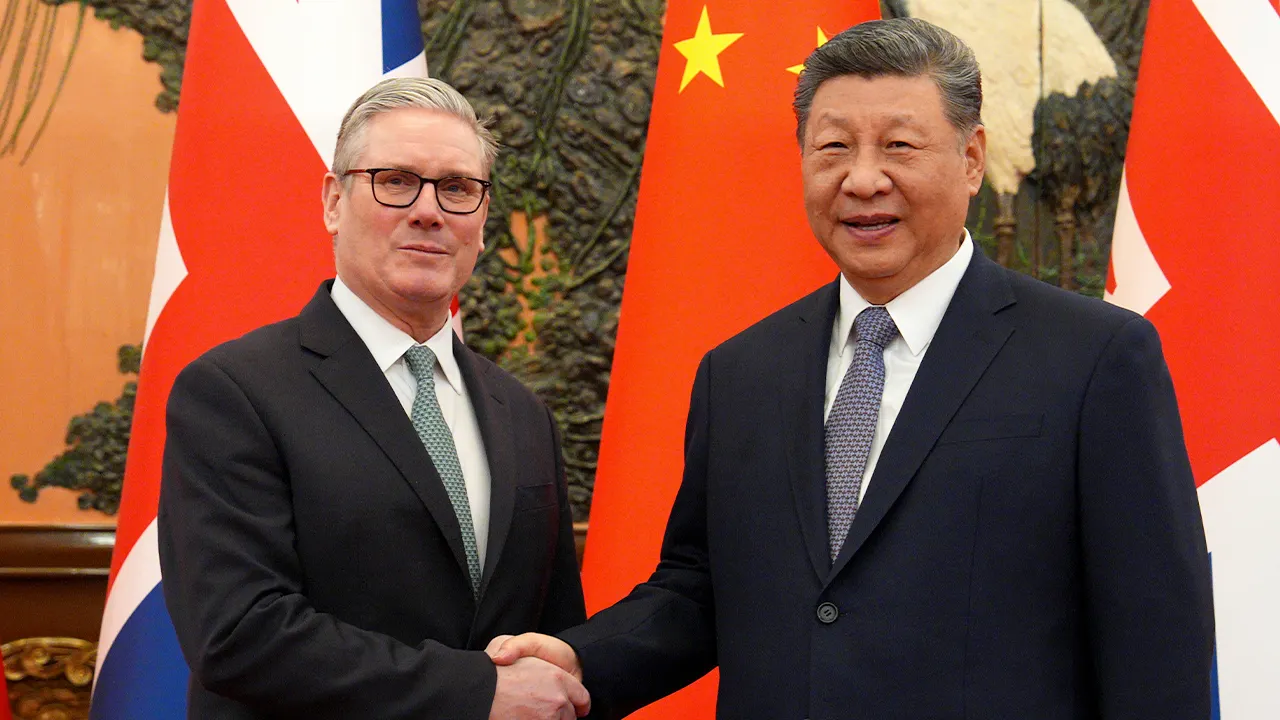
During their meeting in Beijing on Thursday, UK Prime Minister Keir Starmer and Chinese President Xi Jinping avoided directly mentioning Trump, though Xi’s comments appeared to reference growing tensions with the United States.
“In the current turbulent and ever-changing international situation, China and the UK need to strengthen dialogue and cooperation to maintain world peace and stability,” Xi told Starmer at the start of their meeting.
Xi further emphasized, without explicitly naming Trump, that “major powers” must adhere to international law to prevent the world from becoming a “jungle” – a statement that analysts interpret as a veiled criticism of U.S. trade policies.
Starmer, who took office last year, highlighted China’s significance on the global stage while calling for a more sophisticated bilateral relationship. “China is a vital player on the global stage, and it’s vital that we build a more sophisticated relationship where we can identify opportunities to collaborate, but of course, also allow a meaningful dialogue on areas where we disagree,” he stated.
The visit has yielded tangible outcomes, including a border security agreement aimed at disrupting the supply of Chinese-made small boat engines often used to smuggle people across the English Channel. The deal encompasses intelligence sharing to identify smuggling routes and direct cooperation with Chinese manufacturers to prevent legitimate businesses from being exploited by organized crime networks.
This diplomatic engagement comes amid a broader pattern of U.S. allies seeking to maintain productive relations with Beijing. The UK prime minister is the fourth leader of a traditional U.S. ally to visit China this month, following officials from South Korea, Canada, and Finland. German Chancellor Friedrich Merz is reportedly planning a similar trip next month.
Trump has responded harshly to these diplomatic overtures. Following Canadian Prime Minister Mark Carney’s recent visit to China, Trump warned that “China will eat Canada alive” and threatened to impose a 100% tariff on Canadian goods. This exchange followed earlier tensions between Trump and Carney that surfaced during the World Economic Forum in Davos, Switzerland.
The U.S. president has consistently cited security concerns regarding China in his foreign policy positions, including his controversial proposal for the United States to take control of Greenland, claiming that Beijing would pose a security threat in the Arctic Circle if America doesn’t establish a stronger presence there.
Despite these tensions, the United States and China reached their own trade agreement in November that rolled back some tariffs and export controls while expanding U.S. agricultural exports to China. The deal also included provisions to curb the flow of fentanyl precursors and ease pressure on American semiconductor and shipping companies.
Trade experts view these developments as part of a complex realignment of global economic relationships. While the U.S. pushes for more economic decoupling from China, many American allies appear to be seeking a middle path that maintains commercial ties with Beijing while addressing specific areas of concern.
For the UK, this diplomatic balancing act is particularly significant as the country continues to define its global role following Brexit. Starmer’s government appears to be pursuing a pragmatic approach that acknowledges China’s economic importance while remaining vigilant about security concerns – a stance that may put it at odds with the more confrontational position adopted by the United States.
As global powers navigate these shifting alliances, the increasing divergence between U.S. and European approaches to China could reshape international trade patterns and diplomatic relationships in the coming years.
Fact Checker
Verify the accuracy of this article using The Disinformation Commission analysis and real-time sources.

14 Comments
Xi’s comments about adhering to international law and avoiding a ‘jungle’ dynamic seem like veiled criticism of Trump’s unilateral approach. Careful diplomacy is key.
Yes, the UK and China appear to be seeking a more balanced relationship, which could benefit global stability.
Interesting to see the UK and China strengthening ties despite US pressure. Diplomacy and pragmatic cooperation seem wise in these turbulent times.
Agreed. The world needs more nuanced international relationships, not just confrontation.
This meeting between Starmer and Xi is a significant geopolitical development. Navigating the complex US-China-UK dynamic will be crucial for the mining industry.
Absolutely. Maintaining open channels of communication and finding areas of cooperation will be key, despite the political tensions.
The mining and commodities sectors will be watching this UK-China dynamic closely. Strengthened ties could open up new trade and investment opportunities.
Absolutely, particularly for critical minerals and metals needed for the energy transition. Diversifying supply chains is prudent.
It will be interesting to see how this UK-China dialogue evolves. Maintaining open channels of communication is important, even with strategic competitors.
Precisely. Dialogue and cooperation, where possible, are better than confrontation. The mining industry will be watching closely.
Trump’s pressure on allies to limit ties with China is concerning. Geopolitical tensions shouldn’t derail pragmatic economic cooperation, in my view.
Agreed. The world is complex, and allies shouldn’t be forced into binary choices. Nuanced relationships are needed.
The energy and commodities sectors will be closely monitoring this developing relationship. Strengthened UK-China ties could have implications for global supply chains.
Agreed. Diversifying supply sources and trade partners is prudent, especially for critical minerals needed for the clean energy transition.