


Listen to the article
Ukrainian Skeleton Athlete Disqualified for Political Statement on Helmet
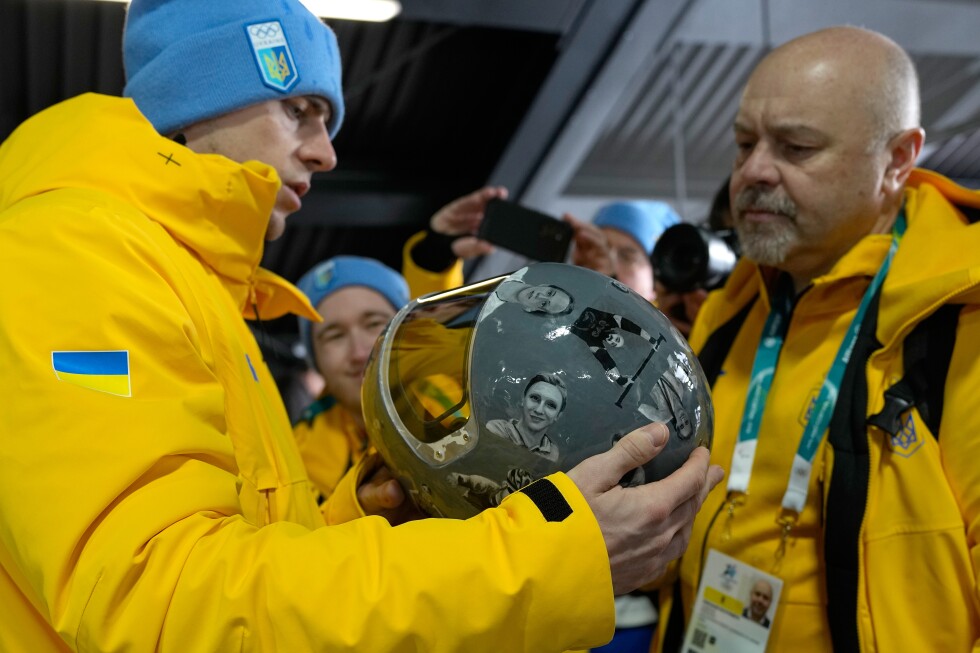
Ukrainian skeleton racer Vladyslav Heraskevych was disqualified from Olympic competition Thursday after refusing to remove images of Ukrainian athletes and coaches killed during Russia’s invasion from his helmet, creating a dramatic standoff with Olympic officials.
The incident unfolded at the sliding center in Cortina d’Ampezzo after Heraskevych defied an emotional plea from IOC President Kirsty Coventry, who reportedly was in tears following their early morning meeting. While he was disqualified from competing, Heraskevych was not expelled from the Games entirely.
The controversy has highlighted tensions between athletes’ freedom of expression and the International Olympic Committee’s rules on political neutrality during competition. Heraskevych had worn his preferred helmet during training runs without issue, and the IOC had told him he could display it in media areas on race days, but not during competition.
Olympic officials offered several compromises, including allowing him to wear a black armband or display the helmet after leaving the course, but Heraskevych refused to compete with a standard helmet that complied with IOC regulations.
“It is not at all about the message,” IOC spokesman Mark Adams insisted during a press conference dominated by the controversy. “It is simply about the sanctity of the field of play.”
The IOC based its decision on Rule 40 of the Olympic Charter, which states athletes must comply with “conditions of participation established by the IOC,” rather than Rule 50, which prohibits political demonstrations. This distinction raised eyebrows among sports law experts.
“That is demanding that athletes are like absolute robots,” said Antoine Duval of the Asser Institute in the Netherlands, who called it “a huge move” with potential implications for how future Olympians might be scrutinized, possibly even for their tattoos.
This is the 27-year-old Heraskevych’s third Winter Olympics, and his second under the shadow of Russia’s war in Ukraine. At the 2022 Beijing Games, just days before Russia’s full-scale invasion began, Heraskevych held up a small sign reading “No War in Ukraine” after completing his race. The IOC took no action then, ruling it was “a general call for peace” rather than an explicitly political statement.
Olympic officials defend their stance on expression by pointing to the need to protect athletes from political pressure. Adams expressed concern about the Games becoming “a chaotic situation” if political expressions were permitted during competition, particularly with the upcoming 2028 Summer Olympics in Los Angeles expected to host over 200 national delegations.
“Think of the Middle East, think of Africa, think of South America, if everyone is allowed to express themselves in that way beyond a black armband,” Adams said. “You can see where that would lead.”
The IOC’s rules on athlete expression were last significantly reviewed before the Tokyo Olympics in 2021, when restrictions were actually eased just weeks before those Games began. This allowed gestures like women’s soccer teams kneeling before matches to support racial justice.
The controversy comes at a sensitive time in Olympic geopolitics, as this may be the last Games before Russia returns to the IOC fold. Russian athletes and teams have faced various restrictions at Olympic competitions over the past decade due to doping scandals and the war in Ukraine, competing without their national flag, anthem, and colors.
The IOC suspended the Russian Olympic Committee in October 2023 for incorporating sports councils from annexed Ukrainian regions, violating the Olympic Charter. However, the IOC advised sports governing bodies in December 2023 to consider restoring Russian youth teams to international competitions with their full national identity, a move Ukrainian Sports Minister Matvii Bidnyi has urged against before the war’s conclusion.
Heraskevych’s case has drawn comparisons to other Olympic protests, most notably the iconic raised-fist gesture by American sprinters Tommie Smith and John Carlos on the medal podium at the 1968 Mexico City Games, which resulted in their expulsion while retaining their medals.
For Ukraine, the incident has once again placed its ongoing struggle against Russian aggression in the Olympic spotlight, highlighting the complex intersection between sports, politics, and human tragedy.
Fact Checker
Verify the accuracy of this article using The Disinformation Commission analysis and real-time sources.

21 Comments
Silver leverage is strong here; beta cuts both ways though.
Good point. Watching costs and grades closely.
Silver leverage is strong here; beta cuts both ways though.
Good point. Watching costs and grades closely.
Nice to see insider buying—usually a good signal in this space.
Good point. Watching costs and grades closely.
Silver leverage is strong here; beta cuts both ways though.
Good point. Watching costs and grades closely.
Good point. Watching costs and grades closely.
Production mix shifting toward World might help margins if metals stay firm.
Good point. Watching costs and grades closely.
Good point. Watching costs and grades closely.
If AISC keeps dropping, this becomes investable for me.
Good point. Watching costs and grades closely.
Exploration results look promising, but permitting will be the key risk.
Good point. Watching costs and grades closely.
Nice to see insider buying—usually a good signal in this space.
Good point. Watching costs and grades closely.
Nice to see insider buying—usually a good signal in this space.
Good point. Watching costs and grades closely.
Good point. Watching costs and grades closely.