


Listen to the article
The White House declared Tuesday that President Donald Trump has the authority to amend the permit for the Gordie Howe International Bridge, escalating tensions between the United States and Canada just hours after Canadian Prime Minister Mark Carney suggested progress toward resolving the dispute.
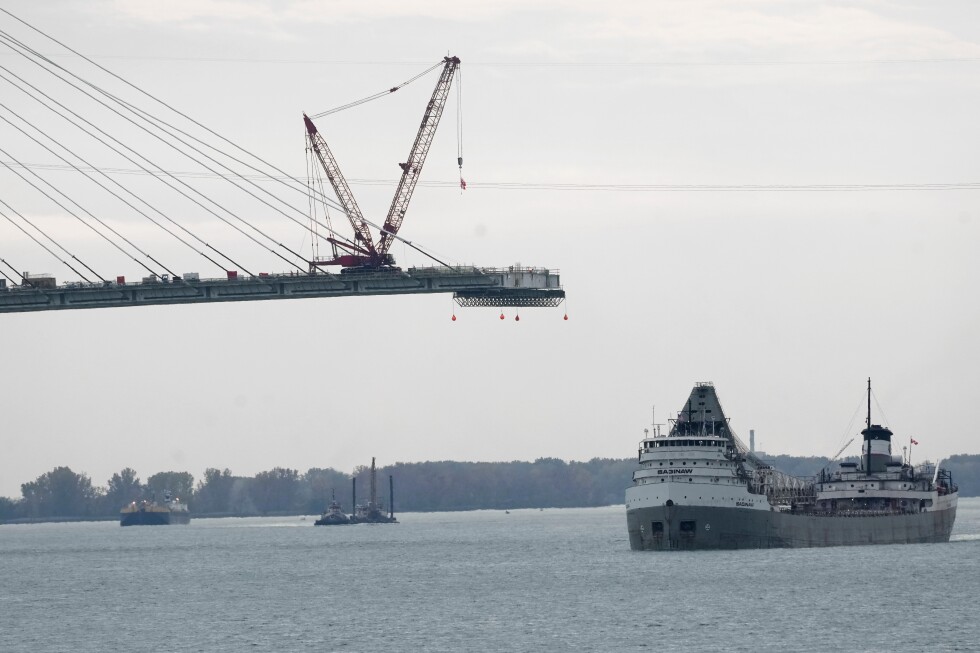
The $5.7 billion bridge, a critical infrastructure project connecting Ontario and Michigan, is currently under construction and scheduled to open in early 2026. It represents a vital economic corridor between the two nations, with significant implications for cross-border trade and transportation.
Trump has threatened to block the bridge’s opening, demanding Canada meet unspecified conditions ahead of anticipated trade negotiations later this year. The bridge has unexpectedly become a flashpoint in deteriorating U.S.-Canada relations.
“The fact that Canada will control what crosses the Gordie Howe Bridge and owns the land on both sides is unacceptable to the president,” White House press secretary Karoline Leavitt told reporters. “It’s also unacceptable that more of this bridge isn’t being built with more American-made materials.”
A White House official, speaking on condition of anonymity, emphasized that all international infrastructure projects require presidential permits, which Trump could legally modify. This assertion directly contradicts Carney’s earlier optimistic tone following his conversation with Trump.
The Canadian prime minister had expressed confidence earlier Tuesday, stating “this is going to be resolved.” Carney noted he clarified to Trump that the bridge would operate under joint ownership between Canada and Michigan, despite being funded entirely by Canada.
The project, named after Canadian-born Detroit Red Wings hockey legend Gordie Howe, began construction in 2018. It was negotiated by former Michigan Republican Governor Rick Snyder to alleviate congestion at existing border crossings, particularly the Ambassador Bridge and Detroit-Windsor tunnel.
Snyder defended the project Tuesday in a Detroit News op-ed, directly challenging Trump’s assertions. “Canada and the state of Michigan are 50/50 owners of the new bridge,” Snyder wrote. “Canada was wonderful and financed the entire bridge. They will get repaid with interest from the tolls. Michigan and the United States got their half-ownership with no investment.”
The former governor also addressed Trump’s concerns about American-made materials, explaining that portions of the bridge construction were exempt from “Buy America” requirements because half the project lies outside U.S. territory. “President Trump, I would encourage you to challenge your advisers and the sources for your post to correct the information they have provided,” Snyder wrote.
Michigan Governor Gretchen Whitmer’s office has also emphasized the joint ownership structure, supporting Carney’s characterization of the arrangement.
According to Carney, Trump indicated he would ask U.S. Ambassador to Canada Pete Hoekstra, a former Michigan congressman, to “play a role in smoothing the conversation in and around the bridge.” Hoekstra has not yet commented on this development.
The bridge dispute represents the latest in a series of tensions between the historically close allies. Trump has made provocative statements about acquiring Canada as the 51st U.S. state, comments that have been poorly received by Canadians. Trade policy disagreements have also strained relations as both nations prepare for potential renegotiation of existing trade agreements.
Economic analysts note the bridge’s strategic importance for both nations. Once completed, it would significantly enhance the $600 billion annual trade relationship between the U.S. and Canada, particularly benefiting the integrated automotive supply chains that span the border.
The Gordie Howe International Bridge would provide a modern alternative to the aging Ambassador Bridge, which currently handles approximately 25 percent of all merchandise trade between the two countries. Any delay to the project could have substantial economic implications for both nations’ manufacturing sectors.
As construction continues amid the diplomatic uncertainty, stakeholders on both sides of the border await clarity on whether this key infrastructure project will face additional hurdles before its anticipated 2026 opening.
Fact Checker
Verify the accuracy of this article using The Disinformation Commission analysis and real-time sources.

8 Comments
This bridge dispute between the US and Canada highlights the complex geopolitical and economic tensions at play. It’s critical that leaders on both sides work to find a constructive solution that benefits the broader trade and transportation needs of the region.
I agree, maintaining strong US-Canada relations is vital given the deep economic integration between the two countries. This issue needs to be resolved through diplomatic channels, not confrontational rhetoric.
The Gordie Howe Bridge is an important piece of cross-border infrastructure. While I understand the desire for more US-made materials, this shouldn’t come at the expense of the bridge’s timely completion and operational efficiency.
Absolutely, the focus should be on getting this critical link completed as soon as possible to support the flow of goods and people between the US and Canada.
Amending the bridge permit could have significant repercussions for the broader US-Canada trade relationship. I hope the White House considers the potential economic fallout before taking any unilateral action on this project.
From a pure business perspective, disrupting the Gordie Howe Bridge project could disrupt supply chains and increase costs for companies on both sides of the border. Policymakers should weigh these economic realities carefully.
This dispute highlights the need for clear, predictable policies and processes around cross-border infrastructure projects. Shifting positions and political grandstanding help no one in the long run.
Well said. Consistent, transparent decision-making is key to maintaining trust and enabling critical investments in the US-Canada trade corridor.