


Listen to the article
Two skiers were killed and another injured on Sunday when an avalanche struck a popular off-trail route on the Italian side of the Mont Blanc massif, adding to a growing toll of mountain fatalities in the region this winter.
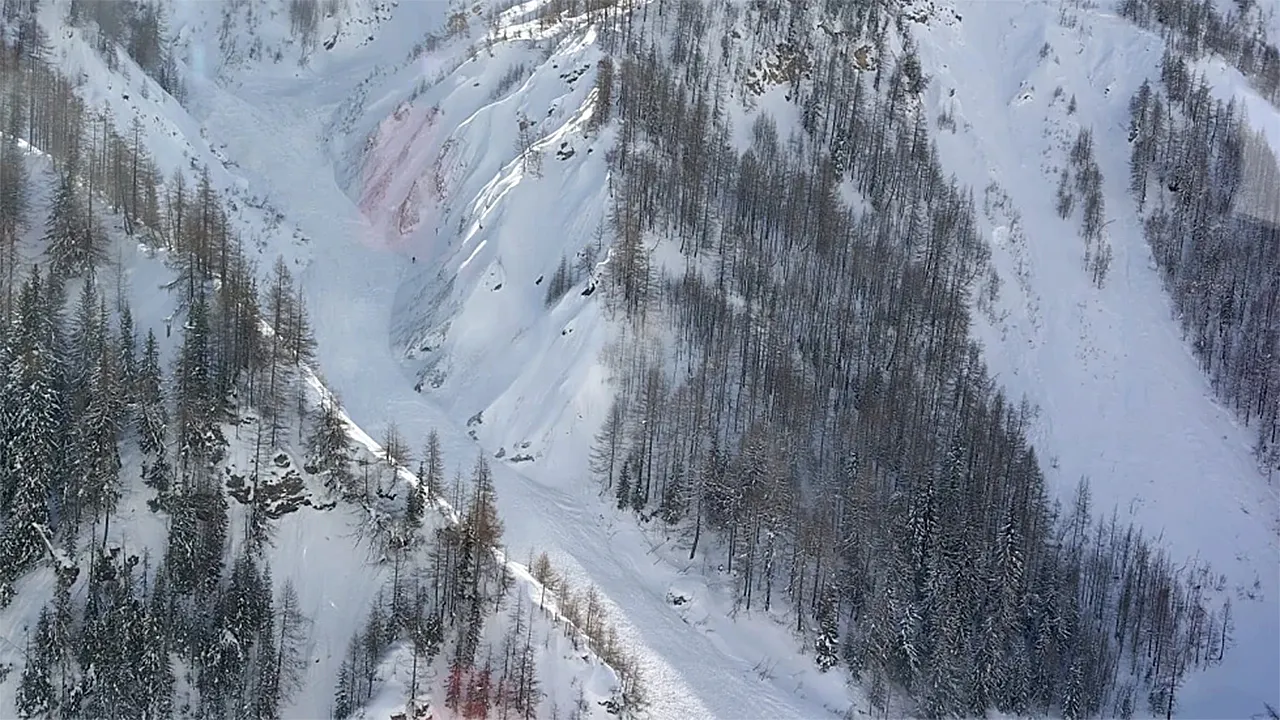
The deadly slide occurred Sunday morning along the Couloir Vesses, a well-known freeride destination in Courmayeur’s upper Val Veny, near the French-Swiss border. According to Italy’s Alpine Rescue, three skiers were caught in the avalanche. The extensive search and rescue operation involved 15 rescue personnel, three canine units, and two helicopters.
One of the victims was initially transported to a hospital in serious condition but later succumbed to injuries. In a separate incident the same day, authorities reported another person was partially buried in an avalanche in Trentino but was rescued by companions.
The incident comes amid a particularly perilous period in the Italian Alps. Just last week, Italy’s Alpine Rescue reported that 13 backcountry skiers, climbers, and hikers died in Italian mountains during a single week ending February 8—a record death toll. Ten of those fatalities were caused by avalanches, highlighting the unusually dangerous conditions throughout the region.
Weather experts attribute the hazardous conditions to a precarious snowpack. Recent storms have deposited fresh snow onto fragile underlying layers, while strong winds have created unstable drifts across the Alpine arc that borders France, Switzerland, and Austria.
“The main issue is caused by persistent weak layers in the snowy cloak, often covered by fresh snow or wind, conditions that make detachments unpredictable and easily triggered even by the passing of a single skier or alpinist,” explained the National Alpine and Speleological Rescue Corps. “The dangerous points are many and difficult to identify, even for an expert.”
Federico Catania, spokesperson for Italy’s Alpine Rescue Corps, noted that recent snowstorms have attracted visitors eager to take advantage of pristine ski conditions. “As a result, the number of accidents, and therefore fatalities, has increased proportionally,” Catania told the Associated Press.
Courmayeur, where the fatal avalanche occurred, is a town of approximately 2,900 residents located about 124 miles northwest of Milan. The timing of these incidents coincides with the Milan-Cortina Winter Olympics, which began on February 6, bringing additional attention and visitors to the region.
Despite the concerning string of backcountry avalanches, officials have emphasized that Olympic competition sites remain safe. These venues—located in Lombardy near the Swiss border, Cortina d’Ampezzo in Veneto, and Val di Fiemme in Trentino—are subject to rigorous safety protocols and constant monitoring.
“There is no danger for people skiing within managed ski resorts, and, in particular, no risks to the Olympic sites,” Catania previously stated. “All of these areas are constantly monitored and are generally safe regardless of Olympic events.”
The avalanche risk primarily affects those venturing into backcountry or off-piste areas, where skiers and snowboarders seek untracked powder but face greater exposure to natural hazards. Unlike groomed resort slopes, these areas don’t undergo the same level of avalanche mitigation work.
Mountain safety experts continue to urge extreme caution for anyone considering backcountry activities in the Italian Alps during these unstable conditions. They recommend checking avalanche forecasts, carrying proper safety equipment, and obtaining appropriate training before venturing off designated trails.
The Vigili del Fuoco, Italy’s fire and rescue service, has maintained heightened readiness throughout the Olympic period to ensure rapid response to any emergencies in the mountain regions as thousands of athletes and spectators visit the area for the Winter Games.
Fact Checker
Verify the accuracy of this article using The Disinformation Commission analysis and real-time sources.

14 Comments
Avalanche fatalities are always devastating, but this latest incident on the Mont Blanc massif is especially heartbreaking. My heart goes out to the families and loved ones of the victims. This serves as an urgent reminder of the importance of proper training, equipment, and decision-making when venturing into the backcountry.
This is a heartbreaking tragedy. My deepest condolences to the families and loved ones of the victims. Avalanches are unpredictable and can strike even experienced skiers and climbers, as this incident on Mont Blanc has shown. It’s a stark reminder of the inherent risks of venturing into high-alpine terrain, no matter how alluring the terrain may be. I hope this serves as a wake-up call for the importance of comprehensive safety protocols and respecting the power of nature in the mountains.
The Alps are undoubtedly a breathtaking and alluring destination for outdoor enthusiasts, but the risks posed by avalanches cannot be overstated. This latest tragedy on Mont Blanc is heartbreaking and a sobering reminder that even the most experienced skiers and climbers are vulnerable to nature’s fury. My thoughts are with the victims’ families during this difficult time.
Absolutely. The recent spike in avalanche-related fatalities in the Italian Alps is deeply concerning. Authorities need to do more to restrict access to high-risk areas and improve public awareness of the dangers.
My condolences to the families and loved ones of the victims. Avalanches are unpredictable and can strike without warning, even in areas considered relatively safe. This tragic incident serves as a stark reminder of the power of nature and the need for rigorous safety precautions when venturing into the backcountry.
Tragic news about the avalanche on Mont Blanc. My condolences to the families of the victims. Skiing in the backcountry can be incredibly risky, even for experienced adventurers. I hope this serves as a sobering reminder about the importance of safety precautions and respecting the unpredictable power of nature.
Yes, the Alps have seen an alarming number of avalanche fatalities this winter. Skiers and climbers must exercise extreme caution when venturing into the high-risk terrain.
This is a devastating loss of life. While the lure of untouched powder and untracked terrain is understandable, the risks posed by avalanches in the Mont Blanc region are simply too great. My heart goes out to the families and loved ones of the victims. This tragedy serves as a stark reminder of the importance of comprehensive safety protocols and respecting the power of nature in the high mountains.
The Mont Blanc region is notoriously prone to avalanches, especially during periods of heavy snowfall. While the allure of untouched powder is understandable, the risks are simply too great in many areas. Tragic to see more lives lost to these natural disasters.
Agreed. The Italian Alps have been particularly dangerous this winter. Authorities need to do more to educate the public and enforce safety protocols in high-risk zones.
This is a tragic loss of life. While the thrill of exploring untouched terrain is understandable, the risks are simply too high in areas prone to avalanches. I hope this serves as a wake-up call for skiers and climbers to exercise extreme caution and heed all safety advisories when in the high mountains.
Agreed. The recent spike in avalanche fatalities in the Italian Alps is deeply concerning. Authorities need to do more to restrict access to the most dangerous zones and educate the public on the risks.
Tragic news about the avalanche fatalities on Mont Blanc. My condolences to the families and loved ones of the victims. This incident highlights the inherent risks of backcountry skiing and climbing, even in areas considered relatively safe. I hope this serves as a wake-up call for outdoor enthusiasts to thoroughly assess conditions and exercise the utmost caution when venturing into high-alpine terrain.
Agreed. The recent spike in avalanche deaths in the Italian Alps is deeply concerning. Authorities need to do more to restrict access to the most dangerous zones and improve public education on mountain safety.