


Listen to the article
Turkey’s Military and Economic Expansion in Africa Challenges U.S. Objectives
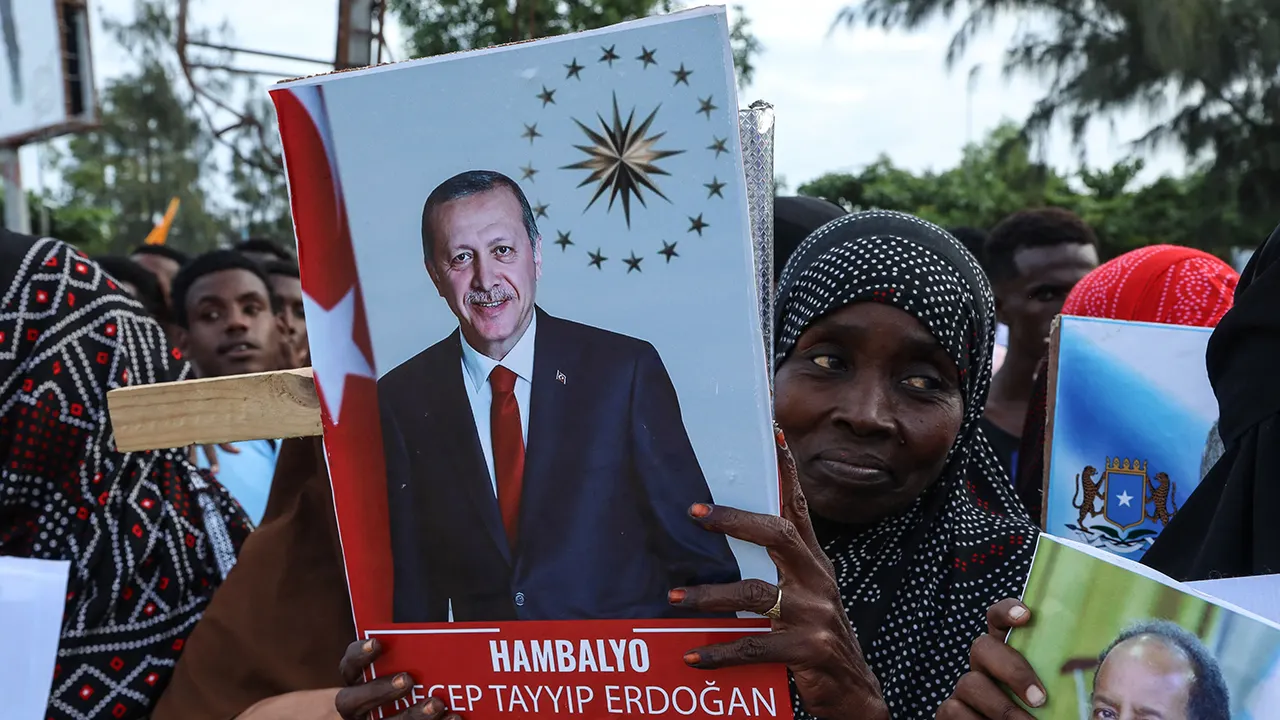
Turkey’s rapidly growing military, trade and diplomatic presence across Africa is increasingly undermining American interests on the continent, according to security analysts and foreign policy experts. President Recep Tayyip Erdogan’s government is capitalizing on regional conflicts to expand Turkey’s influence while selling weapons to multiple sides in ongoing wars.
Reports have emerged that Turkish companies recently sold military drones to both warring factions in Sudan’s devastating three-year civil war. This approach directly contradicts U.S. policy, which aims to curtail external military support that fuels the violence in Sudan.
“Turkey is really capitalizing on all these conflicts in Sudan, in Ethiopia, in Somalia, to strengthen its military presence, its diplomatic and economic engagements,” said Gönül Tol, founding director of the Middle East Institute’s Turkey program, at a recent American Enterprise Institute seminar. “Turkey is one of the top, top weapons providers to Africa. So if there is more chaos, that will only help Erdogan strengthen his hands.”
The commercial relationship between Turkey and Africa has grown dramatically under Erdogan’s leadership. The president recently announced that overall trade volume with the continent has increased from $5.4 billion in 2003 to $41 billion in 2024. State-backed Turkish Airlines now serves as a vanguard for Turkish business interests, flying to 64 African destinations.
“We have advanced our relations hand in hand, shoulder to shoulder, and most importantly, heart-to-heart, to a level that could not even be imagined,” Erdogan told a business forum in Istanbul last October.
Experts warn that Turkey’s arms sales strategy appears focused on profit and influence rather than regional stability. Turkish-made Bayraktar TB2 drones, manufactured by a company reportedly owned by President Erdogan’s son-in-law, cost approximately one-sixth the price of American equivalents like the Reaper drone, making them attractive to conflict zones with limited budgets.
According to the U.S. Africa Command’s Africa Defense Forum, the TB2 typically costs between $2 million and $5 million per aircraft, with total systems including ground control stations and training potentially reaching $5–$15 million—still significantly less expensive than Western alternatives. Operating costs are estimated at only a few hundred dollars per hour.
“Turkish drones, marketed as cost-effective and politically low-friction alternatives to U.S. or European systems, have proliferated across African conflict zones,” explained Mariam Wahba, research analyst at the Foundation for Defense of Democracies. “Reporting that Turkish firms supplied drones to both the Sudanese Armed Forces and the Rapid Support Forces underscores Ankara’s transactional approach: access and influence take precedence over stability, civilian protection or alignment with Western policy objectives.”
A 2025 Foundation for Defense of Democracies report revealed that a deal between drone maker Baykar and the Sudanese Armed Forces was worth $120 million, resulting in the sale of six TB2 drones, three ground control stations, and 600 warheads. The deal reportedly took place after the U.S. had placed sanctions on such sales.
While a Turkish company has been accused of selling similar equipment to the opposing Rapid Support Forces militia, the company has publicly denied the allegations. The State Department, when asked about these reports, referred questions to the Turkish government, which did not respond to requests for comment.
Turkey’s diplomatic footprint has also expanded dramatically across Africa, with the number of Turkish embassies increasing from 12 in 2002 to 44 today. Some analysts suggest Turkey is attempting to revive aspects of its Ottoman Empire legacy, particularly in Africa’s Sahel region.
“On the whole, this is a worrying development that risks undermining U.S. interests,” Wahba noted. “In addition to backing Islamist movements such as Hamas and the Muslim Brotherhood, which does not bode well for its ideological orientation, Ankara is pursuing a neo-Ottoman foreign policy that is already taking concrete shape across parts of Africa.”
Sinan Siddi, senior fellow at the Foundation for Defense of Democracies, argues that Turkey’s arms sales represent “a deliberate strategy to expand Ankara’s political, military and economic footprint on a continent increasingly contested by global and middle powers.”
“By exporting drones, small arms and security services to fragile states such as Sudan… the Erdogan government positions Turkey as a low-cost, low-conditionality alternative to Western partners, while simultaneously opening new markets for its rapidly growing defense industry,” Siddi explained.
This comprehensive approach, combining military sales, trade initiatives, diplomatic presence, and state-backed infrastructure like Turkish Airlines, presents a growing challenge to American objectives in Africa, particularly in conflict zones where stability remains elusive.
Fact Checker
Verify the accuracy of this article using The Disinformation Commission analysis and real-time sources.

8 Comments
Turkey’s expanding economic and military ties across Africa are a clear challenge to U.S. influence. It will be important to understand Erdogan’s strategic calculus and whether this is part of a broader effort to counter Western power in the region.
This is a fascinating geopolitical development. Turkey seems to be exploiting regional instability to bolster its own position, even at the expense of U.S. interests. Closely monitoring how this plays out will be crucial for U.S. policymakers.
You’re absolutely right. Turkey’s actions here appear to be driven more by self-interest than any concern for regional stability or development. The U.S. will need to carefully consider its response.
Interesting to see Turkey’s growing influence in Africa. This could certainly complicate U.S. strategic interests in the region if not managed carefully. It will be important to understand Turkey’s motivations and how their involvement is impacting local dynamics.
You’re right, the geopolitical implications here could be quite significant. The U.S. will need to re-evaluate its approach to maintain influence in Africa.
Turkey’s growing presence in Africa is a complex issue with significant geopolitical implications. While its economic and military engagement may bring benefits to some African nations, the potential to exacerbate conflicts is concerning. Thoughtful diplomacy will be essential going forward.
Turkey’s arms sales to both sides of the conflict in Sudan is concerning. This kind of activity could further destabilize the region and undermine efforts to find a peaceful resolution. Careful diplomacy will be needed to navigate these complex dynamics.
Agreed, profiting from regional conflicts in this way is quite troubling. The U.S. and allies will need to pressure Turkey to take a more responsible and constructive role.