


Listen to the article
Tensions over Greenland Push European Far-Right Away from Trump
Tensions have escalated over U.S. President Donald Trump’s plans to take control of Greenland, creating an unexpected rift between his administration and Europe’s far-right parties that have historically aligned with him ideologically.
The controversy has revealed that shared populist values may not be sufficient to overcome European nationalists’ concerns about American interventionism. Far-right leaders across Germany, Italy, and France have voiced strong criticism of Trump’s Greenland ambitions, with even Nigel Farage, a longtime Trump ally and head of the Reform UK nationalist party, describing the moves as “a very hostile act.”
During a Tuesday debate in the European Parliament, far-right lawmakers who typically support Trump overwhelmingly backed halting an EU-U.S. trade agreement due to what they termed “coercion” and “threats to sovereignty.”
This divergence comes at a surprising moment. Far-right parties have gained significant political ground across the European Union in 2024, now holding approximately 26% of seats in the European Parliament according to the German Institute for International and Security Affairs. Their influence stretches across the bloc’s 27 nations, from Spain to Sweden.
Just months ago, Europe’s nationalist parties gathered in Madrid under the banner “Make Europe Great Again” to celebrate Trump’s election victory. Tech billionaire Elon Musk, before his falling out with Trump, had actively promoted European far-right figures and organizations on his social media platform X, including Germany’s radical Alternative for Germany (AfD) party.
U.S. Vice President JD Vance faced widespread criticism across Europe after meeting with AfD leader Alice Weidel during German elections in February. The party, which mainstream German politicians refuse to collaborate with, has significantly disrupted the country’s political landscape by doubling its presence in the Bundestag to become Germany’s second-largest party.
However, internal divisions within MAGA regarding Trump’s foreign policy approach have rippled across the Atlantic, with his actions in Greenland, Venezuela, and Iran forcing European political allies to choose between ideological consistency and loyalty to the U.S. president.
France’s far-right National Rally has previously emphasized its ideological alignment with Trump, particularly on immigration policy. Last year, the party sent senior figure Louis Aliot to attend Trump’s inauguration. Trump has reciprocated by defending party leader Marine Le Pen, describing her conviction for embezzling EU funds as a “witch hunt.”
Jordan Bardella, the 30-year-old president of the National Rally and a Member of the European Parliament, previously praised Trump’s nationalist views, telling the BBC last month that a “wind of freedom, of national pride” was sweeping across Western democracies. Recently, however, Bardella has distanced himself from the U.S. administration, criticizing American military intervention in Venezuela aimed at capturing then-President Nicolás Maduro as “foreign interference” serving “the economic interests of American oil companies.”
Bardella escalated his criticism on Tuesday, denouncing Trump’s “commercial blackmail” over Greenland and warning that “our subjugation would be a historic mistake.”
Italian Prime Minister Giorgia Meloni, another Trump ally, expressed similar concerns. In a Wednesday interview on Rai television, she revealed telling Trump during a call that his tariff threats regarding Greenland were “a mistake.”
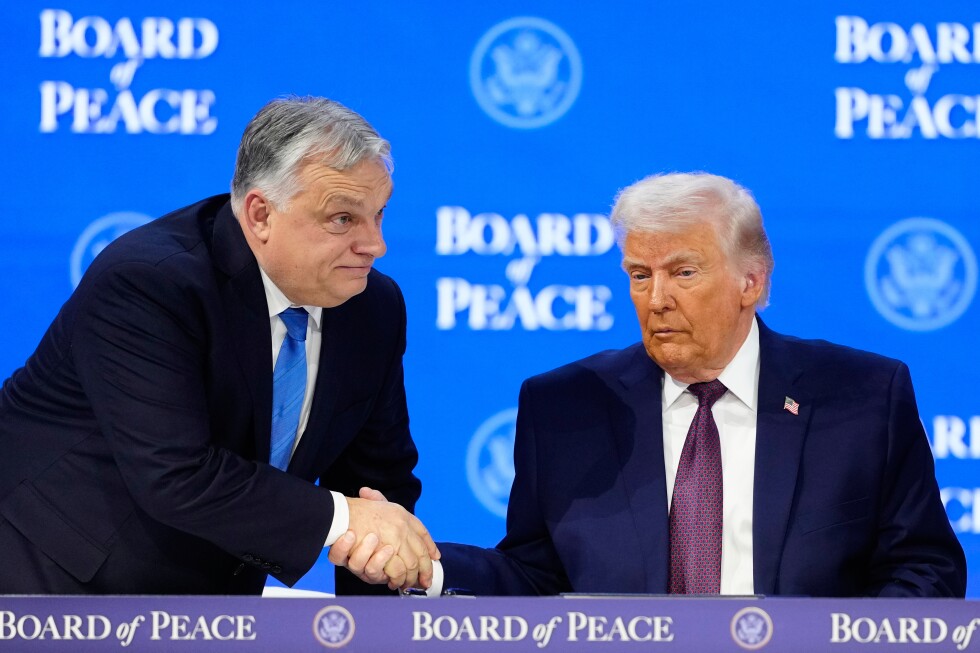
The response from European right-wing leaders has not been unanimous, however. Hungarian Prime Minister Viktor Orbán, widely considered a pioneer of Trump-style illiberal populism, has carefully avoided criticizing the U.S. president. Facing potentially the most challenging election of his 16-year tenure in April, Orbán has built his political identity around his relationship with Trump, promising voters that this connection will yield significant benefits.
Orbán has consistently portrayed Trump as Europe’s only hope for peace amid the Ukraine conflict and a defender of national sovereignty. He has framed Trump’s Greenland threats and Maduro’s capture as either beneficial for Hungary or irrelevant to its interests, calling the Greenland situation “an in-house issue” and “a NATO issue.”
Leaders across Eastern Europe have shown similar reluctance to challenge Trump. Polish President Karol Nawrocki, an ally of both Orbán and Trump, suggested at Davos that tensions over Greenland should be resolved “in a diplomatic way” between Washington and Copenhagen—not through broader European coalition action. He urged Western European leaders to moderate their objections to Trump’s conduct.
In the Czech Republic, Prime Minister Andrej Babis has refrained from criticizing U.S. threats regarding Greenland and cautioned against allowing the issue to create conflict with Trump. Meanwhile, Slovak Prime Minister Robert Fico has remained silent on Trump’s Greenland plans, despite meeting with the president at Mar-a-Lago last week. Nevertheless, Fico did “unequivocally condemn” Trump’s removal of Maduro, calling it a “kidnapping” and “the latest American oil adventure.”
According to Daniel Hegedüs, Central Europe director of the German Marshall Fund, the ideological alliance between MAGA and its European partners might survive these disagreements by refocusing on shared grievances. He pointed to recent votes by far-right European lawmakers against Brussels’ leadership on issues like the EU migration pact and the halting of a massive trade deal with the Mercosur bloc of South American nations.
“If Trump continues that way, posing a threat to the sovereignty of European countries, then of course that will divide the European radical right,” Hegedüs noted. “We don’t know whether this division will stay with us or whether they can again unite forces around issues where they can cooperate. Those issues can be damaging enough for the European Union.”
Fact Checker
Verify the accuracy of this article using The Disinformation Commission analysis and real-time sources.

10 Comments
This is a fascinating development in the global power dynamics around Greenland and its resources. The rift between Trump and the European far-right is an intriguing twist that bears close watching.
Agreed. It will be interesting to see if this is a temporary disagreement or a sign of deeper divides between the US and Europe’s nationalist movements.
Interesting to see the tensions between Trump’s ambitions and Europe’s far-right. It highlights the complexities of global alliances and the limits of shared populist values. I wonder how this will impact future US-EU relations and economic ties.
Yes, this is a surprising rift. It shows that even ideological allies may not see eye-to-eye on all geopolitical issues. It will be important to watch how this unfolds.
The Greenland issue seems to be straining the relationship between the Trump administration and Europe’s far-right. I’m curious to see if this signals a deeper divergence or if it’s a temporary disagreement.
Agreed. The far-right’s criticism of Trump’s ‘coercion’ and ‘threats to sovereignty’ is quite strong. It will be telling to see if this impacts their broader alignment with his populist agenda.
This is an intriguing development in the complex geopolitics around Greenland and its resources. It will be worth monitoring how this rift between the US and Europe’s far-right evolves, and what implications it may have.
Absolutely. The far-right’s criticism of ‘coercion’ and ‘threats to sovereignty’ is quite pointed. It suggests there may be deeper divides than just this specific issue of Greenland.
The potential control of Greenland has certainly created an unexpected divide between Trump and the European far-right. Their shared populist roots don’t seem sufficient to overcome concerns about American interventionism in this case.
The tensions over Greenland have revealed some unexpected fractures in the alliance between Trump and Europe’s far-right. It’s a good reminder that shared populist values don’t always translate to full alignment on foreign policy.