


Listen to the article
Donald Trump’s Peace Diplomacy Yields Mixed Results in First Year
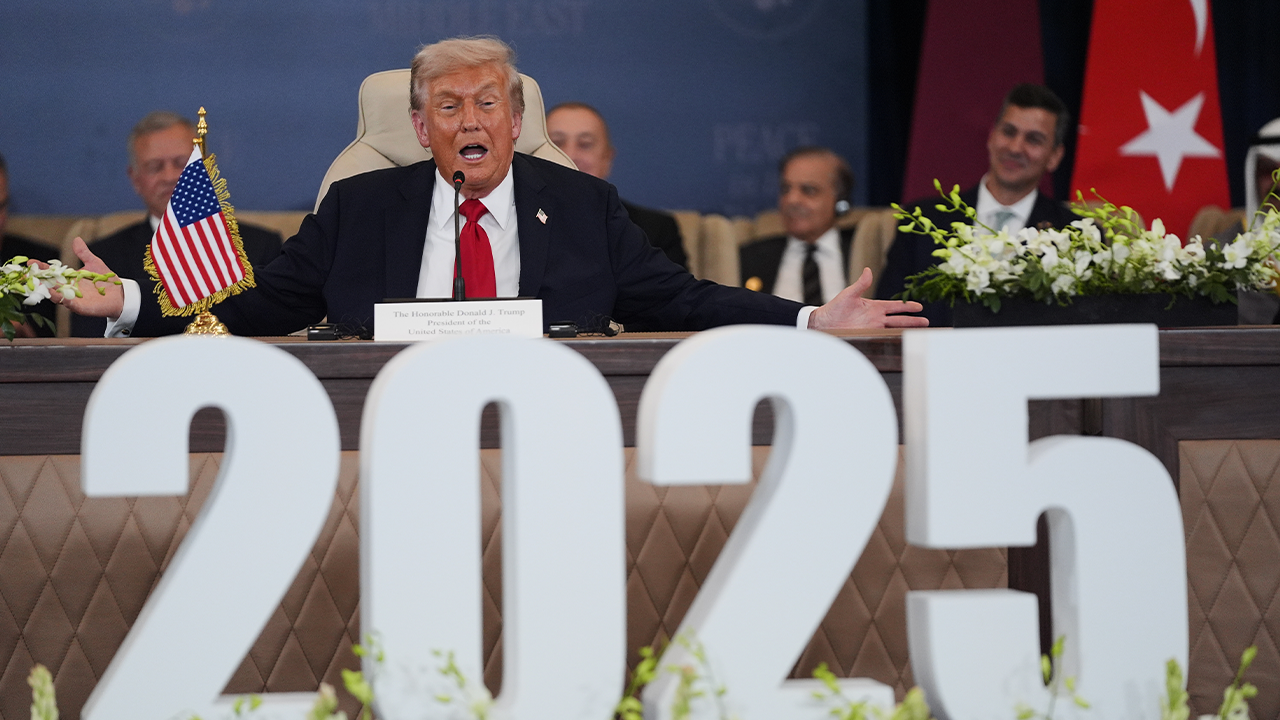
Donald Trump entered 2025 with a clear foreign policy vision centered on what he repeatedly described as “peace through strength.” Throughout the year, the president cast his diplomatic efforts as peace-focused, publicly suggesting his record merited a Nobel Peace Prize. By year’s end, several conflicts saw significant diplomatic breakthroughs, while others remained entrenched in cycles of violence despite American intervention.
The most consequential diplomatic development came in early October, when the Trump administration brokered a ceasefire framework between Israel and Hamas. The agreement halted large-scale fighting after months of intense combat in Gaza and enabled the release of all remaining hostages from Hamas’ October 7 attack on Israel, except for the body of Ron Gvili, which remains in Hamas custody.
While the Gaza truce largely held through year’s end, core issues including long-term governance, demilitarization, and reconstruction of the devastated enclave remain unresolved. U.S. officials continue working with regional partners as Israeli Prime Minister Netanyahu prepares for talks with President Trump next week.
In August, Trump hosted a historic summit at the White House between the leaders of Armenia and Azerbaijan, resulting in a U.S.-brokered peace declaration addressing decades of conflict over Nagorno-Karabakh. The agreement focused on establishing transit routes, economic cooperation, and regional connectivity. While implementation continues, the declaration represented a significant diplomatic achievement for the administration.
Ukraine remained Trump’s most ambitious and elusive peace target throughout 2025. The president began the year insisting the Russia-Ukraine war could be resolved through direct U.S. engagement and leverage over both Kyiv and Moscow. Diplomacy intensified in August when Trump hosted Russian President Vladimir Putin in Alaska, a summit framed as a test of whether personal diplomacy could unlock a settlement.
By December, Ukraine-Russia peace talks accelerated significantly. Ukrainian President Volodymyr Zelenskyy revealed that discussions with U.S. officials had produced a 20-point plan with accompanying documents including security guarantees involving Ukraine, the United States, and European partners. While acknowledging the framework was imperfect, Zelenskyy described it as tangible progress. Reports indicate Russia views the plan as merely a starting point, seeking additional restrictions on Ukraine’s military and arguing the proposal leaves many questions unanswered.
In early December, Trump hosted the signing of the Washington Accords between the Democratic Republic of Congo and Rwanda, aimed at ending decades of conflict and expanding economic cooperation. Despite this breakthrough, armed groups remain active in eastern Congo, highlighting the fragility of the agreement.
Following a terrorist attack in Kashmir and retaliatory strikes that raised fears of escalation between nuclear-armed India and Pakistan, U.S. officials engaged in emergency diplomacy that successfully deescalated tensions. Similarly, Trump helped mediate a ceasefire between Cambodia and Thailand during an ASEAN summit after months of border clashes, though subsequent flare-ups necessitated a new ceasefire agreement just last Saturday.
After U.S. and Israeli strikes on Iranian nuclear facilities earlier in the year, the Trump administration focused on containing escalation and reinforcing deterrence. While no diplomatic agreement followed, the confrontation has not expanded into a broader regional war, though Israel recently warned that Iran might use ballistic missile drills as cover for a surprise attack.
Sudan remains one of the world’s deadliest ongoing conflicts, with U.S. diplomacy primarily focused on halting fighting and expanding humanitarian access rather than brokering comprehensive peace. In December, Saudi Arabia and the United States presented Sudanese army chief Abdel Fattah al-Burhan with a three-point proposal aimed at ending the war, facilitating aid delivery, and transferring power to civilians.
As 2025 drew to a close, Venezuela emerged as a point of direct confrontation for the United States. Unlike its approach elsewhere, the administration’s Venezuela strategy relied almost entirely on pressure rather than negotiations. Trump continued to cast President Nicolás Maduro as a criminal threat tied to drug trafficking, maintaining sweeping sanctions and intensifying efforts against cartel networks linked to the regime. With no diplomatic channel open, opposition figures and U.S. allies argue that sustained pressure could force political change in 2026.
Throughout his first year back in office, Trump’s peace initiatives yielded a mixed record – achieving notable breakthroughs in some longstanding conflicts while making incremental progress in others, validating to some extent his “peace through strength” doctrine while revealing its limitations in more complex global disputes.
Fact Checker
Verify the accuracy of this article using The Disinformation Commission analysis and real-time sources.

10 Comments
Interesting to see Trump’s foreign policy vision focused on ‘peace through strength’ in 2025. While the ceasefire in Gaza was a notable diplomatic breakthrough, it seems core issues remain unresolved. Curious to see how the administration navigates the complex regional dynamics going forward.
Agree, brokering ceasefires is an important step, but long-term solutions will require addressing deeper political and security challenges. Careful diplomacy and regional cooperation will be key.
The mixed results on diplomatic breakthroughs versus entrenched conflicts highlight the challenges of pursuing ‘peace through strength’ foreign policy. It will be critical for the administration to balance hard and soft power approaches to make meaningful progress.
Absolutely, a nuanced strategy blending military, political, and economic tools will likely be needed to address the root causes of ongoing conflicts. Careful management of global relationships will also be crucial.
The article’s focus on Trump’s foreign policy in 2025 raises interesting questions about the evolution of US global leadership and the challenges of conflict resolution in volatile regions. Curious to see how this vision plays out over the longer term.
Agreed, the long-term sustainability of this approach will be critical. Balancing hard and soft power tools, as well as managing complex regional dynamics, will be key tests for the administration.
Pursuing ‘peace through strength’ is an ambitious but complex foreign policy vision. The mixed results highlighted in this piece demonstrate the need for the administration to engage in patient, pragmatic diplomacy to translate military power into lasting peace agreements.
The ceasefire in Gaza is a positive step, but the article rightly points out that core issues remain unresolved. Durable peace will require addressing the root causes of the conflict through nuanced diplomacy and regional cooperation.
Interesting to see the mixed results of Trump’s ‘peace through strength’ foreign policy vision in 2025. The article highlights the challenges of translating military power into lasting political settlements, particularly in complex regional conflicts. Careful statecraft will be essential going forward.
While the ceasefire in Gaza is a positive development, the article suggests that core issues like governance, demilitarization, and reconstruction remain unresolved. Sustainable peace in the region will require durable political settlements on these thorny matters.