


Listen to the article
U.S. President Donald Trump’s Board of Peace is scheduled to convene for its first meeting Thursday in Washington, marking a critical juncture for one of his signature foreign policy initiatives aimed at solidifying the fragile ceasefire in Gaza.
The board faces immediate challenges as it attempts to navigate the complex realities on the ground. Despite the ceasefire agreement, Palestinians, including civilians, continue to be killed in what Israel describes as targeted strikes against militants. Hamas remains armed, no international peacekeeping forces have been deployed, and a Palestinian transitional committee meant to govern Gaza remains stranded in Egypt, unable to enter the territory.
“If this meeting does not result in fast, tangible improvements on the ground — and particularly on the humanitarian front — its credibility will quickly crumble,” warned Max Rodenbeck, Israel-Palestine Project Director at the International Crisis Group.
More than two dozen nations have joined as founding members of the board, including Israel and other regional powers involved in ceasefire negotiations. The membership roster has raised concerns from various quarters. Israeli officials have expressed reservations about the participation of Qatar and Turkey, countries with established ties to Hamas. Meanwhile, Palestinian representatives were notably absent from the invitation list, despite the board’s mandate to determine the future of Gaza, home to approximately 2 million Palestinians.
Several key U.S. allies, including France, Norway, and Sweden, have thus far declined to join the initiative.
Trump, who has appointed himself chairman of the board, claimed earlier this week that member countries had collectively pledged $5 billion toward Gaza’s reconstruction and would commit thousands of personnel for peacekeeping and policing operations. However, specific financial commitments and the meeting’s agenda have not been publicly disclosed.
“We want to make it successful. I think it has the chance to be the most consequential board ever assembled of any kind,” Trump told reporters on Monday, reiterating his criticism of the United Nations’ effectiveness in resolving international conflicts.
The administration’s vision for Gaza’s reconstruction is ambitious. Trump’s son-in-law Jared Kushner and envoy Steve Witkoff have outlined plans for transforming Gaza with international investment. During a presentation at the World Economic Forum in Davos last month, Kushner suggested reconstruction could be completed within three years, despite UN assessments indicating that debris clearance and demining operations alone could take significantly longer.
Kushner’s proposal includes creating coastal tourism districts, industrial zones, and data centers. He acknowledged that rebuilding would commence only in demilitarized areas and that security would be essential to attract investment.
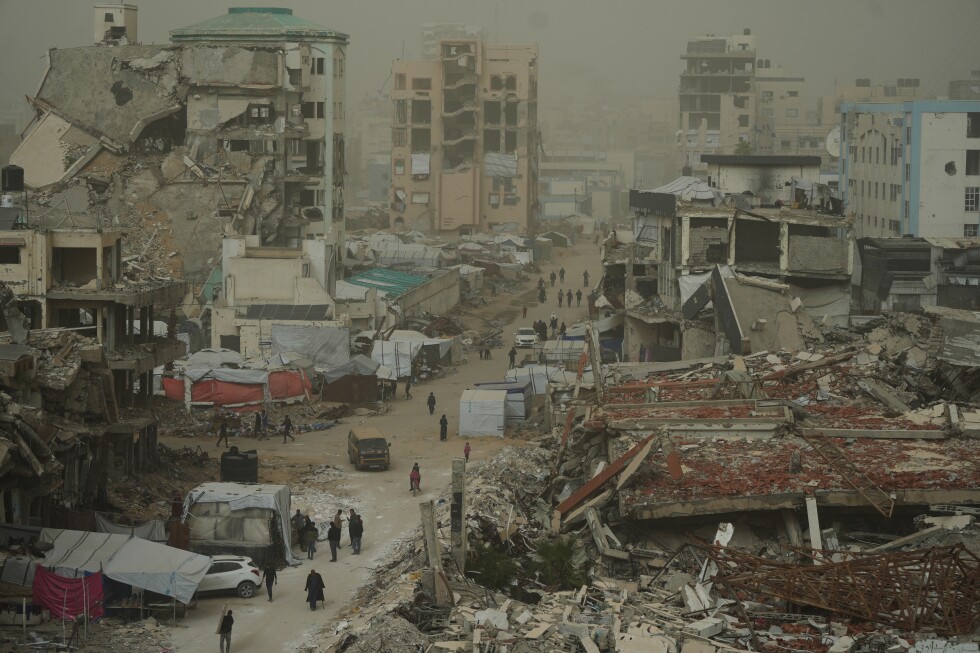
The scale of reconstruction required is staggering. The latest joint assessment from the UN, European Union, and World Bank estimates costs at approximately $70 billion. Israeli Prime Minister Benjamin Netanyahu has maintained that reconstruction cannot begin until Hamas disarms, leaving Gaza’s Palestinian population in a state of limbo amid widespread devastation.
While the ceasefire agreement has halted major military operations, secured the release of remaining hostages, and increased aid deliveries to Gaza, a sustainable resolution to the conflict that began with Hamas’ October 7, 2023 attack remains elusive.
The agreement outlines a process for Hamas to surrender its weapons and for Israeli forces to withdraw as international peacekeepers deploy. However, it leaves several critical questions unanswered and establishes no clear timeline for implementation.
Israel and the United States maintain that Hamas’ disarmament is essential for progress on other fronts. Arab and Muslim board members have accused Israel of undermining the ceasefire through continued military strikes and have urged the U.S. to exert more influence over its ally. While these nations have called on Hamas to disarm, they emphasize that Israel’s withdrawal is equally important.
The definition of “disarmament” remains contentious. Israel seeks the surrender of an estimated 60,000 automatic rifles, along with heavier weapons. Hamas has made only vague commitments to disarm, conditional upon progress toward Palestinian statehood, and insists on retaining some weaponry for maintaining law and order during the transition period.
According to regional officials familiar with negotiations, proposals include Hamas “freezing” its arsenal in sealed depots under external supervision or surrendering heavy weapons while retaining some handguns for policing functions. These officials, speaking on condition of anonymity, indicated the disarmament process could extend over several months.
The ceasefire agreement also calls for an International Stabilization Force comprised of troops from Arab and Muslim-majority countries to vet, train, and support a new Palestinian police force. Their mandate would include securing aid deliveries and preventing weapons smuggling, though specific details remain undefined.
Countries asked to contribute forces insist on framing the mission as peacekeeping rather than disarmament, which they fear could place their personnel at risk. Indonesia has begun training up to 8,000 soldiers for the force, though its foreign minister recently clarified they would not participate in disarming Hamas.
The post-war governance structure hinges on Hamas transferring power to a transitional committee of politically independent Palestinian administrators. The U.S. has appointed a 15-member committee led by former Palestinian Authority deputy minister Ali Shaath and named former UN envoy Nickolay Mladenov as the board’s envoy to Gaza.
The committee, however, remains in Egypt, awaiting Israeli permission to enter Gaza. Israel has not commented on the matter, while Mladenov warned last week at the Munich Security Conference that the committee’s effectiveness depends on Hamas relinquishing control and an end to ceasefire violations.
“We’re only embarrassing the committee and ultimately making it ineffective,” Mladenov said. “All of this needs to move very fast.”
Fact Checker
Verify the accuracy of this article using The Disinformation Commission analysis and real-time sources.

14 Comments
The Board of Peace’s first meeting is an important step, but Gaza’s issues are deeply entrenched. Civilian casualties, the continued presence of Hamas, and the lack of an effective governing body all pose major obstacles. Tangible progress will be key to maintaining the Board’s legitimacy.
Well said. The Board will need to take a balanced and nuanced approach, engaging all parties to find a path forward that addresses the complex realities on the ground.
The Board of Peace’s first meeting is an important milestone, but the challenges in Gaza are immense. Navigating the complex dynamics between Israel, Hamas, and the Palestinian authorities will require exceptional diplomacy and a commitment to addressing the region’s deep-rooted issues. Tangible progress on the humanitarian front will be crucial for the Board’s credibility.
Absolutely. The Board will need to take a balanced, impartial approach and demonstrate a clear path forward if it hopes to make a meaningful difference in the conflict.
While the Board of Peace is a positive initiative, it faces an uphill battle in Gaza. The region’s long history of conflict, competing interests, and lack of trust between stakeholders make this a daunting challenge. Careful diplomacy and a focus on humanitarian relief may be a good starting point.
Absolutely. The Board will need to tread carefully and demonstrate tangible progress quickly if it hopes to maintain credibility and drive meaningful change in the region.
Interesting development, though the Board of Peace will face significant challenges in resolving the long-standing conflict in Gaza. Navigating the complex dynamics between Israel, Hamas, and the Palestinians will require nuanced diplomacy and a commitment to address humanitarian needs.
Agreed. Establishing a sustainable ceasefire and creating conditions for a lasting political solution will be crucial yet extremely difficult. The Board’s credibility will be tested early on.
While the Board of Peace’s formation is a step in the right direction, the situation in Gaza remains highly volatile. Civilian casualties, the continued presence of Hamas, and the lack of an effective governing body are just some of the obstacles the Board will need to overcome. Establishing trust and finding a sustainable solution will be critical.
Well said. The Board’s success will depend on its ability to engage all stakeholders, address humanitarian concerns, and develop a clear roadmap for a lasting political solution.
The Board of Peace faces a daunting task in trying to find a resolution for the ongoing conflict in Gaza. With continued violence, the presence of Hamas, and the lack of a unified Palestinian governing body, the challenges are significant. Tangible improvements on the humanitarian front will be crucial for the Board’s credibility.
Agreed. The Board will need to navigate the complex geopolitical realities in the region and demonstrate a clear path forward that addresses the needs of all parties involved.
Establishing the Board of Peace is a laudable goal, but the situation in Gaza remains extremely complex. Balancing the interests of Israel, Hamas, and the Palestinian authorities will require immense skill and patience. Prioritizing humanitarian aid and a roadmap for a lasting political solution should be the Board’s key focus.
Well said. The Board will need to take a comprehensive, impartial approach and engage all stakeholders if it hopes to make meaningful progress in resolving the conflict.