


Listen to the article
Latin American Leaders Pivot to Tougher Crime Policies Under Trump Pressure and Bukele’s Influence
Latin American progressive leaders, once champions of holistic approaches to combating organized crime, are increasingly adopting harder-line security measures as they face mounting pressure from the Trump administration and their own citizens seeking Bukele-style results.
The shift comes as El Salvador President Nayib Bukele’s controversial anti-gang campaign, launched in 2022, continues to draw international attention for its dramatic results – a sharp decline in homicides that has translated into soaring approval ratings. Bukele has not only consolidated his power at home but has positioned himself as a regional model for addressing endemic violence, gaining admirers among voters and conservative populists across the hemisphere, including U.S. President Donald Trump.
Over the past year, Trump has taken an unusually confrontational stance toward Latin America, declaring numerous criminal groups as foreign terrorist organizations, indicting former Venezuelan President Nicolás Maduro on drug-trafficking charges, threatening military intervention in multiple countries, and repeatedly citing Bukele as the regional standard-bearer for security policy.
These pressures have created a difficult balancing act for progressive administrations in Mexico, Colombia, and Guatemala that had campaigned on promises of addressing root causes of violence through anti-corruption measures and economic opportunities rather than mass incarceration.
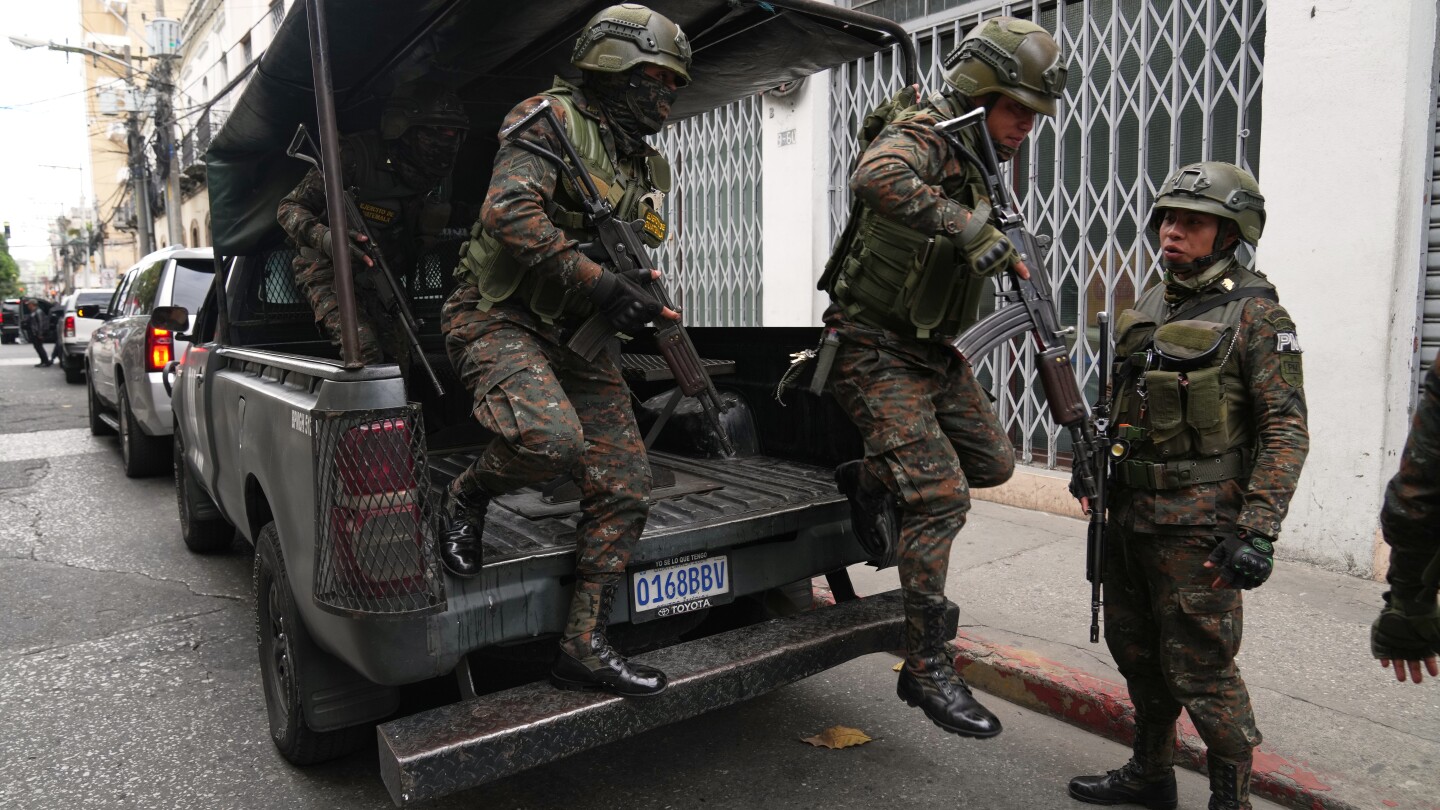
Guatemala’s President Bernardo Arévalo became the latest leader to shift course after suspected gang members killed 10 police officers last weekend in apparent retaliation for the government denying privileges to imprisoned gang leaders. The violence erupted when inmates in prisons, notoriously controlled by gangs, rioted and took guards hostage.
On Sunday evening, Arévalo declared a 30-day state of emergency to combat what he called “violent criminals who commit acts of terrorism.” The measure, approved by Guatemala’s congress on Monday, limits constitutional rights including freedoms of movement, assembly, and protest.
“We will spare no resources to punish, to pursue, to find those responsible for these crimes,” Arévalo declared at a funeral for the slain officers.
Arévalo’s emergency declaration mirrors steps taken by Bukele in 2022, though El Salvador’s state of emergency remains in place nearly four years later with more than 90,000 Salvadorans arrested. Human rights organizations have documented widespread abuses, but the country’s dramatic security improvement – just 82 homicides in 2025 compared to 6,656 in 2015 – has kept public support high.
“A lot of it is political theater and taking strong measures, but from there to actually being effective and actually delivering is the challenge,” said Michael Shifter, a senior fellow at the Washington-based Inter-American Dialogue. “Projecting toughness is a political winner.”
Several countries have attempted to replicate aspects of Bukele’s approach, including Ecuador, Honduras, and Costa Rica, which recently broke ground on a prison modeled after El Salvador’s infamous detention center for gang members. However, most have stopped short of implementing the full range of Bukele’s controversial measures, which have resulted in the detention of more than 1% of El Salvador’s population.
When elected in 2023, Arévalo, the son of a former progressive president, promised to strengthen legal institutions and root out corruption as solutions to endemic gang violence, distinguishing himself from competitors who advocated more Bukele-esque approaches. While he proposed improved security and construction of a maximum security prison, the state of emergency marks a significant escalation.
Tiziano Breda, senior analyst for Latin America and the Caribbean at the conflict analysis group ACLED, attributed Arévalo’s pivot to both Trump’s pressure and upcoming judicial elections in Guatemala, a crucial moment for his anti-corruption agenda.
Mexico’s President Claudia Sheinbaum has similarly adopted a more aggressive stance against cartels than her predecessor Andrés Manuel López Obrador, who favored a policy of “hugs, not bullets” that prioritized addressing poverty and lack of opportunity rather than direct confrontation with criminal groups.
In Colombia, President Gustavo Petro faces comparable challenges. The former rebel became Colombia’s first leftist leader in 2022 promising to achieve “total peace” by negotiating agreements with armed groups while providing economic alternatives for youth. But as peace talks have stalled with guerrillas from the National Liberation Army (ELN) and other factions, frustration toward the left has intensified ahead of presidential elections.
Trump has threatened military intervention in Colombia and accused Petro of drug trafficking, similar to accusations against Maduro who now awaits trial in U.S. federal court following a U.S. military operation in Venezuela that ousted him.
Under this dual pressure from Trump and dissatisfied Colombian citizens, Petro has increasingly relied on the military he once criticized. Last week, in a dramatic shift from his hopeful campaign rhetoric, he threatened joint military action with Venezuela if the ELN refused to enter peace negotiations.
“What Bukele did, the reason it’s attractive across the region is that it appears to provide a fast and simple, straightforward solution to a very complex problem,” explained Elizabeth Dickinson, a Colombia analyst at the International Crisis Group. “It takes a very long time to mobilize action on these holistic ideas, and even longer for those holistic ideas to yield results.”
Fact Checker
Verify the accuracy of this article using The Disinformation Commission analysis and real-time sources.

14 Comments
This article highlights the challenges Latin American progressives face in dealing with entrenched crime and violence. Trump’s aggressive stance and Bukele’s popular crackdown have put significant pressure on these leaders to shift towards tougher policies, even if they go against their previous beliefs. It’s a difficult position to be in.
Absolutely. The regional power dynamics and public demands make it very difficult for progressive leaders to maintain their original approaches. They are in a tough spot, having to weigh the need for public security against their principles.
The pressure on Latin American progressives to adopt Bukele-style tactics is understandable given the public’s desire for results, but it’s a concerning trend. While tough on crime policies may yield short-term gains, the long-term risks to democracy and civil liberties are significant. I hope these leaders can find a way to address violence without resorting to authoritarian measures.
You make a fair point. The temptation to adopt hardline tactics may be strong, but the potential consequences for democratic institutions and human rights are quite serious. Careful, evidence-based policymaking that prioritizes both public safety and civil liberties will be crucial going forward.
This is a challenging situation for Latin American progressives, caught between public demands for security and their own ideological leanings. The Bukele model has shown dramatic results, but at what cost to civil liberties and the rule of law? It will be interesting to see how these leaders navigate this delicate balance in the coming years.
Absolutely. The tradeoffs between public security and democratic principles are not easy to resolve. Careful analysis of the long-term impacts, both positive and negative, will be critical as these leaders chart the way forward.
The Bukele model in El Salvador has certainly gained attention, both positive and negative. While the sharp drop in homicides is impressive, there are valid concerns about human rights abuses and democratic backsliding. It will be critical for Latin American leaders to find an effective yet balanced approach to combating organized crime.
You make a good point. Effective crime reduction is important, but it cannot come at the expense of fundamental rights and liberties. Carefully balancing security and civil liberties will be crucial for the long-term stability and wellbeing of these countries.
The increasing adoption of tougher crime policies in Latin America is a complex issue. While the Bukele model in El Salvador has shown dramatic results, there are concerns about human rights and due process. It will be interesting to see how leaders balance public demands for security with protecting civil liberties.
You raise a good point. Maintaining the delicate balance between public safety and civil liberties is crucial. Careful implementation and oversight will be key as leaders explore security-focused approaches.
This is a complex issue with no easy solutions. While the public may demand tougher action on crime, history has shown that heavy-handed security measures often backfire and lead to further instability. I hope Latin American leaders can find a way to address violence and organized crime without compromising democratic principles.
I share your concerns. Implementing effective security policies without sacrificing human rights and the rule of law is a delicate balance that requires nuanced policymaking and strong institutions. Careful consideration of long-term consequences will be crucial.
The shift towards tougher crime policies in Latin America is concerning, but understandable given the immense public pressure and regional dynamics at play. While the Bukele model has yielded results, the potential for human rights abuses and democratic backsliding is worrying. I hope these progressive leaders can find a way to address violence effectively without sacrificing core democratic values.
Well said. Balancing public security needs with the protection of civil liberties is a delicate challenge, and one that will require nuanced policymaking and strong institutions to achieve. It’s a complex issue without easy answers, but the stakes are high for the future of democracy in the region.