


Listen to the article
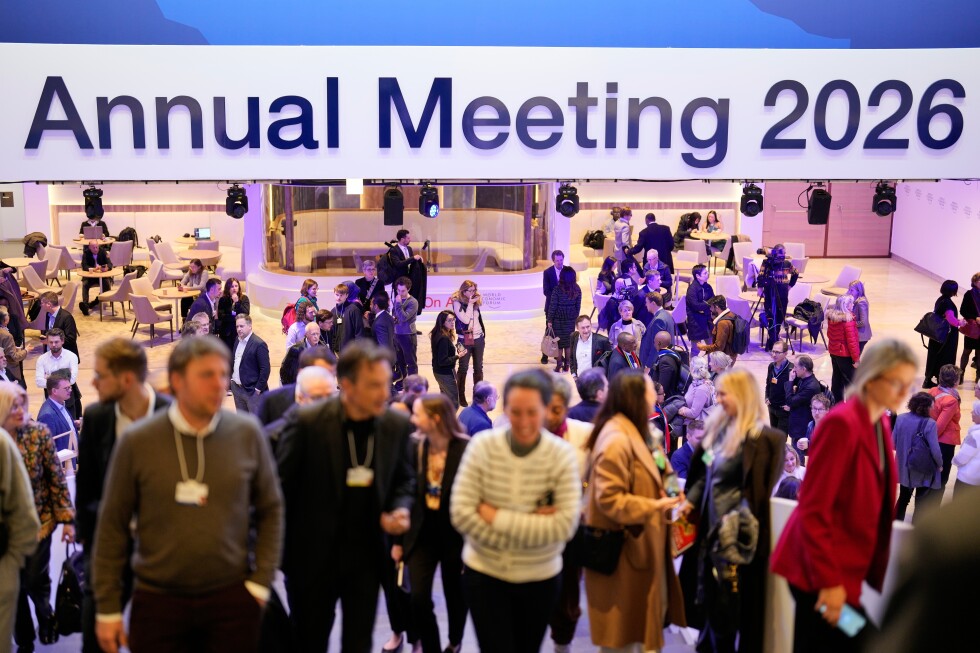
U.S. President Donald Trump dominated the World Economic Forum in Davos this week, overshadowing discussions on climate change, artificial intelligence, and renewable energy that typically characterize the annual gathering of global leaders and executives in the Swiss Alps.
“I think there were two Davoses,” noted former Democratic Congresswoman Jane Harman. “One of them was very senior industrial leaders talking about AI… The second was foreign policy, or geopolitics, and that was dominated by one person.”
Trump’s whirlwind 24-hour visit marked his third appearance at the forum as president. He delivered a speech that critics described as rambling and hyperbolic while touting America’s global role. Unlike previous visits where corporate executives welcomed him warmly, Trump faced pointed criticism from figures like California Governor Gavin Newsom, who made himself available to media throughout the event.
Despite the pushback, Trump garnered praise from NATO Secretary General Mark Rutte and Ukrainian President Volodymyr Zelenskyy. Both leaders met with Trump in Davos and commended his efforts to help end Russia’s war in Ukraine, strengthen Western defense capabilities, and deliver security guarantees to Kyiv.
One recurring narrative at the forum centered on growing divisions between the United States under Trump and its Western allies. Canadian Prime Minister Mark Carney described this as a “rupture” that could never be fully repaired.
Trump created fresh tension with European allies before the forum by announcing plans to impose new tariffs on eight European countries that opposed his bid to acquire Greenland, a semi-autonomous territory belonging to NATO member Denmark. By Wednesday, however, Trump had dramatically reversed course after widespread criticism.
“I have agreed with NATO chief Rutte on a framework of a future deal on Arctic security,” Trump wrote on his social media platform, potentially defusing a situation with significant geopolitical implications.
During the forum, Trump unveiled his “Board of Peace” initiative aimed at maintaining a ceasefire in Israel’s war with Hamas and eventually helping to map Gaza’s future. The concept drew support from diverse nations including Belarus, Kosovo, Indonesia, and Argentina, but faced opposition from traditional U.S. allies in Europe. Critics rejected Trump’s assertion that the board could eventually rival the United Nations.
“I think they were trying to duplicate what happened when the United Nations came about,” said Amnesty International Secretary-General Agnes Callamard in an interview. “But frankly it was a very poor and sad attempt to repeat what happened in the 1940s.” Callamard and others suggested that reinforcing existing UN structures would be more productive than creating competing institutions.
Artificial intelligence dominated the business discussions at Davos, with billionaire Elon Musk and Nvidia CEO Jensen Huang making their first appearances at the forum. Musk, who had previously dismissed the WEF event as “boring,” made an unexpected appearance to discuss robotics and address AI’s electricity demands. He also subtly criticized the Trump administration’s tariffs on Chinese solar panels.
Huang countered fears about AI eliminating jobs, suggesting the technology would create work for people building its infrastructure, including “plumbers and electricians and construction and steel workers and network technicians.”
The U.S.-China technological rivalry surfaced when Anthropic CEO Dario Amodei compared the Trump administration’s decision to allow sales of advanced Nvidia chips to China to “selling nuclear weapons to Pyongyang,” highlighting ongoing tensions in global technology policy.
Despite geopolitical tensions, business executives maintained optimistic outlooks about technology and economic growth, embodying the forum’s stated goal of improving global conditions through dialogue. As BlackRock Chairman and CEO Larry Fink noted in the closing ceremony, quoting Musk: “It’s better to be an optimist and wrong than be a pessimist who’s right.”
The contrasting themes of optimistic business leaders and contentious geopolitics defined this year’s World Economic Forum, with Trump’s presence ultimately defining much of the international conversation despite the event’s broader agenda.
Fact Checker
Verify the accuracy of this article using The Disinformation Commission analysis and real-time sources.

12 Comments
The pushback from figures like Newsom is understandable given Trump’s mixed record on issues like climate change. But his ability to still garner praise from some leaders suggests he retains a degree of influence on the world stage.
I’ll be watching to see if Trump’s Davos performance translates into any meaningful policy shifts or breakthroughs in the weeks and months ahead.
Trump’s Davos visit certainly generated a lot of buzz, though the reactions seem mixed. I’m curious to hear more about the specifics of his speech and how it was received by the global business and political elite in attendance.
It will be interesting to see if Trump’s outspoken rhetoric and confrontational style helps or hinders progress on key issues like climate change and geopolitical tensions.
It’s interesting to see Trump praised by some global leaders like Rutte and Zelenskyy, even as he faces criticism from others. Suggests he’s still able to exert influence, for better or worse, on key international issues.
The mixed reactions highlight the challenge of reconciling Trump’s America First rhetoric with the need for collective action on global challenges.
The contrast between the ‘two Davoses’ – one focused on technology/innovation, the other on foreign policy and geopolitics – highlights the challenges of aligning diverse global interests at these elite gatherings.
Trump seems to have dominated the geopolitical narrative, but I wonder how much substantive progress was made on the other key agenda items in Davos.
The ‘two Davoses’ dynamic reflects the broader polarization we’re seeing globally, where economic/technological concerns and geopolitical/ideological divides are often at odds. Navigating that will be crucial for world leaders.
While Trump’s style may rub some the wrong way, his ability to command the spotlight at Davos shows he remains a major force on the world stage.
While Trump’s brash style may have rubbed some the wrong way, his meetings with leaders like Rutte and Zelenskyy suggest he was able to make some headway on issues like Ukraine. Curious to see if that translates into concrete outcomes.
It’s a delicate balancing act for Trump – asserting US interests while also working constructively with global partners. The Davos response highlights the challenges he faces.