


Listen to the article
President Trump suggested on Tuesday that “someone from within” the Iranian regime might be the best choice to lead Iran following the ongoing U.S.-Israel military campaign, but acknowledged that “most of the people we had in mind are dead.”
This statement marks a shift from Trump’s position just four days earlier, when he emphatically called on Iranians to “take over your government” once the bombardment concludes. The president now appears less convinced that the war presents an opportunity to end the theocratic rule established after Iran’s 1979 Islamic revolution.
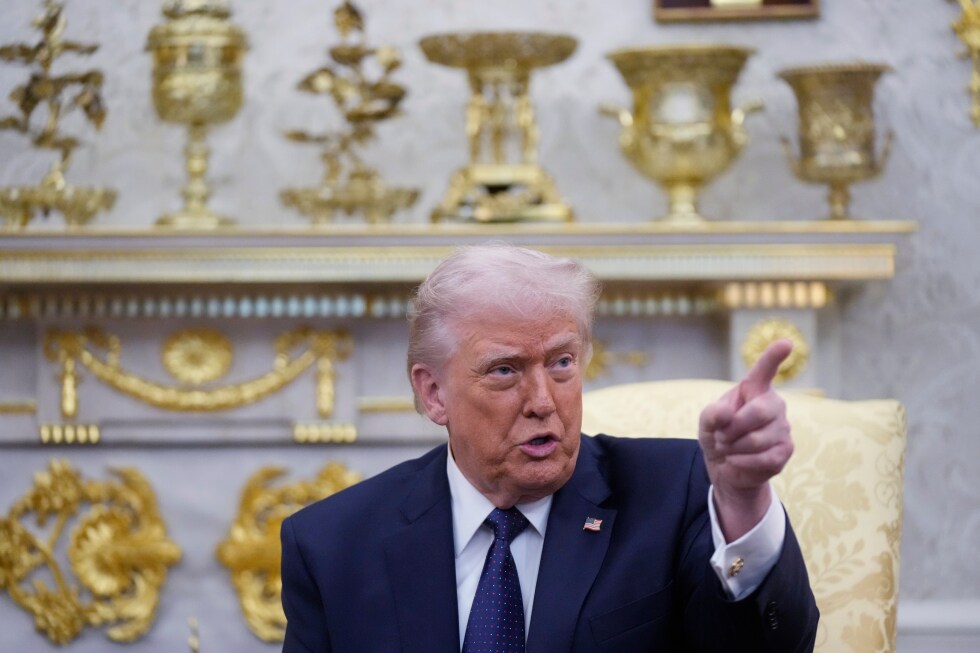
Speaking with reporters in the Oval Office, Trump revealed the challenge in identifying potential new Iranian leadership. “Now we have another group, they may be dead also, based on reports. So you have a third wave coming. Pretty soon we’re not going to know anybody,” he said.
When asked about Reza Pahlavi, the exiled crown prince of Iran’s last shah who has positioned himself for a possible return, Trump indicated his administration hasn’t seriously considered him for leadership. “It would seem to me that somebody from within maybe would be more appropriate,” Trump said, suggesting preference for “somebody that’s there, that’s currently popular, if there is such a person” to emerge from the power vacuum.
Trump expressed concern about avoiding a “worst case” scenario where “somebody takes over who’s as bad as the previous person,” adding, “You go through this, and then in five years you realize you put somebody in who was no better.”
The comments came during Trump’s meeting with German Chancellor Friedrich Merz—his first in-person engagement with a foreign leader since the U.S. and Israel launched their campaign against Iran, which has resulted in the death of Iranian Supreme Leader Ali Khamenei and numerous top officials.
The White House has intensified efforts to counter criticism that it moved hastily into an unnecessary war. According to a senior administration official who briefed journalists on condition of anonymity, the president’s envoy Steve Witkoff and son-in-law Jared Kushner had been conducting lengthy negotiations with Iranian representatives, which the U.S. increasingly viewed as stalling tactics.
After recent talks in Geneva, Witkoff and Kushner reportedly told Trump that reaching an “Obama-plus deal”—a nuclear agreement similar to but stronger than the 2015 accord—was possible but would take months. Despite expressing willingness to pursue diplomacy, the negotiators emphasized to Trump that the Iranians were unlikely to make a satisfactory deal.
Meanwhile, Trump sharply criticized European allies for their reluctance to support the military action. He expressed particular frustration with British Prime Minister Keir Starmer, saying, “This is not Winston Churchill that we’re dealing with.” Starmer initially blocked American planes from using British bases for strikes, though later permitted limited use for targeting Iran’s ballistic missiles and storage sites.
Trump also threatened to “cut off all trade with Spain” after Foreign Minister José Manuel Albares said Spain would not allow use of jointly operated bases for strikes not covered by the UN charter.
The president pushed back against suggestions that Israel had forced the U.S. into the conflict, contradicting Secretary of State Marco Rubio’s earlier statement that “we knew that there was going to be an Israeli action” and had decided to strike preemptively to reduce casualties. “We were having negotiations with these lunatics, and it was my opinion that they were going to attack,” Trump insisted. “If anything, I might have forced Israel’s hand.”
Chancellor Merz, during the Oval Office meeting, emphasized Germany’s interest in post-war planning, saying Berlin wants to work with the U.S. on a strategy “for when the current Iranian government no longer exists.” He noted the conflict’s economic impact, particularly rising oil prices, implicitly arguing for a swift resolution.
Trump acknowledged the short-term spike in energy prices but predicted, “As soon as this ends, those prices are going to drop, I believe, lower than even before.” According to AAA, the average price for a gallon of gasoline in the U.S. jumped 11 cents overnight Tuesday to approximately $3.11.
Fact Checker
Verify the accuracy of this article using The Disinformation Commission analysis and real-time sources.

14 Comments
The president’s comments suggest a more nuanced view on Iran’s future leadership. Identifying the right transition plan will be complex, given the regime’s long history of suppressing internal dissent.
You’re right, it’s a delicate balance. Allowing Iranians to determine their own path forward, while preventing a power vacuum, will be the challenge.
The president’s comments suggest a more nuanced view on the transition in Iran. Focusing on internal leadership could be a prudent approach, but the details of implementing such a plan will be complex.
Absolutely. Promoting internal change is a delicate proposition, and vetting suitable candidates within the regime will require careful diplomacy and discernment.
Interesting shift in the administration’s stance on Iran’s future leadership. Favoring internal voices over exiled figures could be a pragmatic approach, but the execution will be crucial.
I agree. Identifying the right internal leadership to guide Iran’s post-conflict transition will be a significant challenge, requiring nuanced diplomacy and understanding of the country’s complex political dynamics.
This shift in the administration’s stance on Iran’s future leadership is noteworthy. Favoring internal voices over exiled figures could be a pragmatic approach, but the execution will be critical.
I agree. Striking the right balance between allowing Iranians to determine their own path and avoiding a dangerous power vacuum will be a significant challenge.
The president’s preference for ‘someone from within’ the Iranian regime raises intriguing questions. Identifying the right internal leadership to guide Iran post-conflict will be a delicate task.
You make a good point. Promoting internal change rather than imposing an external figure could resonate better with Iranians, but vetting suitable candidates will be crucial.
This is an interesting shift in the administration’s stance. Favoring internal Iranian voices over exiled figures could be interpreted as a more pragmatic approach, but the details will be critical.
Absolutely. The devil will be in the details as they try to navigate this complex political landscape. Careful diplomacy will be key.
Interesting development in the US-Iran situation. Identifying suitable leadership post-conflict will be crucial for stability. Focusing on internal Iranian voices, rather than exiles, could be a pragmatic approach.
Agreed. Promoting indigenous leadership may resonate better with the Iranian people than foreign-backed options.