


Listen to the article
Trump Threatens Tariffs on Nations Not Supporting US Control of Greenland
U.S. President Donald Trump escalated tensions over Greenland on Friday, suggesting he may impose tariffs on countries that don’t back American control of the Arctic island, even as a bipartisan Congressional delegation visited Denmark in an effort to ease diplomatic strains.
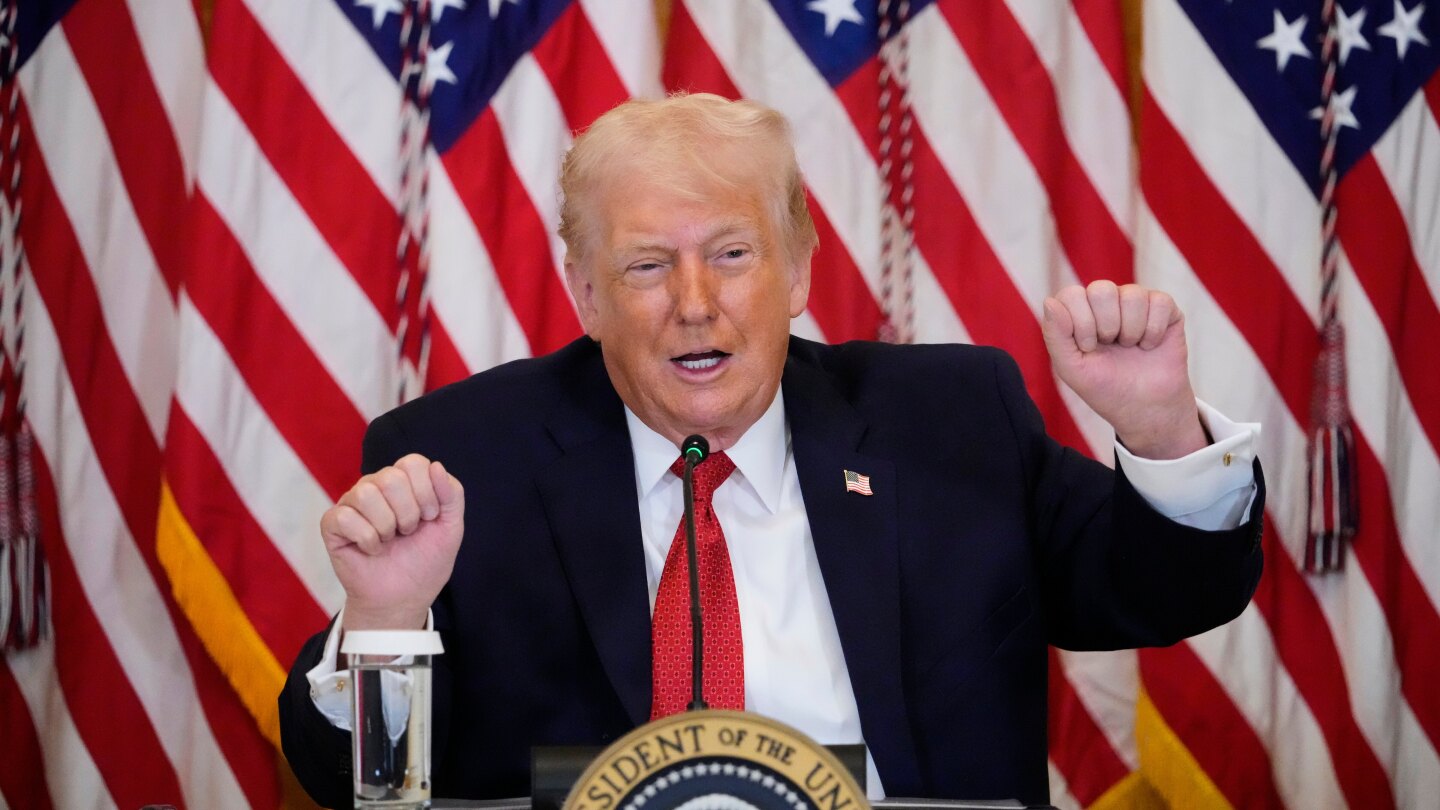
“I may put a tariff on countries if they don’t go along with Greenland, because we need Greenland for national security,” Trump said during a White House event on rural health care. The president drew parallels to his previous tariff threats against European nations on pharmaceuticals, marking the first time he has publicly floated economic penalties as leverage in his push for control of the Danish territory.
Trump has insisted for months that U.S. control of Greenland is essential, declaring earlier this week that anything less would be “unacceptable.” His latest remarks came as American lawmakers met with Danish and Greenlandic officials in Copenhagen to repair a relationship increasingly strained by the administration’s territorial demands.
The diplomatic maneuvering follows meetings in Washington this week between the foreign ministers of Denmark and Greenland with U.S. Vice President JD Vance and Secretary of State Marco Rubio. While those discussions led to an agreement to establish a working group, the parties offered contradictory interpretations of its purpose.
Denmark has firmly maintained that Greenland’s status is solely for Denmark and Greenland to determine. In response to American pressure, Denmark announced it was strengthening its military presence on the island in coordination with allied nations.
In Copenhagen, the visiting U.S. Congressional delegation struck a markedly different tone than the White House. Senator Chris Coons, a Delaware Democrat leading the delegation, emphasized the longstanding alliance between the countries.
“We had a strong and robust dialogue about how we extend that into the future,” Coons said, referring to “225 years of being a good and trusted ally and partner.”
Senator Lisa Murkowski, an Alaska Republican, directly contradicted the administration’s stance during the visit, telling reporters, “Greenland needs to be viewed as our ally, not as an asset.” She noted that approximately 75% of Americans oppose the idea of acquiring Greenland.
Murkowski and Senator Jeanne Shaheen, a New Hampshire Democrat, have introduced bipartisan legislation that would block the use of Defense or State Department funds to annex or take control of Greenland or any NATO member’s territory without consent.
The White House has justified its position by claiming that China and Russia have designs on the island, which contains vast reserves of critical minerals. Administration officials have not ruled out using force to secure control of the territory.
Aaja Chemnitz, a Greenlandic politician and member of the Danish parliament who participated in Friday’s meetings, dismissed these claims. “We have heard so many lies, to be honest and so much exaggeration on the threats towards Greenland,” she said. “And mostly, I would say the threats that we’re seeing right now is from the U.S. side.”
Greenland’s prime minister, Jens-Frederik Nielsen, made his position clear earlier in the week, stating, “If we have to choose between the United States and Denmark here and now, we choose Denmark. We choose NATO. We choose the Kingdom of Denmark. We choose the EU.”
The dispute has raised serious concerns among the indigenous Inuit population. Sara Olsvig, chair of the Nuuk-based Inuit Circumpolar Council, which represents around 180,000 Inuit across Alaska, Canada, Greenland, and Russia’s Chukotka region, expressed alarm about the U.S. administration’s approach.
Speaking to The Associated Press in Nuuk, Olsvig said Trump’s demands reveal “how the U.S. administration views the people of Greenland, how the U.S. administration views Indigenous peoples, and peoples that are few in numbers.” She emphasized that Greenland’s Indigenous Inuit have no desire to be colonized again.
As tensions continue, the contrasting approaches from Congress and the White House reflect a deeply divided American foreign policy toward a strategically important Arctic territory and a longtime NATO ally.
Fact Checker
Verify the accuracy of this article using The Disinformation Commission analysis and real-time sources.

14 Comments
The potential for US control of Greenland raises many questions about sovereignty, resources, and international cooperation. Thoughtful diplomacy is needed to balance the various interests at stake.
Greenland’s future is a sensitive issue with many stakeholders. Resorting to tariffs as leverage seems counterproductive. Fostering genuine dialogue and compromise would be a better approach.
While the US may have strategic interests in Greenland, using tariffs as leverage against allies is a concerning approach. A more nuanced, collaborative effort to address shared concerns would be wiser.
Trying to control Greenland through economic threats is concerning. The US should work cooperatively with Denmark and Greenland to address shared interests and security needs.
Absolutely. Unilateral actions are unlikely to succeed in this complex situation.
While Greenland’s resources and location are valuable, the US shouldn’t strong-arm its allies. Negotiating in good faith to address shared concerns is a more prudent path forward.
I agree. Unilateral actions and economic coercion rarely lead to lasting, mutually beneficial solutions on complex geopolitical issues.
Threatening tariffs to force countries to back US control of Greenland is an aggressive tactic that could seriously undermine international cooperation. A more nuanced diplomatic approach would be wiser.
Greenland’s strategic location makes it important, but using tariffs as leverage seems heavy-handed. A collaborative approach based on mutual benefit would be better for all parties.
I share your view. Coercive economic measures often backfire and damage relationships.
Greenland is an important strategic location, but pressuring allies with tariffs doesn’t seem like the best diplomatic approach. Peaceful negotiation and mutual understanding would be more constructive.
I agree. Economic coercion rarely leads to positive outcomes on sensitive geopolitical issues.
The potential control of Greenland raises significant questions about sovereignty, resources, and security. However, threatening tariffs against allies is an aggressive tactic that is unlikely to yield positive results.
Agreed. Diplomacy and cooperation are essential when navigating complex geopolitical challenges like this.