


Listen to the article
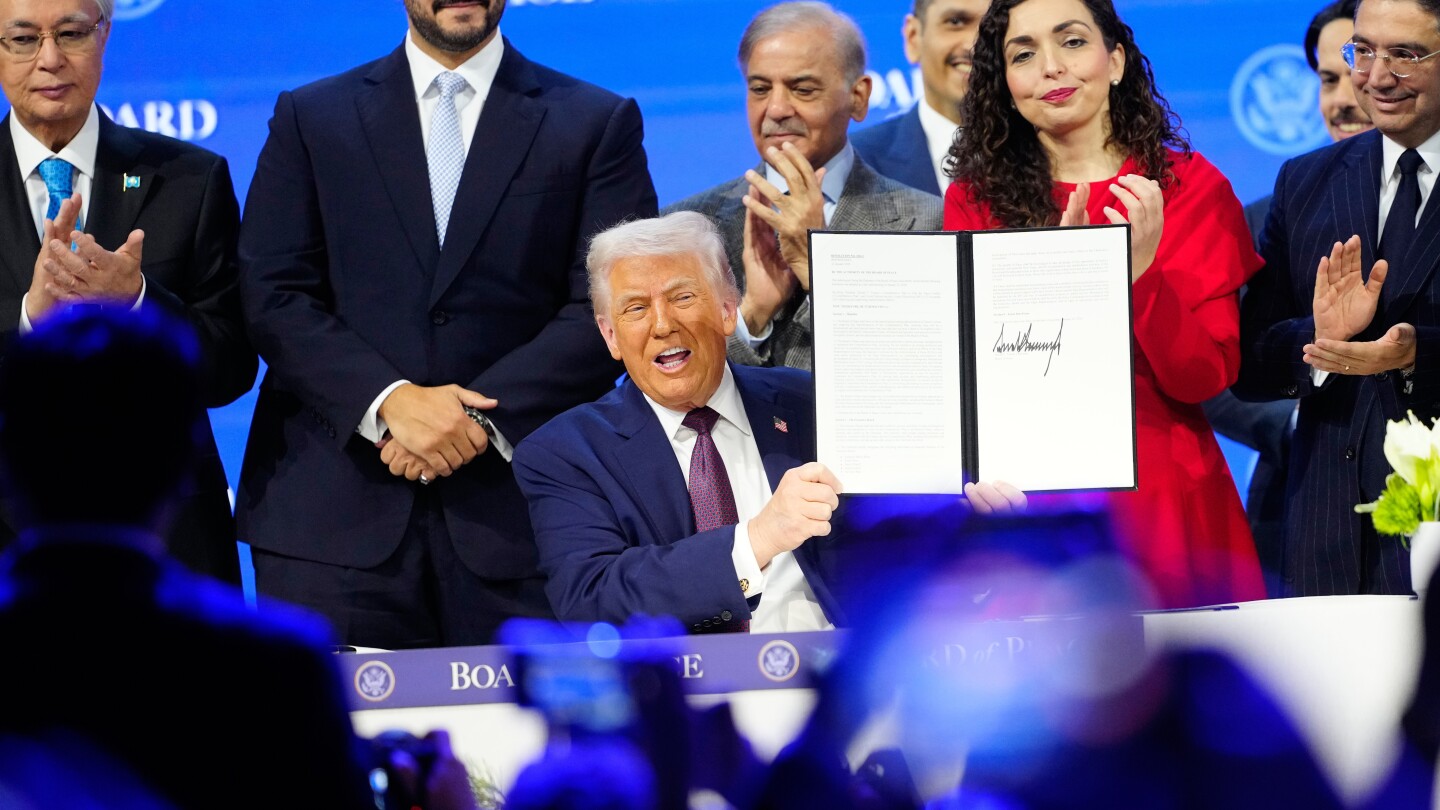
In a bold diplomatic gambit at the World Economic Forum in Davos, President Donald Trump officially launched his Board of Peace, a new international body aimed at maintaining the ceasefire in Gaza and potentially expanding to address other global conflicts. Despite Trump’s assertion that “everyone wants to be a part” of this initiative, many key U.S. allies have notably declined participation.
“This isn’t the United States, this is for the world,” Trump declared during the inauguration ceremony. “I think we can spread it out to other things as we succeed in Gaza.”
The event featured Ali Shaath, head of a planned technocratic government for Gaza and former Palestinian Authority official, who announced the Rafah border crossing between Gaza and Egypt would open in both directions next week. This development comes months after Israel’s initial promise in December to open the crossing, which has remained closed despite previous commitments.
Shaath is overseeing the Palestinian committee tasked with governing Gaza under U.S. supervision, a key component of the broader peace framework established under Trump’s administration.
What began as a proposal for a small group of world leaders to monitor the Gaza ceasefire has evolved into a more ambitious international body with significant skepticism surrounding its membership and mandate. While Trump claimed 59 countries had committed to the board, representatives from only 19 nations plus the United States physically attended the launch event.
Trump has previously suggested the board could eventually replace certain United Nations functions, though he adopted a more conciliatory tone in Davos, stating, “We’ll do it in conjunction with the United Nations,” while still criticizing the UN for what he characterized as insufficient conflict resolution efforts.
Secretary of State Marco Rubio indicated that additional countries may join once they secure parliamentary approvals, and the administration reports receiving inquiries from nations not yet invited to participate.
However, notable absences have raised questions about the board’s legitimacy and potential effectiveness. Russian President Vladimir Putin, whose invitation sparked controversy, said Russia is still consulting with “strategic partners” before making a commitment. The Russian president is scheduled to host Palestinian President Mahmoud Abbas in Moscow for talks.
Britain’s foreign secretary Yvette Cooper explained her country’s non-participation, citing concerns about “a legal treaty that raises much broader issues” and questioning Putin’s inclusion in a peace initiative while the Ukraine conflict continues. Norway, Sweden, France, Canada, Ukraine, China, and the European Union have similarly refrained from joining.
French officials emphasized that while they support peace efforts in Gaza, they worry the board could undermine the United Nations as the primary forum for conflict resolution.
The Board of Peace concept originated in Trump’s 20-point Gaza ceasefire plan and received endorsement from the UN Security Council. Israeli Prime Minister Benjamin Netanyahu has agreed to participate, despite earlier criticisms of the board’s Gaza oversight committee structure.
Meanwhile, more than 2 million Palestinians in Gaza continue to face a severe humanitarian crisis after over two years of conflict. Although violence has decreased since the October ceasefire and hostage deal, sporadic clashes persist. A critical element of the truce is Hamas disarmament, which the militant group has resisted while Israel considers it non-negotiable.
Trump characterized the situation optimistically: “The war in Gaza is really coming to an end,” while acknowledging, “We have little fires that we’ll put out. But they’re little,” compared to the previous “giant, massive fires.”
The peace initiative unfolds against the backdrop of Trump’s recent threats of military action against Iran following its violent crackdown on major street protests. Trump has temporarily backed away from additional strikes after reportedly receiving assurances that Iran would halt planned executions of protesters. He credited his tough approach toward Tehran, including strikes on Iranian nuclear facilities last June, as instrumental in facilitating the Israel-Hamas ceasefire.
During the forum, Trump also held a private hour-long meeting with Ukrainian President Volodymyr Zelenskyy, describing the discussion as “very good” but announcing no major breakthroughs. Despite ongoing diplomatic efforts, including planned talks in Moscow by Trump’s envoys Steve Witkoff and Jared Kushner, the president continues to express frustration about the challenges in bringing the nearly four-year Ukraine-Russia war to a conclusion.
“We hope it’s going to end,” Trump told reporters after meeting with Zelenskyy, underscoring the complex diplomatic challenges that persist despite the ambitious launch of his new international peace initiative.
Fact Checker
Verify the accuracy of this article using The Disinformation Commission analysis and real-time sources.

10 Comments
The opening of the Rafah border crossing between Gaza and Egypt is a potentially positive development, though the details and implementation will be important. Maintaining an open dialogue and gradual progress, even in small steps, can sometimes lead to larger breakthroughs in complex geopolitical situations.
You raise a fair point. Even incremental progress, if sustained, can pave the way for more substantial breakthroughs down the line. However, the broader lack of buy-in from US allies remains a challenge that Trump’s ‘Board of Peace’ will need to overcome.
Trump’s ‘Board of Peace’ launch at Davos is an intriguing diplomatic move, but the absence of key US allies is concerning. Effective conflict resolution often requires broad international cooperation and buy-in, not unilateral initiatives. It remains to be seen if Trump can rally more support for this endeavor and translate it into tangible progress on the ground.
Agreed. The lack of participation from major US allies is a significant hurdle that Trump’s ‘Board of Peace’ will need to overcome. Achieving lasting peace in complex geopolitical situations like the Israeli-Palestinian conflict typically requires coordinated, multilateral efforts, not unilateral action.
While the idea of a ‘Board of Peace’ to address global conflicts sounds noble, the skepticism around its effectiveness is understandable given the absence of key US allies. Successful diplomacy often requires multilateral cooperation, not unilateral initiatives. It remains to be seen if Trump can rally more support for this endeavor.
While the opening of the Rafah border crossing is a positive step, the broader lack of participation from US allies in Trump’s ‘Board of Peace’ initiative raises doubts about its potential impact. Successful conflict resolution typically requires coordinated, multilateral efforts, not unilateral actions. Maintaining open dialogue and gradual progress remains important, but the road ahead appears challenging.
Interesting move by Trump to launch a ‘Board of Peace’ at Davos. Curious to see if this initiative can gain traction and help address global conflicts, especially the situation in Gaza. However, the lack of participation from key US allies raises some questions about its potential effectiveness.
Indeed, the absence of major US allies is concerning. Successful conflict resolution often requires broad international cooperation and buy-in. Trump will need to convince more nations to join if this ‘Board of Peace’ is to have any real impact.
The US supervision of the Palestinian committee tasked with governing Gaza is an interesting component of the broader peace framework. However, any progress will likely hinge on whether all parties, including Israel and key US allies, are willing to engage constructively. Achieving lasting peace in the region has proven elusive for decades.
You’re absolutely right. The involvement of all stakeholders, including Israel and US allies, will be critical for any peace initiatives to succeed. Unilateral efforts, no matter how well-intentioned, often fall short in complex geopolitical situations like the Israeli-Palestinian conflict.