


Listen to the article
The Trump administration is considering housing the newly formed Board of Peace in the controversial former headquarters of the U.S. Institute of Peace in Washington, according to four administration officials who spoke on condition of anonymity.
The officials emphasized that while the location has been under serious discussion, no final decision has been made regarding where the board’s administrative staff will be based. The Board of Peace is a key component of both the recent Gaza ceasefire and the administration’s broader international ambitions.
The building in question remains at the center of ongoing litigation after the Republican administration seized the facility last year and terminated nearly all staff at the nonprofit think tank. Following the takeover, the building was renamed the Donald J. Trump U.S. Institute of Peace, though both its name and legal status remain contested in court.
A federal judge previously ruled that the U.S. Institute of Peace, established by Congress as an independent nongovernmental organization, cannot legally be controlled by the executive branch, declaring the government’s takeover illegal. However, enforcement of this ruling has been temporarily suspended pending the government’s appeal.
“A stay is not permission for the loser of a case to hijack the property of the winning party,” said George Foote, legal counsel representing former USIP leadership and staff. “The government does not have a license to rename the USIP headquarters building or lease it out for ten years.”
Foote added, “It certainly has no right to open the building to a new international organization like the proposed Board of Peace.”
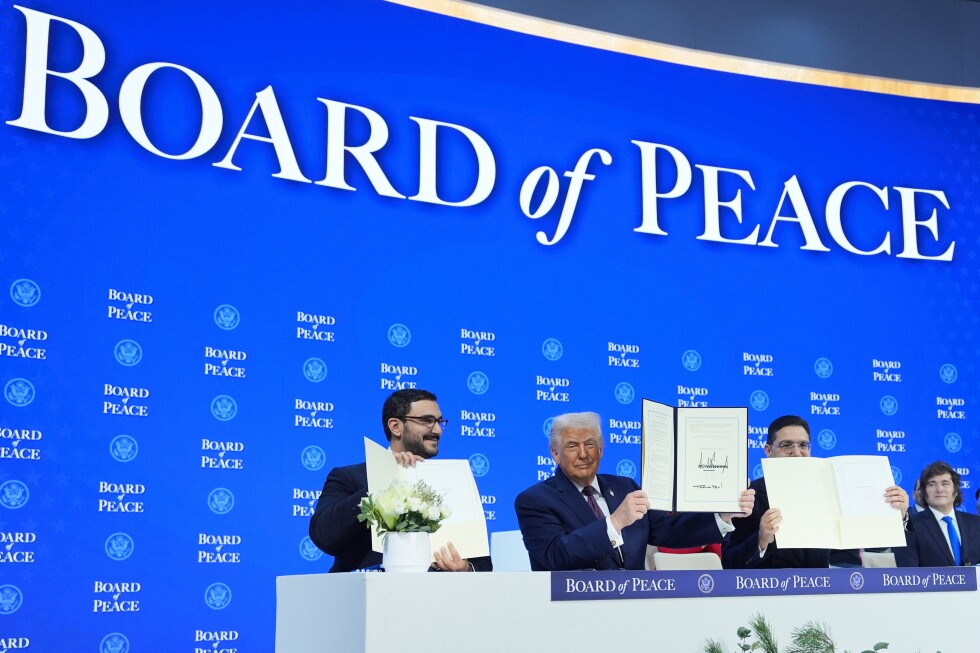
Speculation about the administration’s plans for the building intensified after officials displayed the Board of Peace logo superimposed over an image of the USIP building with its distinctive domed architecture. This imagery was prominently featured when Trump unveiled the Board of Peace at last week’s World Economic Forum in Davos, Switzerland.
The Board of Peace currently consists of 27 “founding members” drawn from various world leaders. While its initial mandate is to oversee the implementation of Trump’s Gaza ceasefire plan, the administration appears to have more extensive plans for the organization. The board’s charter explicitly states it will seek to address and resolve other global conflicts beyond Gaza.
The ceasefire in Gaza represents a significant diplomatic achievement for the administration, with humanitarian organizations now able to deliver aid more consistently to the war-torn region. The Red Cross has played a crucial role in facilitating hostage exchanges and coordinating relief efforts under the terms of the agreement.
Despite the administration’s ambitious vision for the Board of Peace, many of America’s traditional allies in Europe and elsewhere have declined to participate. Critics suggest the board may be designed to function as a rival to the United Nations Security Council, creating an alternative forum for international conflict resolution that could potentially diminish the UN’s authority.
The administration’s move comes at a time of increasing skepticism toward traditional multilateral institutions. Trump has repeatedly criticized organizations like the UN and NATO throughout both his terms, arguing they often fail to effectively address global challenges while placing disproportionate financial burdens on the United States.
As litigation over the building continues, former USIP employees maintain that the administration’s actions not only violated legal procedures but also undermined the institute’s longstanding nonpartisan mission to promote international peace and conflict resolution through research, education, and direct engagement.
The outcome of this dispute could have significant implications for the independence of congressionally established organizations and the boundaries of executive power in managing federal properties and institutions.
Fact Checker
Verify the accuracy of this article using The Disinformation Commission analysis and real-time sources.

12 Comments
The Board of Peace seems like an ambitious initiative, but basing it in a facility with an unclear legal status could undermine its credibility and effectiveness. Transparency around the location decision will be key.
Agreed. Establishing the Board of Peace on solid legal ground should be a priority to ensure its long-term success and legitimacy.
The legal issues surrounding the former U.S. Institute of Peace building are troubling. Locating the new Board of Peace there could raise questions about the administration’s commitment to upholding international law and norms.
Absolutely. The administration needs to ensure the Board of Peace has a strong legal foundation to be taken seriously as a global peacebuilding entity.
I’m curious to learn more about the Board of Peace and its specific mandate. Locating it in a contested building raises questions about the administration’s commitment to impartiality and international cooperation.
Absolutely. The choice of venue could send a concerning signal about the true nature and intentions behind the Board of Peace initiative.
It’s concerning to see the Trump administration potentially using a contested building for the new Board of Peace. Maintaining impartiality and the rule of law should be paramount for an organization tasked with international conflict resolution.
I agree. The choice of venue could undermine the Board of Peace’s legitimacy and credibility before it even gets off the ground.
While the Gaza ceasefire is a positive development, housing the Board of Peace in a legally dubious facility raises red flags. Transparent and lawful governance should be a top priority for an entity tasked with international peacebuilding.
Well said. The administration needs to ensure the Board of Peace has a clear legal foundation to operate effectively and credibly on the global stage.
Interesting that the Trump administration is considering housing the Board of Peace in a building with such a contested legal status. I wonder if they’ll be able to overcome the court ruling that the takeover was illegal.
The legal limbo around the building’s ownership certainly complicates matters. It will be important to see how this plays out in the courts.