


Listen to the article
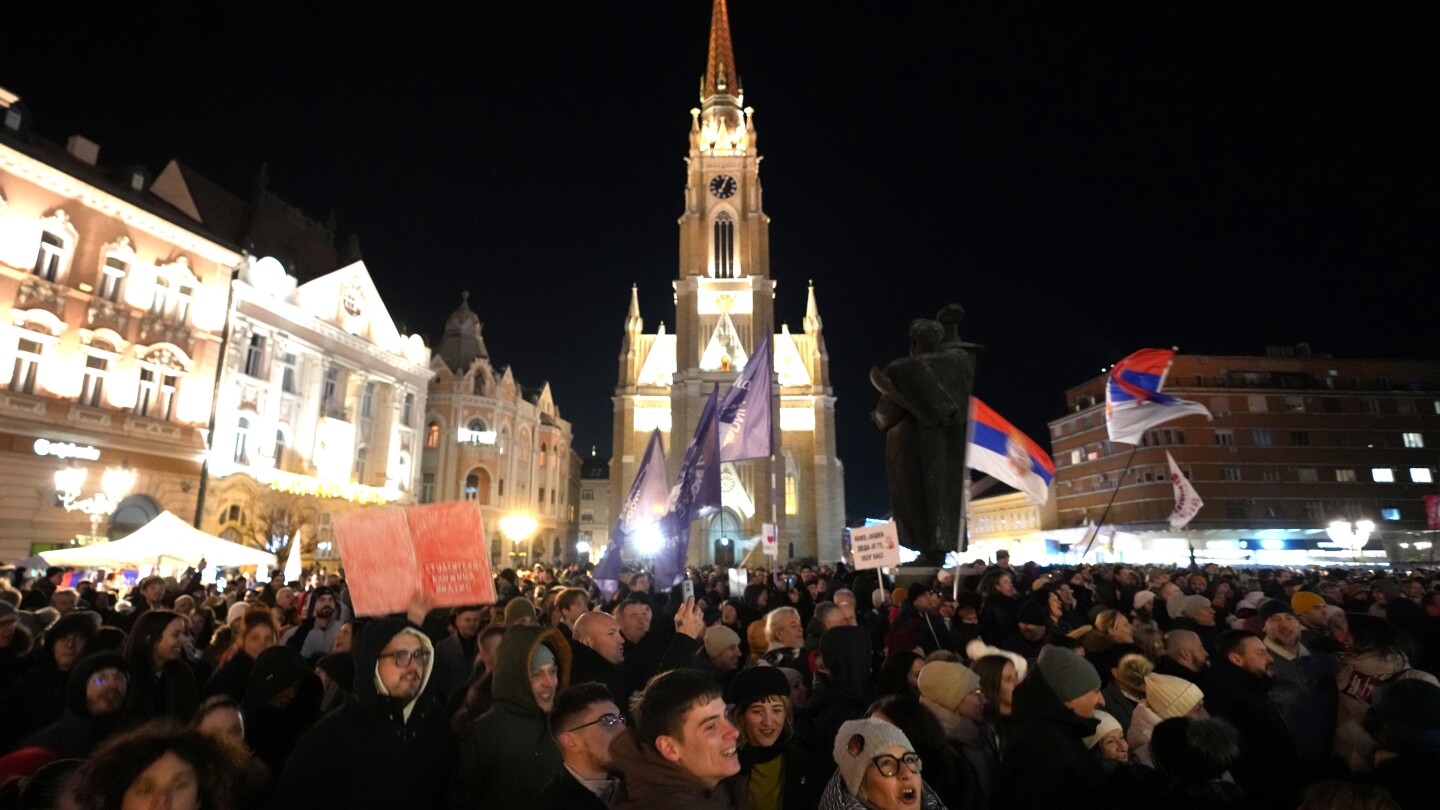
Thousands of protesters gathered in Novi Sad, Serbia on Saturday as university students announced a new phase in their protracted struggle against President Aleksandar Vucic’s government. The demonstration marks more than a year of sustained civil unrest that has significantly challenged the president’s decade-long grip on power in the Balkan nation.
In the northern city of Novi Sad, demonstrators filled the streets chanting “thieves” while condemning what they describe as endemic corruption within Vucic’s administration. Protesters specifically linked this corruption to a devastating train station disaster in November 2024 that claimed 16 lives and catalyzed the nationwide movement for political change.
Despite mounting pressure, President Vucic has steadfastly refused the students’ central demand for immediate early elections. The standoff has led to serious concerns about civil liberties, with reports that hundreds of government critics have been detained by authorities. Many protesters have reportedly lost their jobs or faced intimidation tactics for their participation in the anti-government movement.
Saturday’s rally, themed “What victory will mean,” saw student organizers unveiling a concrete roadmap for political reform. Their vision for a post-Vucic Serbia includes imposing lifetime bans on corrupt officials from holding public office and launching thorough investigations into suspicious accumulation of wealth by government figures.
“We’re no longer just protesting—we’re planning for Serbia’s future,” said one student leader addressing the crowd. “Corruption hasn’t just damaged our economy; it has cost Serbian lives.”
The student movement has gained significant traction in recent months, with organizers claiming they’ve collected approximately 400,000 signatures supporting their call for early elections. This represents a substantial portion of Serbia’s electorate, signaling growing discontent with Vucic’s leadership across demographic groups.
Political analysts note that the movement’s strength lies in its appeal to Serbians disillusioned with the established political class. Unlike previous opposition movements, the student-led protests have managed to maintain momentum and expand beyond urban centers.
“These aren’t just routine demonstrations. The student movement has tapped into genuine frustration across Serbian society,” explained Milan Jovanovic, a political science professor at Belgrade University. “Their non-partisan approach has attracted support from people who wouldn’t typically join political protests.”
Vucic, who rose to power in 2012 promising European integration, has increasingly pivoted Serbia toward Russia and China in recent years. His administration faces accusations from international watchdogs of democratic backsliding, including restrictions on media freedom and judiciary independence. The president has dismissed these criticisms while characterizing the student protesters as puppets of Western powers.
“The president’s claims that we’re foreign agents working to ‘destroy Serbia’ show just how disconnected he is from reality,” a student organizer told the crowd. “We are Serbians fighting for Serbia’s future.”
The movement announced their next major demonstration will take place on January 27 in Belgrade, the country’s capital, where they expect to draw even larger crowds.
Serbia’s political instability comes at a critical juncture for the Balkan region, which continues to navigate complex relationships with both the European Union and Russia. The country, once considered a frontrunner for EU accession, has seen its progress stall amid concerns about democratic standards and rule of law.
International observers are closely monitoring developments, with EU officials repeatedly expressing concern about Serbia’s democratic trajectory. Meanwhile, Russia has strengthened its economic and cultural ties with the country, particularly in the energy sector.
As protesters dispersed in Novi Sad, many expressed determination to continue their struggle despite government pressure. “This isn’t just about removing one man from power,” said a 22-year-old student participant. “It’s about rebuilding Serbia’s institutions and creating a country where corruption isn’t the norm.”
Fact Checker
Verify the accuracy of this article using The Disinformation Commission analysis and real-time sources.

16 Comments
The students’ commitment to continuing their fight for change is admirable. But the president’s refusal to call early elections is concerning. Clearly there is a serious breakdown of trust between the people and the government.
Indeed. Denying legitimate democratic demands often backfires and escalates tensions. The president should reconsider his stance before things spiral further out of control.
This protest movement appears to have significant momentum behind it. The government’s intransigence is only fueling the flames of discontent. I hope both sides can find a way to de-escalate the situation through dialogue and compromise.
It’s heartening to see citizens taking to the streets to demand change, even in the face of repressive tactics. The government’s refusal to call early elections is concerning, as it suggests a troubling lack of democratic responsiveness. I hope the protesters can sustain their momentum and push for meaningful reforms.
Absolutely. The government’s resistance to the protesters’ central demand is a worrying sign. Early elections could provide a peaceful outlet for the public’s frustrations and a chance to reset the political landscape.
Sustained civil unrest over corruption is never a good sign. I hope the Serbian authorities recognize the gravity of the situation and engage in meaningful dialogue with the protesters rather than resorting to repressive measures.
Corruption is a major problem across the Balkans, so it’s not surprising to see widespread protests in Serbia. The train disaster seems to have been the catalyst, but the roots of this unrest run deep. I wonder what specific reforms the students are calling for.
Good point. Transparency and accountability in public institutions are crucial. The government would be wise to work with the protesters to enact meaningful anti-corruption measures.
This is a complex and high-stakes situation. The protesters have a legitimate grievance, but the government’s intransigence is understandable to a degree given the potential for instability. Both sides need to find a way to find common ground and move forward.
Corruption is a scourge that undermines public trust and institutions. I applaud the Serbian students for taking a stand and demanding accountability from their leaders. However, the government’s heavy-handed response is concerning and risks further polarization.
Agreed. The government would be better served by engaging constructively with the protesters rather than trying to suppress them. Meaningful reform is the only way to address the underlying issues here.
Corruption is a scourge that undermines public trust and institutions. I applaud the Serbian students for taking a stand and demanding accountability from their leaders. However, the government’s heavy-handed response is concerning and risks further polarization.
This is a concerning situation in Serbia. Grassroots protests against corruption are often a sign of deeper systemic issues. I hope the government engages constructively with the student demands rather than resorting to heavy-handed tactics.
Agreed. Cracking down on dissent rarely solves the underlying problems. The government should listen to the legitimate grievances of its citizens.
The allegations of job losses and intimidation tactics against protesters are deeply troubling. The government should respect the rights of its citizens to peacefully assemble and advocate for reform. Cracking down on dissent is not the answer here.
Absolutely. Silencing critics and punishing protesters will only exacerbate the crisis. The president would be better off listening to the grievances and working to address the root causes of the unrest.