


Listen to the article
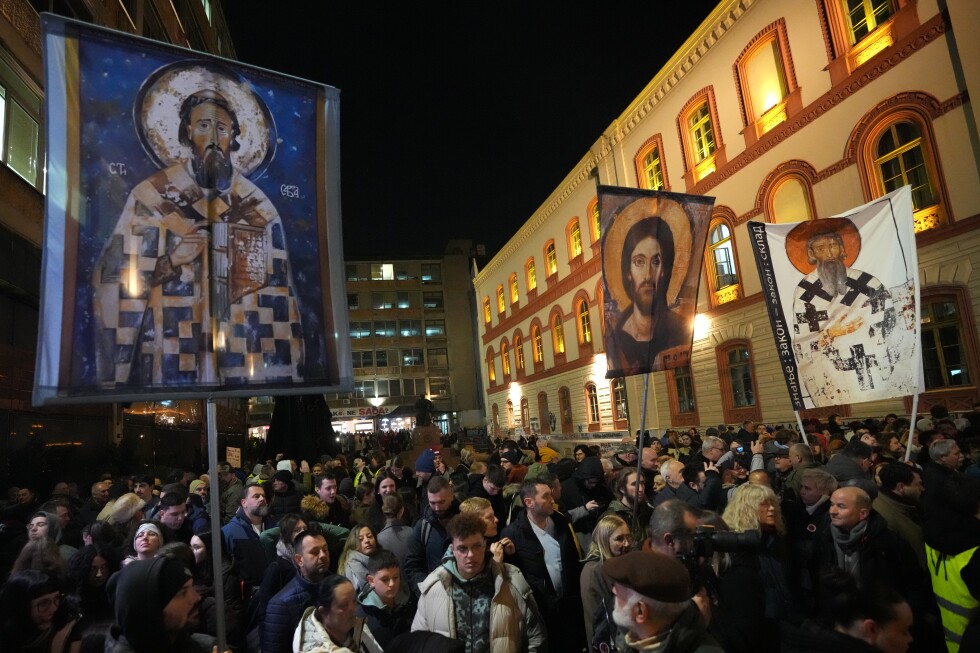
Thousands of academics and students rallied in Belgrade on Tuesday to protest what they describe as a government crackdown on universities, which have emerged as a focal point of anti-government sentiment in Serbia in recent months.
The demonstration, held under the banner “Knowledge is power,” saw protesters gather outside the University of Belgrade headquarters on the national day of education. The peaceful rally was organized in solidarity with dozens of professors and teachers who claim they have lost their positions for participating in ongoing anti-government protests.
“No government in our history has treated members of the academic community with such arrogance, vengeance and malice and only because the academic community refused to be silent,” said Vladan Djokic, the head dean of the University of Belgrade, addressing the crowd.
The current wave of protests began following a tragic incident in November 2024, when a concrete railway station canopy collapsed in the northern city of Novi Sad, killing 16 people. Many Serbians blamed the disaster on alleged corruption and disregard for safety regulations during renovation work.
What began as outrage over a specific incident has evolved into the most significant and sustained protest movement Serbia has witnessed in years, with hundreds of thousands taking to the streets across the country. Protesters have demanded that President Aleksandar Vucic call early elections, a request he has consistently refused while reportedly intensifying pressure on demonstrators.
The Belgrade rally came in the wake of a controversial police action in Novi Sad, where riot police forcibly removed protesting students from a faculty building. The operation, which some students characterized as violent, has been widely interpreted as a show of force intended to discourage further university strikes.
During Tuesday’s demonstration, Djokic highlighted the various forms of pressure being exerted on universities, including financial restrictions and legal challenges. He noted that government officials and pro-government media frequently label protesting professors and students as “terrorists,” creating a hostile environment for academic dissent.
“We must resist the pressure and preserve the dignity of our profession through personal example,” Djokic urged his colleagues.
In a symbolic gesture of solidarity with the protest movement, several faculties in Belgrade suspended classes for the day.
The tensions between Serbia’s academic community and the government reflect broader concerns about the state of democracy in the country. While Serbia is formally pursuing membership in the European Union, President Vucic has simultaneously strengthened ties with Russia and China. This dual approach has raised questions about the country’s true geopolitical orientation and commitment to democratic values.
International observers have expressed concern over reports of excessive force and arbitrary detentions of protesters. Human rights organizations have documented numerous instances of police overreach during demonstrations, adding to worries about Serbia’s democratic backsliding under Vucic’s leadership.
The university protests represent a significant challenge to Vucic’s decade-long grip on power. Academic institutions have historically played important roles in democratic movements worldwide, often serving as incubators for opposition to authoritarian regimes. In Serbia, universities appear to be assuming this traditional role as centers of resistance.
As the standoff between the academic community and the government continues, many observers are watching closely to see whether the protests will maintain momentum or whether government pressure will eventually succeed in suppressing this wave of dissent.
The conflict underscores the increasingly polarized nature of Serbian society, with universities emerging as a key battleground in the struggle between those seeking greater democratization and a government determined to maintain its control over the country’s institutions.
Fact Checker
Verify the accuracy of this article using The Disinformation Commission analysis and real-time sources.

8 Comments
I’m curious to learn more about the specific issues and allegations that have fueled these protests. It seems there are complex social and political dynamics at play beyond just the immediate trigger of the infrastructure failure.
Agreed, the roots of the unrest likely run deeper than a single tragic incident. Understanding the broader context of public grievances will be key to finding a constructive resolution.
This is a concerning development for academic freedom in Serbia. Cracking down on professors and teachers for participating in protests seems like a worrying assault on freedom of expression and the independence of universities.
I agree, the university community should not face retaliation for voicing dissent. Academic institutions must remain independent and able to critically examine government policies.
This situation highlights the delicate balance between maintaining public order and upholding democratic freedoms. The government must find a way to address the protesters’ concerns without resorting to heavy-handed tactics that undermine academic independence.
The government’s crackdown on professors and teachers participating in the protests is worrying. Academic institutions should be havens of free expression, not targets of political retaliation.
The protests appear to stem from broader public anger over issues like safety failures and alleged corruption. The government’s heavy-handed response to student-led demonstrations is unlikely to ease tensions.
You raise a good point. The original protests were sparked by a tragic incident, and the government’s crackdown on academic institutions seems to be further escalating the situation.