


Listen to the article
Thousands of Slovakians took to the streets Tuesday in coordinated protests across the country, voicing their opposition to Prime Minister Robert Fico’s latest controversial legislative moves that critics say undermine anti-corruption efforts and the rule of law.
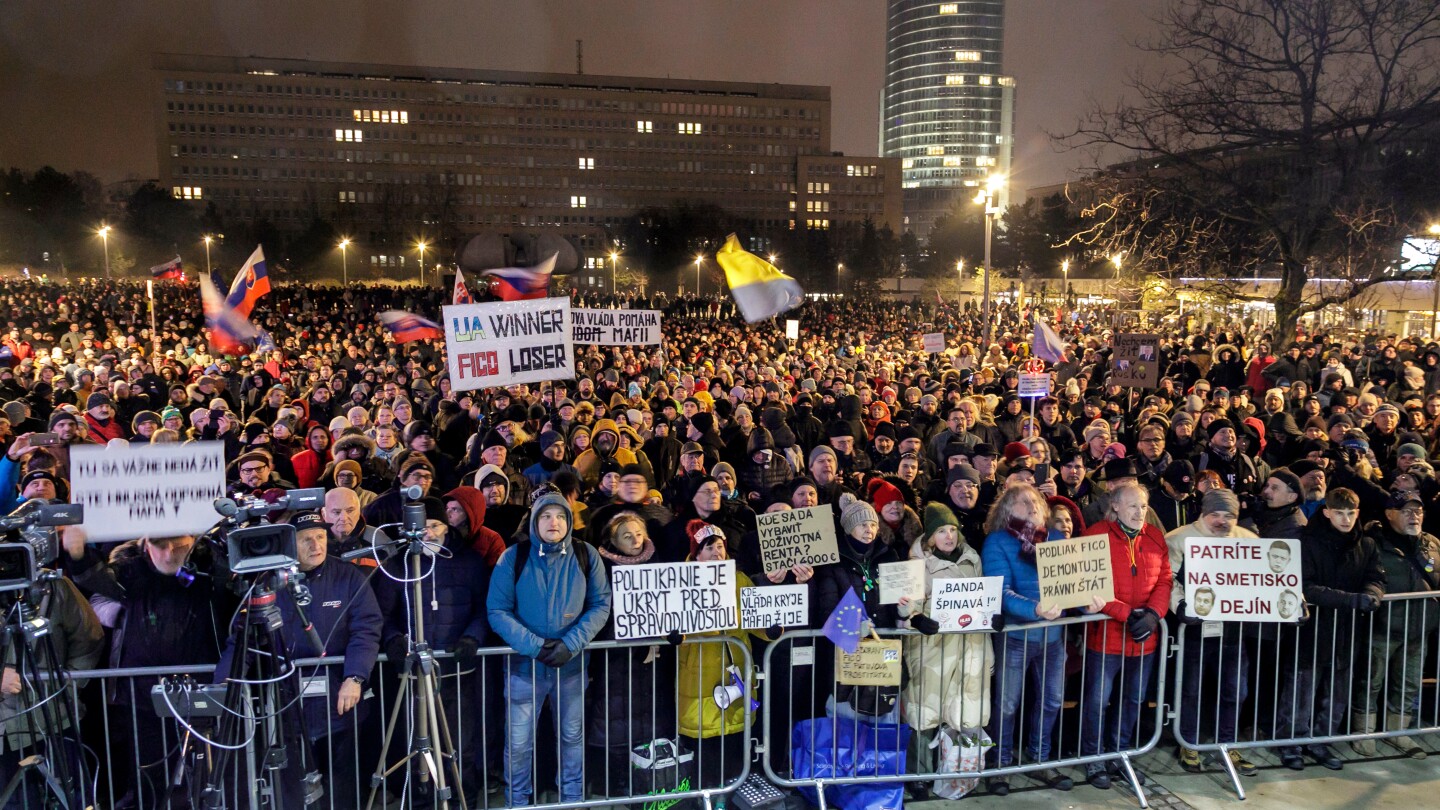
The demonstrations, which spread across 10 communities including the capital Bratislava, saw protesters gather at Freedom Square with a clear message for the populist leader: “Resign, resign.” The rallies mark another chapter in the ongoing political tensions that have defined Fico’s divisive leadership.
At the heart of the protests is the parliament’s recent decision to abolish the country’s Whistleblower Protection Office, an independent body established to safeguard those who report corruption and other criminal activities. The move has sparked widespread condemnation both domestically and internationally, with critics viewing it as part of a broader pattern of democratic backsliding.
Adding fuel to public outrage, lawmakers also approved amendments to the penal code that would prohibit the use of evidence obtained from suspects who cooperated with law enforcement in exchange for reduced sentences. Under the new rules, such evidence would be inadmissible if the suspects were found to have provided false information in any other case.
“Slovakia is the only country where the government approves laws to make life easier for criminals and mafia,” Michal Šimečka, leader of the Progressive Slovakia opposition party that organized the protest, told the crowd in Bratislava. His statement was met with chants of “Shame, shame” from the assembled demonstrators, many of whom held banners reading “Fico’s government helps mafia.”
Opposition parties have alleged that these legislative changes were specifically designed to benefit Tibor Gašpar, the deputy speaker of Parliament and a close Fico ally, who faces trial on charges of establishing a criminal group. The timing and nature of the amendments have raised serious concerns about political interference in the judicial process.
Protesters are now calling on President Peter Pellegrini, typically aligned with Fico’s government, to veto the controversial legislation. While the president must sign the bills for them to become law, Fico’s coalition government holds enough seats in parliament to potentially override any presidential veto.
This latest wave of protests reflects growing concerns that Slovakia, under Fico’s leadership, is following a path similar to neighboring Hungary under Viktor Orbán, where democratic institutions have been significantly weakened over the past decade. In a notable development, László Gubík, who heads the Hungarian Alliance party representing Slovakia’s 450,000-strong Hungarian minority, joined the anti-government protests for the first time, signaling broadening opposition to Fico’s policies.
Fico, who returned to power in October 2023 after previously serving as prime minister from 2006 to 2010 and 2012 to 2018, has increasingly embraced pro-Russian positions and nationalist rhetoric. His government has faced regular protests over its foreign policy orientation, approach to media freedoms, and now its judicial reforms.
The dismantling of anti-corruption mechanisms comes at a particularly sensitive time for Slovakia, a nation of 5.4 million that has struggled with corruption issues since its independence in 1993. The 2018 murder of investigative journalist Ján Kuciak and his fiancée sparked the largest protests in the country’s modern history and ultimately led to Fico’s resignation during his previous term.
International organizations, including the European Commission, have expressed concern about the trajectory of Slovakia’s democracy under Fico’s current government, particularly regarding judicial independence and anti-corruption frameworks. The country risks joining Hungary and Poland as EU member states subject to Article 7 proceedings for alleged violations of core EU values.
As night fell over Bratislava, protesters remained determined in their stance against what they perceive as a systematic dismantling of democratic safeguards, vowing to continue their resistance to Fico’s controversial reforms.
Fact Checker
Verify the accuracy of this article using The Disinformation Commission analysis and real-time sources.

11 Comments
The proposed changes to the penal code and the closure of the Whistleblower Protection Office are extremely problematic. They appear to undermine the fight against corruption and erode important safeguards for transparency and accountability.
You’re right, these measures run counter to the public interest and democratic values. The government must seriously reconsider this course of action and engage meaningfully with citizens’ concerns.
Concerning developments in Slovakia. Dismantling anti-corruption efforts and weakening whistleblower protections is very troubling for democracy. Authorities must respect the rule of law and listen to the people’s justified concerns.
I agree, these legislative changes seem to undermine core democratic principles. Peaceful protests are an important way for citizens to voice their opposition to such actions.
While I understand the government’s desire for legislative changes, closing the Whistleblower Protection Office and restricting use of evidence obtained through cooperation raises serious red flags. Safeguarding whistleblowers is crucial for combating corruption.
I share your concerns. Protecting whistleblowers and ensuring the integrity of the justice system should be top priorities for any democracy. The public’s reaction shows these issues cannot be ignored.
These protests highlight the public’s deep worries about the state of democracy in Slovakia. Weakening anti-corruption mechanisms and whistleblower protections is a concerning trend that warrants close international scrutiny.
I agree, the international community should closely monitor these developments and press the Slovak government to uphold democratic principles and the rule of law. Citizen protests are a crucial check on state power.
Thousands of Slovaks taking to the streets in protest is a clear sign that the public sees these legislative changes as a threat to anti-corruption efforts and the rule of law. The government should listen to the people’s voices and address these issues responsibly.
The protests across Slovakia highlight the public’s strong commitment to fighting corruption and upholding transparency. The government should carefully reconsider these controversial measures that appear to erode critical anti-graft safeguards.
You’re right, the public backlash is a clear sign that these new laws are not aligned with the people’s values and priorities. The government must address these concerns constructively.