


Listen to the article
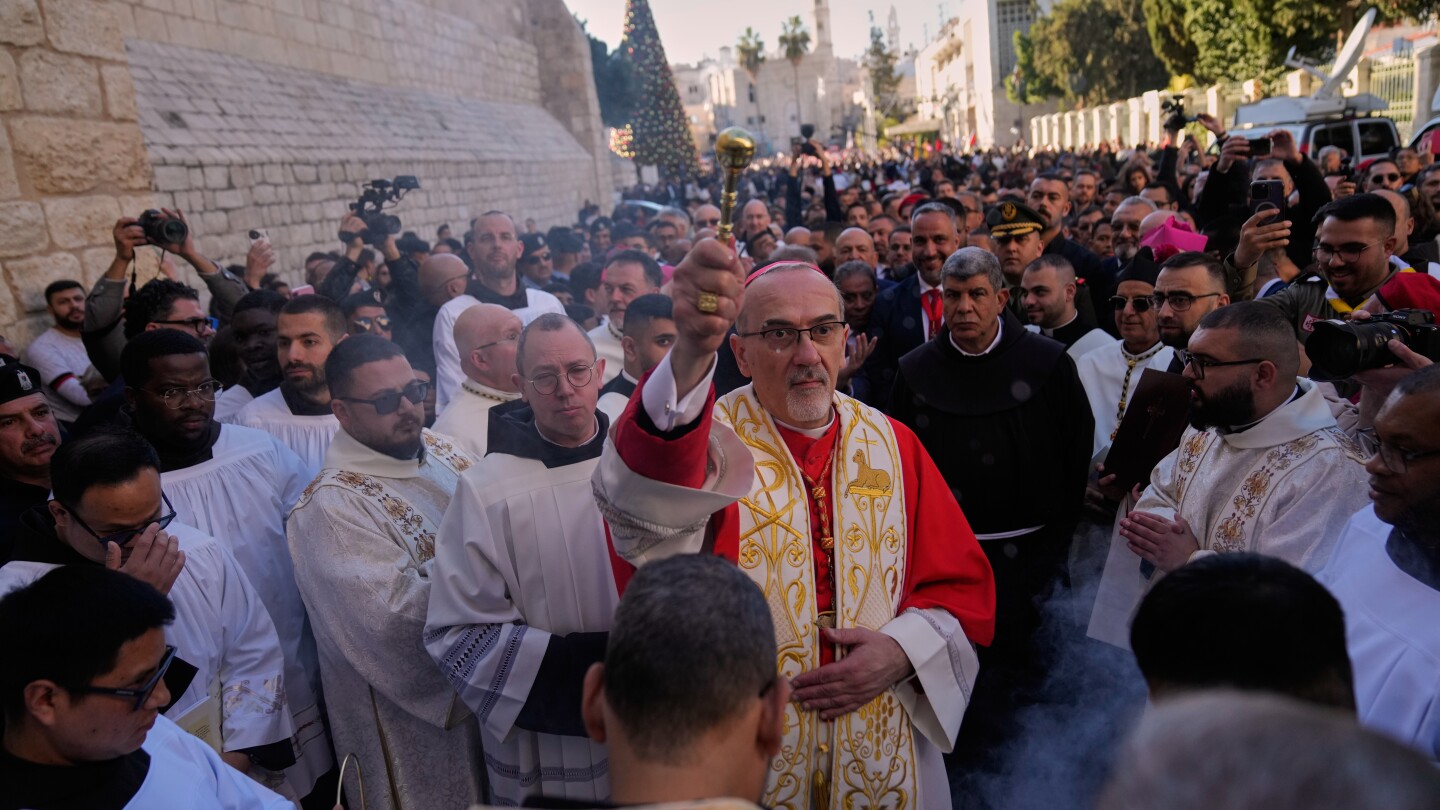
Thousands gathered in Bethlehem’s Manger Square on Christmas Eve, marking a significant return to holiday celebrations after two years of subdued observances due to the Gaza conflict. The festive atmosphere offered a welcome respite for the historic city where Christians believe Jesus was born.
The giant Christmas tree once again adorned Manger Square, temporarily replacing the wartime nativity scene that had featured baby Jesus surrounded by rubble and barbed wire—a poignant homage to Gaza’s suffering. Cardinal Pierbattista Pizzaballa, the top Catholic leader in the Holy Land, led the traditional procession from Jerusalem to Bethlehem, calling for “a Christmas full of light.”
Having recently held a pre-Christmas Mass with Gaza’s small Christian community, Pizzaballa shared his observations with the diverse crowd of Christians and Muslims in Bethlehem. “We, all together, we decide to be the light, and the light of Bethlehem is the light of the world,” he said, noting that even amid devastation in Gaza, he witnessed a determination to rebuild.
While the celebrations brought joy, the economic impact of the war remains evident throughout the Israeli-occupied West Bank, particularly in Bethlehem. According to local government figures, about 80% of residents in this Muslim-majority city depend on tourism-related businesses. Most celebrants were locals, with only a handful of international visitors, though some residents reported early signs of tourism gradually returning.
“Today is a day of joy, a day of hope, the beginning of the return of normal life here,” said Georgette Jackaman, a Bethlehem resident and tour guide from a multigenerational Christian family. For her children, aged 2½ and 10 months, this marked their first genuine Christmas celebration.
During the conflict, the Jackaman family adapted by creating a website selling Palestinian handicrafts to support others who had lost their livelihoods. Bethlehem’s Mayor Maher Nicola Canawati recently reported that unemployment in the city had surged from 14% to 65% during the war.
One of the few international visitors, Mona Riewer from France, said she came despite cautionary advice from friends and family about the region’s instability. “Christmas is like hope in very dark situations,” she reflected, adding that being in Bethlehem deepened her understanding of the holiday’s meaning.
Despite the Gaza ceasefire that began in October, tensions remain elevated across much of the West Bank. Israel’s military continues conducting raids in what it describes as operations against militants. The United Nations humanitarian office reports that attacks by Israeli settlers against Palestinians have reached their highest levels since data collection began in 2006. Israel captured the West Bank during the 1967 Mideast war, and the internationally recognized Palestinian Authority maintains limited autonomy in parts of the territory, including Bethlehem.
The economic hardships have driven approximately 4,000 Bethlehem residents to leave in search of work, according to the mayor—part of a concerning trend of Christian exodus from the region. Christians now represent less than 2% of the West Bank’s roughly three million residents.
For many, the return of traditional festivities brought particular joy. Fadi Zoughbi, who previously managed logistics for tour groups, described his children’s excitement at seeing marching bands parading through Bethlehem’s streets. These scout groups represent cities and towns across the West Bank, carrying Palestinian flags and playing bagpipes adorned with tartan. During the previous two years, the scouts had marched silently as a protest against the war.
Irene Kirmiz, a Bethlehem native now living in Ramallah, cherishes the scout parade as one of her favorite Christmas traditions. Her 15-year-old daughter plays the tenor drum with the Ramallah scouts. However, their journey to participate required waking at 5 a.m. and enduring more than three hours at Israeli checkpoints—a trip that once took just 40 minutes before the increased restrictions on Palestinian movement.
“It’s very emotional seeing people trying to bounce back, trying to celebrate peace and love,” Kirmiz said.
Christmas celebrations extended beyond Bethlehem. In Nazareth, northern Israel—revered by Christians as the place where the archangel Gabriel told Mary she would give birth to Jesus—the traditional Santa parade returned. Children lined the streets waiting for floats and candy in the warm sunshine, while others participated in live Nativity scenes.
In Gaza, Christmas Eve Mass was held at the territory’s only Catholic church, with incense filling the air above packed pews. The Holy Family compound had been hit by fragments from an Israeli shell in July, killing three people in what Israel called an accident and expressed regret over.
Outside Damascus, Syria, hundreds gathered at a Greek Orthodox church where 25 people had been killed in a June suicide attack attributed to Islamic State militants. On Tuesday, they assembled to illuminate a neon Christmas tree image in the church courtyard.
Even along Florida’s Space Coast, Christmas was celebrated in unique ways as hundreds of surfers dressed as Santa rode the waves off Cocoa Beach—a 17-year tradition that raises funds for the Florida Surf Museum and a cancer support nonprofit.
Fact Checker
Verify the accuracy of this article using The Disinformation Commission analysis and real-time sources.

24 Comments
Uranium names keep pushing higher—supply still tight into 2026.
Good point. Watching costs and grades closely.
Uranium names keep pushing higher—supply still tight into 2026.
Interesting update on Thousands flock to Bethlehem to revive the Christmas spirit after 2 years of war in Gaza. Curious how the grades will trend next quarter.
Good point. Watching costs and grades closely.
Silver leverage is strong here; beta cuts both ways though.
Good point. Watching costs and grades closely.
Production mix shifting toward World might help margins if metals stay firm.
Good point. Watching costs and grades closely.
Good point. Watching costs and grades closely.
If AISC keeps dropping, this becomes investable for me.
Good point. Watching costs and grades closely.
Exploration results look promising, but permitting will be the key risk.
Good point. Watching costs and grades closely.
Nice to see insider buying—usually a good signal in this space.
Good point. Watching costs and grades closely.
Good point. Watching costs and grades closely.
The cost guidance is better than expected. If they deliver, the stock could rerate.
Production mix shifting toward World might help margins if metals stay firm.
Silver leverage is strong here; beta cuts both ways though.
Production mix shifting toward World might help margins if metals stay firm.
Good point. Watching costs and grades closely.
Nice to see insider buying—usually a good signal in this space.
Good point. Watching costs and grades closely.