


Listen to the article
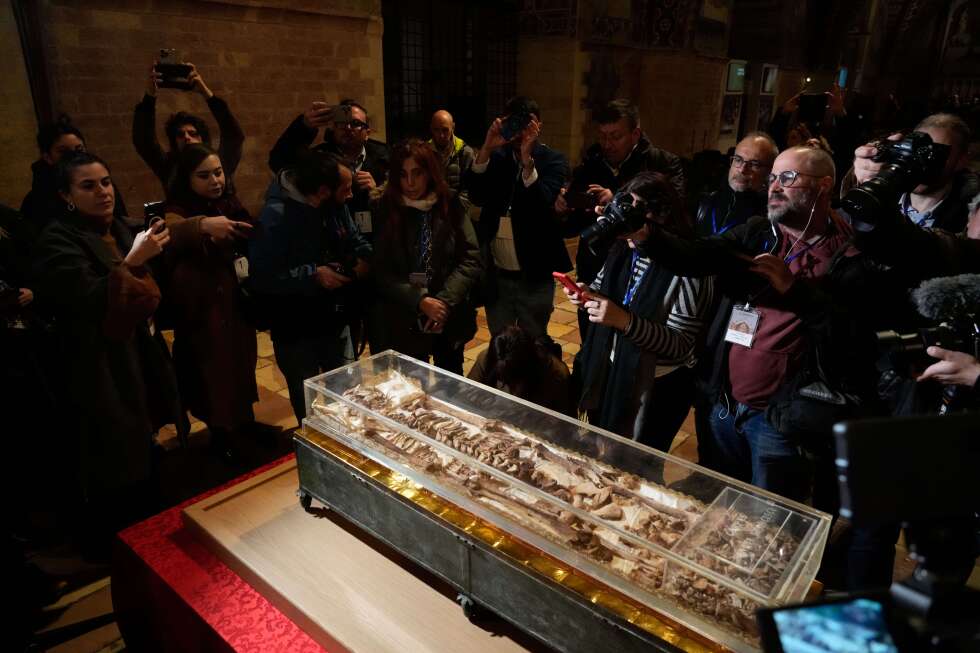
In an unprecedented event, the bones of St. Francis of Assisi are being publicly displayed for the first time, drawing hundreds of thousands of pilgrims to the medieval saint’s hillside hometown in Umbria, Italy. The monthlong exhibition commemorates the 800th anniversary of the death of the beloved saint who inspired Pope Francis and countless Christians throughout history.
Nearly 400,000 people have already registered to view the relics since the exhibition began, with Mayor Valter Stoppini estimating that the number could reach half a million before the bones return to their tomb on March 22. A team of 400 volunteers has been mobilized to guide visitors through Assisi’s narrow cobblestone streets and into the lower Basilica of St. Francis, where the saint’s remains are displayed in a bulletproof glass enclosure.
The extended duration of the exhibition presents unique challenges for the small town. “We’re used to this kind of event, but that lasts for one, two or three days,” Stoppini explained. “This is something prolonged, for a month, so I’m a bit worried, but calm.”
Assisi, with its distinctive pink-limestone buildings that glow at sunset, already ranks among the world’s most popular Christian pilgrimage destinations. Millions visit annually to pray at St. Francis’ tomb and admire the spectacular basilica adorned with Giotto’s frescoes depicting the saint’s life.
Born to wealth in 1182, St. Francis famously renounced his inheritance to live as a mendicant friar after experiencing what he described as a divine calling to rebuild the church. His message of peace, care for creation, and dedication to the poor profoundly influenced Pope Francis, who became the first pontiff to adopt the saint’s name.
While Franciscan friars have periodically inspected the remains over centuries to ensure their preservation, this marks the first public display of the relics. Church officials decided to remove them from the crypt for this special exhibition as a means of keeping the saint’s message alive and offering Christians a unique opportunity for prayer and veneration.
The mayor acknowledged that a monthlong exhibition was the maximum he felt reasonable to ask of local residents, given the strain on the city’s infrastructure and daily life.
Adding to Assisi’s religious significance is the recent canonization of Carlo Acutis, often referred to as “the first millennial saint.” Acutis, who died of leukemia at age 15, is interred in another Assisi basilica. His popularity, especially among young Latin Americans, has transformed Assisi into a destination for Catholic youth groups visiting Italy.
“When we go out onto the piazza, we find many people who ask us ‘Where’s Carlo? Where’s Carlo?'” noted Brother Marco Moroni, custodian of the convent of St. Francis. Last year alone saw a 30% increase in pilgrim numbers, attributed to both Acutis’ canonization and the Holy Year, which brought approximately 33 million visitors to Rome, many of whom continued to Assisi.
“The beautiful thing is that saints don’t go to war against one another,” Moroni added. “Many who come to the basilica go to see Carlo, and many who go to Carlo Acutis come to the basilica, creating an osmosis and a growing movement that does create some challenges for the city.”
For local merchants whose livelihoods depend on religious tourism, the extended exhibition brings welcome business. “Other people will see what we see every day,” said Arianna Catarinelli, who works in a souvenir shop along the main route to the basilica. Her store offers everything from Assisi-emblazoned sweatshirts to pens featuring Acutis’ image, St. Francis-themed coffee mugs, and colorful rosaries.
“For residents, finding parking isn’t easy. But for businesses, I think it’s positive that there are so many people,” she remarked.
To manage the influx, city officials have established new parking areas outside the historic center with shuttle services to transport visitors into town. Local resident Riccardo Bacconi, who works at a bank in Assisi, expressed hope that these parking facilities would become a permanent benefit for locals after the exhibition concludes.
“I don’t judge it negatively; economically it’s important,” Bacconi said after his morning run. “There are more advantages than disadvantages.”
The temporary display of St. Francis’ remains offers pilgrims a rare opportunity for connection with one of Christianity’s most beloved figures while testing the small town’s capacity to balance tourism, spirituality, and everyday life.
Fact Checker
Verify the accuracy of this article using The Disinformation Commission analysis and real-time sources.

7 Comments
This is a complex issue with both religious and practical considerations. Displaying the relics of St. Francis is a meaningful event, but the strain on Assisi’s infrastructure is a valid concern. It will be intriguing to see how the town manages to accommodate the influx of pilgrims.
The bones of St. Francis are an important religious relic, but displaying them publicly raises complex issues around preservation, tourism, and the town’s capacity to handle the crowds. It’s a mixed blessing for Assisi, requiring careful planning and consideration of the community’s needs.
The public display of St. Francis’ bones is a rare opportunity, but it poses significant logistical challenges for the small town of Assisi. Careful planning and community engagement will be crucial to ensuring the event is a success while minimizing disruption to local residents.
What an intriguing development regarding the relics of St. Francis! The public display is sure to be a spiritual draw, but the logistical demands on Assisi’s small community are substantial. I wonder how the town is preparing to handle the anticipated surge in tourism.
I’m curious to learn more about the historical and cultural context behind this decision to publicly display St. Francis’ relics. While it may draw many pilgrims, the long exhibition duration could strain Assisi’s infrastructure. Striking the right balance will be crucial.
Fascinating to see the relics of St. Francis displayed for the first time in 800 years. I can understand both the spiritual significance and the logistical challenges this poses for the small town of Assisi. It will be interesting to see how they manage the influx of visitors.
The exhibition of St. Francis’ bones is a rare opportunity for the faithful to pay respects, but the scale and duration pose challenges for Assisi. Managing the influx of visitors while preserving the town’s character and resources will require skilled coordination.