


Listen to the article
Thailand and Cambodia Sign Ceasefire to End Border Conflict
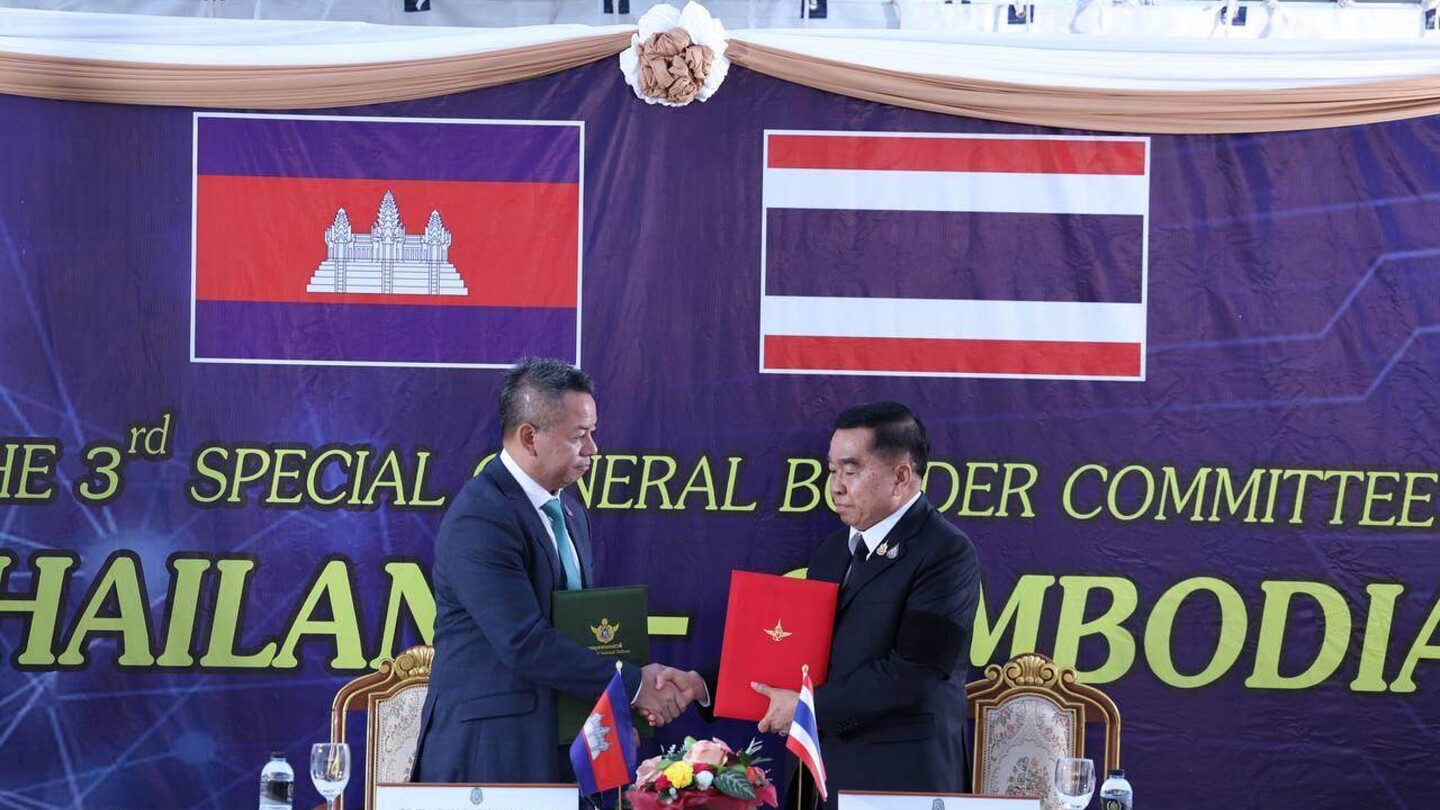
Thailand and Cambodia signed a ceasefire agreement Saturday to halt weeks of armed conflict over disputed territory along their shared border. The agreement, which took effect at noon local time, brings a formal pause to hostilities that have claimed dozens of lives and displaced hundreds of thousands of people.
The accord was signed by the countries’ defense ministers, Cambodia’s Tea Seiha and Thailand’s Nattaphon Narkphanit, at a border checkpoint following three days of military-level talks through the established General Border Committee.
According to the terms, both nations have agreed to cease all military movements and respect each other’s airspace. The agreement specifically prohibits airstrikes, which Thailand had deployed as recently as Saturday morning against targets in Cambodia, according to Cambodia’s defense ministry.
A key provision requires Thailand to repatriate 18 Cambodian soldiers captured during earlier fighting in July, once the ceasefire has held for 72 hours. The release of these prisoners has been a central demand from Cambodia throughout negotiations.
The deal reaffirms both sides’ commitment to an earlier ceasefire that temporarily halted five days of fighting in July. That initial agreement was brokered by Malaysia with significant diplomatic pressure from U.S. President Donald Trump, who threatened to withhold trade privileges unless the two Southeast Asian nations reached an accord. The July ceasefire was later formalized at a regional meeting in Malaysia attended by Trump.
Despite these previous arrangements, tensions remained high along the border. Propaganda campaigns continued from both sides, and sporadic violence persisted before escalating into widespread heavy combat in early December.
The human toll has been significant. Thailand reports losing 26 soldiers and one civilian directly from combat operations since December 7, with an additional 44 civilian deaths from collateral effects. Cambodia has not released official military casualty figures but reports 30 civilians killed and 90 injured. Both countries have evacuated hundreds of thousands of residents from affected border areas.
Each nation has consistently blamed the other for initiating the conflict, with both claiming to be acting in self-defense.
The new agreement addresses several contentious issues beyond the immediate cessation of hostilities. It includes provisions requiring both sides to adhere to international agreements against landmine deployment—a major concern for Thailand, which has reported at least nine incidents this year where soldiers were wounded by what they claim were newly planted Cambodian mines. Cambodia maintains these are remnants from decades of civil war that ended in the late 1990s.
The accord also contains a clause prohibiting the “dissemination of false information or fake news,” addressing the propaganda battle that has accompanied the physical conflict.
Furthermore, the agreement recommits both nations to previously established border demarcation procedures and enhances cooperation on suppressing transnational crimes. This latter point is particularly significant as Cambodia has become known as a center for online scam operations that have defrauded victims worldwide of billions of dollars annually.
This ceasefire represents the most comprehensive attempt yet to resolve the border dispute that has periodically flared into violence between the neighboring countries. Regional observers remain cautious about its long-term prospects, given the history of broken agreements, but diplomatic sources express hope that the detailed nature of this accord and international pressure will lead to a more sustainable peace.
The effectiveness of the agreement will likely depend on both governments’ ability to control military forces along the disputed border areas and their willingness to engage in good-faith negotiations on the underlying territorial claims that have fueled the conflict.
Fact Checker
Verify the accuracy of this article using The Disinformation Commission analysis and real-time sources.

8 Comments
This conflict has gone on for too long, with too many lives lost. A ceasefire is a good start, but I hope the leaders of Thailand and Cambodia can now work towards a more comprehensive and lasting peace agreement.
Absolutely. Resolving border disputes through diplomacy rather than force should be the priority here.
This ceasefire agreement is a positive step, but the long-term stability of the border region will depend on the willingness of Thailand and Cambodia to address the root causes of the conflict. I hope the negotiations can lead to a more durable peace.
Agreed. Maintaining the ceasefire and building trust between the two sides will be critical to achieving a lasting resolution.
While a ceasefire is welcome news, the real test will be whether the two sides can maintain it and make progress on the underlying issues. Dealing with territorial disputes is never easy, but I hope both countries can find a mutually acceptable solution.
It’s good to see Thailand and Cambodia taking steps to resolve their border disputes peacefully. Ceasefires are an important first step, but real progress will require both sides to negotiate in good faith and address the underlying issues.
Agreed. The release of captured soldiers is a positive sign, but the ceasefire will need to hold for some time to build trust between the two countries.
It’s encouraging to see Thailand and Cambodia take this first step towards ending their border conflict. However, the true test will be whether they can translate this ceasefire into a more comprehensive and sustainable peace agreement. I hope the negotiations continue in good faith.