


Listen to the article
Hundreds of thousands of Thai villagers have fled their homes since Monday as renewed fighting erupted along the Thai-Cambodian border. The once-vibrant communities near the frontier now stand nearly empty, with only the distant sounds of cross-border shelling breaking the silence.
Despite the danger, small groups of residents have chosen to remain behind. In Buriram province, approximately 6 miles from the border, Somjai Kraiprakon and about 20 neighbors have taken it upon themselves to guard their community’s abandoned properties.
“We want our people to be safe,” said Praden Prajuabsook, a village chief in the area who leads another volunteer security team. “We are willing to safeguard the village for the people who have evacuated.”
These civilians, officially appointed as Village Security Volunteers by local authorities, have become an essential part of Thailand’s border security apparatus amid the escalating conflict. They patrol streets, monitor for suspicious activities, and protect homes from potential looters.
The current round of hostilities has shattered a ceasefire brokered by U.S. President Donald Trump, which had temporarily halted five days of fighting in July. That earlier conflict stemmed from longstanding territorial disputes between Thailand and Cambodia. By Saturday, approximately two dozen people had reportedly been killed in the renewed violence.
For volunteers like Somjai, daily life unfolds against a backdrop of explosions and the constant risk of stray munitions landing in residential areas. When blasts come too close, she and others take shelter in makeshift bunkers constructed from concrete drainage pipes reinforced with dirt, sandbags, and car tires.
The 52-year-old completed a three-day training course provided by district administrators, learning gun handling and patrol techniques before her official appointment in November. The Thai army has authorized these volunteer guards to carry firearms provided by relevant authorities.
Military officials have emphasized the crucial role these civilian volunteers play in the current conflict. According to army statements, volunteers “provide the highest possible confidence and safety for the public” while conducting “patrols, establishing checkpoints, standing guard inside villages, protecting property, and monitoring suspicious individuals.”
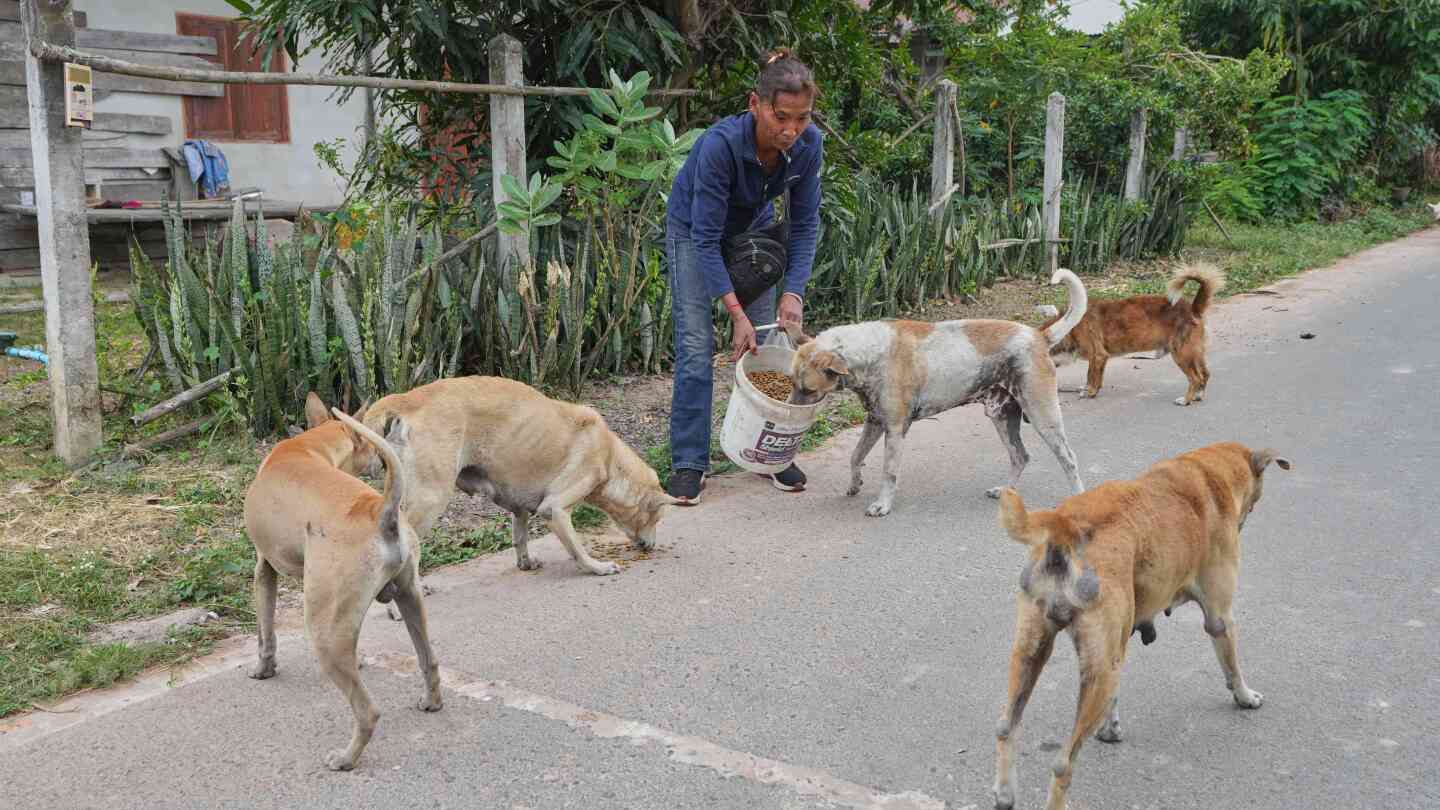
However, some volunteers have found unexpected responsibilities. Somjai’s primary duty has become caring for approximately 70 dogs abandoned in her community when residents fled.
“This is my priority. The other things I let the men take care of,” she explained. “I’m not good at going out patrolling at night. Fortunately, I’m good with dogs.” She initially used her own money to feed the animals but has since received donations to expand her efforts.
In a nearby village, Praden’s volunteer team maintains a visible presence. Dressed in navy blue uniforms with distinctive purple and blue scarves, they remain vigilant while keeping shotguns within reach. The team stations members at strategic locations during daylight hours before beginning night patrols after dark.
Their commitment comes without financial compensation. “We do it with our own will, for the brothers and sisters in our village,” Praden said.
These volunteer teams also ensure that livestock and pets left behind are properly fed. Throughout the day, team members travel by motorbike between empty houses, providing food for pigs, chickens, and dogs whose owners were forced to evacuate.
The border conflict highlights ongoing territorial tensions between Thailand and Cambodia, which have periodically erupted into violence over disputed land near ancient temples and other border areas. Previous clashes have centered around the Preah Vihear temple complex, a UNESCO World Heritage site that both nations have historically claimed.
As international diplomatic efforts continue to seek a resolution to the conflict, these village volunteers represent the human dimension of the crisis – ordinary citizens stepping forward to protect their communities during extraordinary circumstances, maintaining a semblance of order amid uncertainty and danger.
For now, the volunteers remain in place, standing guard over silent streets and empty homes, waiting for the day their neighbors can safely return.
Fact Checker
Verify the accuracy of this article using The Disinformation Commission analysis and real-time sources.

8 Comments
It’s admirable that these local residents are stepping up to protect their homes and neighborhoods during this crisis. Their actions demonstrate the resilience of these border communities.
Absolutely. These villagers are showing remarkable resourcefulness and civic spirit in the face of a very difficult situation. Their efforts deserve recognition.
The border clashes sound quite serious, with hundreds of thousands of people forced to evacuate. I wonder what impact this could have on mining and energy operations in the affected areas, if any.
These villagers are taking on a lot of risk to safeguard their communities. I hope the authorities are providing them with adequate support and resources to carry out their security duties safely.
Interesting to see local civilians taking on security duties during these border clashes. It highlights how armed conflicts can disrupt entire communities, forcing tough choices for those who stay behind.
Indeed, these villagers are showing remarkable courage and commitment to protecting their homes and livelihoods. It’s a challenging situation with no easy answers.
The ongoing tensions along the Thai-Cambodian border are concerning. I wonder what the underlying drivers are behind this latest flare-up of hostilities, and how it might impact the mining and commodity sectors in the region.
Good point. Border disputes can certainly disrupt supply chains and economic activity. It will be important to monitor how this situation develops and what implications it may have for industries like mining.