


Listen to the article
Japanese Prime Minister Takaichi Eyes Stronger US Ties Ahead of Trump Meeting
Japanese Prime Minister Sanae Takaichi is setting her sights on strengthening Japan’s relationship with the United States, particularly in economic security and rare earths development, as she prepares for a crucial meeting with President Donald Trump next month in Washington.
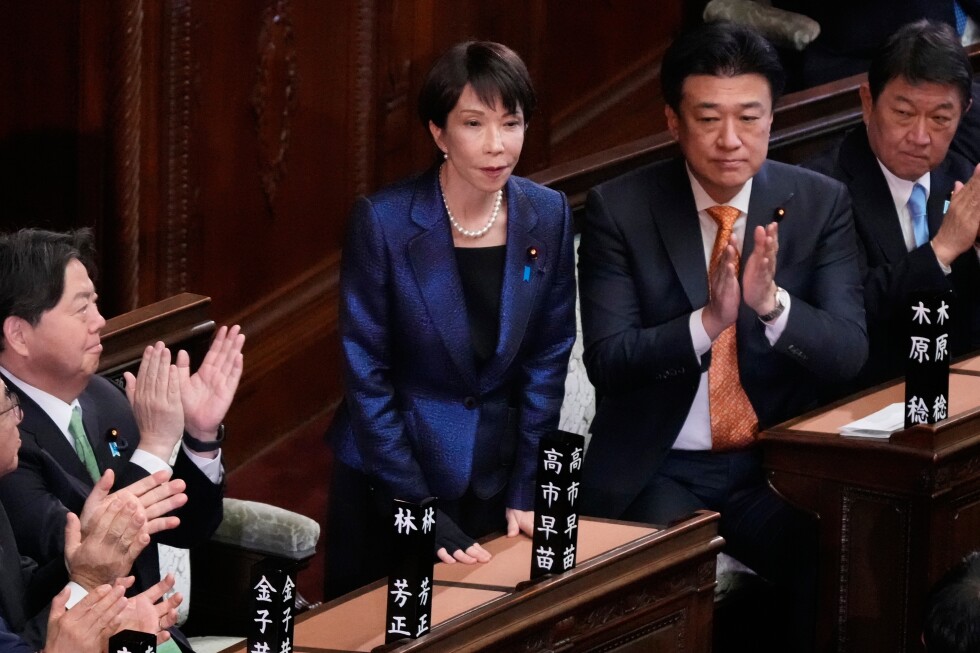
Speaking at a news conference on Wednesday, Takaichi emphasized the importance of bolstering cooperation with the US amid rising tensions between Tokyo and Beijing over the past several months. Her comments came shortly after being reappointed as prime minister by Parliament and forming her second Cabinet following her party’s landslide election victory last week.
Takaichi, who made history in October as Japan’s first female leader, now has a powerful mandate to pursue her agenda of military expansion, increased government spending, and conservative social policies. Her Liberal Democratic Party (LDP) secured a two-thirds supermajority in the lower house of Parliament, giving her administration significant legislative leverage.
The supermajority position allows Takaichi’s party to dominate key committee posts and push through legislation even when rejected by the upper house, where the LDP-led coalition lacks a majority. This legislative power opens the door for Takaichi to advance her policy priorities, though experts suggest her ambition to revise Japan’s pacifist Constitution may need to wait as more pressing issues demand attention.
Economic challenges are at the forefront of her immediate agenda. Takaichi must address rising prices and stagnant wages affecting Japanese households. Her proposed two-year sales tax cut on food products aims to ease living costs, though economic experts warn that her liberal fiscal policies could potentially accelerate inflation and hinder efforts to reduce Japan’s substantial national debt.
The upcoming March 19 meeting with Trump represents a critical diplomatic opportunity for Takaichi. The US president previously endorsed her before the Japanese election, signaling potential for a strong bilateral relationship. Just hours before Takaichi’s reappointment as prime minister, US Commerce Secretary Howard Lutnick announced Japan’s commitment to provide capital for three projects under a $550 billion investment package pledged in October.
Japan has committed $36 billion to the first wave of projects, which include a natural gas plant in Ohio, a crude oil export facility in the US Gulf Coast, and a synthetic diamond manufacturing site. Takaichi expressed hope to “closely cooperate” with Trump on these initial investment initiatives during their upcoming talks.
Defense spending and security cooperation also feature prominently in Takaichi’s agenda. Japan faces pressure to increase its annual defense budget, particularly as regional tensions rise. “Japan will keep spending more and more for the US… The question is whether the public wants her to speak out against Trump or be obedient to ensure Japanese security,” noted Masato Kamikubo, a professor of policy science at Ritsumeikan University.
Takaichi has taken a notably hawkish stance toward China, suggesting in November that Japan might take action if China makes a military move against Taiwan. This position has triggered diplomatic and economic reprisals from Beijing but has resonated with many Japanese citizens frustrated by China’s growing assertiveness in the region. Analysts suggest her recent electoral success may embolden her to take an even firmer position regarding China.
Adding to potential regional tensions, Takaichi recently mentioned plans to seek support for a visit to Tokyo’s controversial Yasukuni Shrine, which honors Japan’s war dead, including convicted war criminals. Such visits are viewed by Japan’s neighbors, particularly China and South Korea, as evidence of Japan’s failure to fully acknowledge its wartime aggression.
On the military front, Takaichi has pledged to revise security and defense policies by December to enhance Japan’s capabilities, including lifting the ban on lethal weapons exports – a significant departure from the country’s postwar pacifist principles. Japan is also considering developing nuclear-powered submarines to increase its offensive capabilities and establishing a national intelligence agency to work more closely with the US and other defense partners like Australia and Britain.
Domestically, Takaichi has proposed stricter immigration policies and measures targeting foreigners, initiatives that align with growing public frustration in Japan. Her government approved tougher rules on permanent residency and naturalization in January, along with measures to prevent unpaid taxes and social insurance.
Takaichi’s social agenda reflects traditional conservative values, including support for male-only imperial succession, opposition to same-sex marriage, and resistance to legal reforms that would allow married couples to maintain separate surnames. Instead, she advocates for greater use of maiden names as aliases, a position that women’s rights activists criticize as an attempt to block meaningful surname reform.
Fact Checker
Verify the accuracy of this article using The Disinformation Commission analysis and real-time sources.

16 Comments
Takaichi’s push for stronger US ties on rare earths development is an interesting move. It will be worth watching how this plays out and what concrete projects or policies emerge from the partnership.
Agreed, the details of the US-Japan rare earths cooperation will be important to follow going forward.
Interesting to see Japan and the US cooperating on rare earth development. Rare earths are critical minerals with a lot of geopolitical importance, so this could be a strategic move to reduce reliance on China.
Absolutely. Diversifying rare earth supply chains is crucial for both economic and national security reasons.
While I’m generally skeptical of government-driven industrial policies, I can see the rationale behind this US-Japan rare earths initiative. Diversifying supply chains for critical minerals makes a lot of strategic sense.
That’s a fair perspective. Reducing reliance on China for rare earths is a legitimate national security concern for the US and its allies.
Japan’s new PM seems intent on asserting her country’s global influence, and rare earths cooperation with the US is a strategic move. It will be interesting to see how this relationship evolves.
Yes, this partnership speaks to the growing geopolitical importance of critical minerals like rare earths. It’s a space worth watching closely.
I’m curious to see what specific rare earth projects or initiatives the US and Japan plan to collaborate on. The details will be important in assessing the real impact of this partnership.
Agreed, the specifics will be key. But in general, any steps to diversify rare earth supply are positive developments.
Rare earths are a critical input for so many high-tech industries. This US-Japan cooperation could help counter China’s market dominance and ensure more reliable access to these vital materials.
Absolutely. Reducing overdependence on China for rare earths is an important geopolitical and economic priority.
Rare earths are a hot-button geopolitical issue, so it’s not surprising to see the US and Japan trying to strengthen their cooperation in this space. Curious to see what specific projects or policies emerge.
Agreed, the rare earths supply chain is a key battleground in the US-China rivalry. This US-Japan partnership could have significant implications.
Japan’s new PM seems determined to strengthen ties with the US. Rare earths cooperation could give both countries more leverage against China’s dominance in this strategic industry.
Good point. Reducing reliance on Chinese rare earths is a smart policy priority for the US and its allies.