


Listen to the article
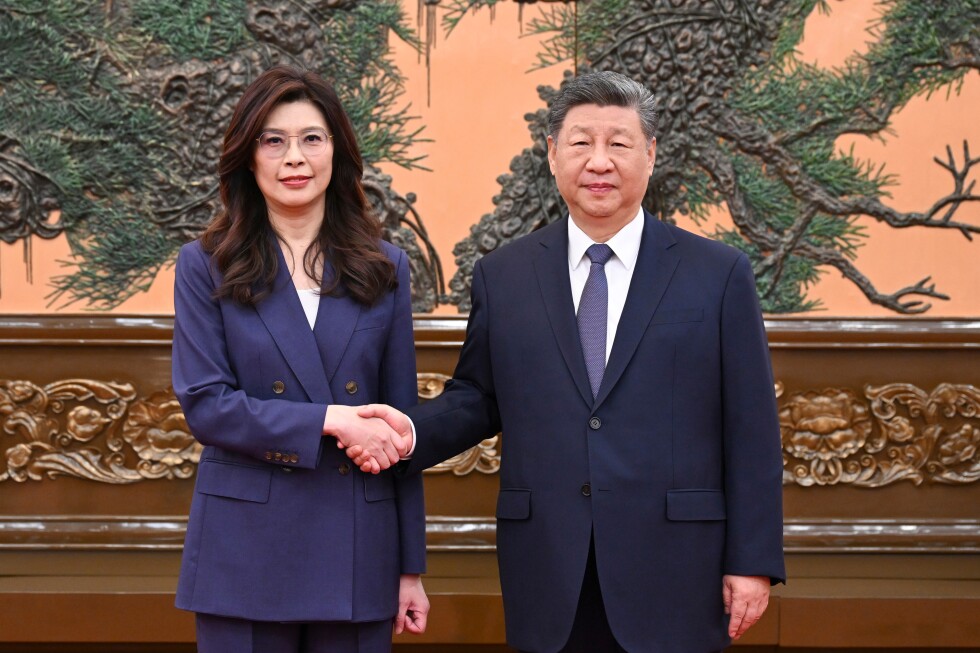
Taiwan’s opposition leader Cheng Li-wun met with Chinese President Xi Jinping in Beijing on Friday, marking the first such high-level encounter between Taiwan’s Kuomintang (KMT) Party and Chinese leadership in over a decade. The meeting, held at the prestigious Great Hall of the People, centered on maintaining peace across the Taiwan Strait while reaffirming both sides’ commitment to eventual reunification.
During the historic meeting, Xi expressed confidence in the “historical necessity” of closer relations between mainland China and Taiwan. “The larger trend of compatriots on both sides of the strait walking nearer, closer, and together will not change,” Xi told the KMT delegation amid applause from attendees.
Cheng, who leads the Beijing-friendly KMT, reciprocated with conciliatory language. “Although people on both sides of the Taiwan Strait live under different systems, we will respect each other and move towards each other,” she said, emphasizing her commitment to “seek systemic solutions to prevent and avoid war.”
The meeting takes place against a backdrop of escalating tensions in the region. China has intensified military exercises around Taiwan in recent years, deploying warships and fighter jets closer to the island while diplomatically isolating Taipei by persuading its few remaining diplomatic allies to switch recognition to Beijing. The Chinese government has consistently refused to rule out the use of force to bring Taiwan under its control.
Taiwan has been governed separately since 1949, when Communist forces won China’s civil war and the defeated Kuomintang forces retreated to the island, establishing their own government. Today, Taiwan functions as a de facto independent democracy with its own military, currency, and foreign policy, though its international status remains contested.
Cheng’s visit to mainland China began Tuesday and included stops in Shanghai and Nanjing before concluding in Beijing. She has positioned herself as a peacemaker between Taiwan and China, frequently opposing increases to Taiwan’s defense budget. Her party continues to block President Lai Ching-te’s special defense budget, which would fund critical arms purchases including the Taiwan Dome air defense system.
President Lai, from the ruling Democratic Progressive Party (DPP), responded indirectly to Cheng’s visit with a warning. “History tells us that compromising with authoritarian regimes only comes at the cost of sovereignty and democracy, and will not bring freedom or peace,” Lai stated Friday morning, urging the KMT to approve his defense funding proposals.
When questioned by reporters after meeting Xi, Cheng offered few specifics about her proposed “framework for peace” between China and Taiwan. She did mention discussing Taiwan’s potential participation in the Regional Comprehensive Economic Partnership free trade agreement, claiming Xi responded “positively” to this suggestion.
Both Xi and Cheng affirmed their commitment to the “1992 Consensus” – an informal understanding that both Taiwan and China belong to “One China,” though with different interpretations of what “China” means. However, political analysts note that while the KMT acknowledges this distinction, the Chinese Communist Party has never formally accepted different interpretations of the concept.
Weihao Huang, a political science professor at Taiwan’s National Sun Yat-sen University, criticized Cheng’s rhetoric. “Her speech is not like that of a Taiwanese politician,” Huang observed. “You can’t see the public’s mindset from her words. It’s either her words are being restricted by China or that she was willing for China to restrict it.”
Ma Chun-wei, an expert in China-Taiwan relations at Taiwan’s Tamkang University, suggested the visit holds greater significance for Beijing than for the KMT. “At the local level, the KMT’s grassroots members didn’t really want Cheng to visit China at this time,” Ma noted, referring to upcoming local elections in Taiwan. For Xi, however, the meeting provides a diplomatic channel with Taiwan despite the absence of official government-to-government contact since the DPP came to power. It also allows Xi to signal to the United States that China has mechanisms to manage cross-strait relations without external interference.
The meeting underscores the complex geopolitical dynamics in the Taiwan Strait, where domestic politics, regional security concerns, and great power competition continue to intersect in one of Asia’s most enduring flashpoints.
Fact Checker
Verify the accuracy of this article using The Disinformation Commission analysis and real-time sources.

14 Comments
The rhetoric around ‘eventual reunification’ is concerning. While I appreciate the desire for stability, any resolution must respect the self-determination of the Taiwanese people. Coercion or unilateral action by Beijing would be extremely problematic.
I share your reservations. Ultimately, the future of Taiwan should be decided through peaceful, democratic means that reflect the will of its citizens.
While the meeting between Cheng and Xi is an important gesture, I remain cautiously optimistic about its long-term impact. The fundamental differences between Taiwan and mainland China on issues of sovereignty and self-determination are deeply entrenched.
Agreed. Bridging those divides will require a delicate balancing act and a willingness to compromise on both sides. Sustained dialogue and confidence-building measures will be essential.
This meeting is a significant political event, but the path forward remains fraught with uncertainty. I’m curious to see if any tangible agreements or mechanisms emerge from these discussions to address the underlying drivers of tension across the Taiwan Strait.
That’s a good question. The devil will be in the details, and any meaningful progress will likely require sustained dialogue and compromise from both sides.
This is an interesting development, though the path to eventual reunification seems uncertain. It’s good to see both sides commit to maintaining peace and avoiding conflict. I wonder what specific systemic solutions Cheng has in mind to prevent war across the Strait.
Agreed, the details of their discussions will be important. Reducing military tensions and finding areas of mutual understanding appear to be key priorities.
While the conciliatory language from both sides is encouraging, the reality is that cross-Strait tensions have been rising in recent years. I hope this meeting can help establish a more constructive foundation for future negotiations and cooperation.
Absolutely. Concrete, verifiable confidence-building measures will be key to translating the rhetoric into meaningful progress.
This meeting is a notable diplomatic development, but I’m not convinced it will lead to any significant breakthroughs in cross-Strait relations. The underlying political and security dynamics remain highly complex and fraught with risk.
That’s a fair assessment. Meaningful progress will likely require sustained, good-faith efforts from both sides to address the core issues driving tensions.
The meeting between Xi and Cheng is a positive step, but the broader geopolitical situation in the region remains complex and fragile. Fostering greater dialogue and trust between Taiwan and mainland China will be critical to avoiding miscalculation and conflict.
You raise a good point. Maintaining open communication channels despite political differences is essential for stability and preventing unintended escalation.