


Listen to the article
Kurdish Families Return to Afrin, Celebrate Nowruz as National Holiday for First Time
Abdul Rahman Omar’s return to his village in northern Syria’s Afrin district marks the end of an eight-year exile that began when Turkish forces swept through the area in 2018. Omar is among hundreds of Kurdish families who have recently made their way back to their ancestral homes following a landmark agreement between Kurdish forces and the Syrian government.
Last week, Omar joined neighbors in celebrating Nowruz, the ancient Persian spring festival marking the new year, for the first time since their return. The celebration carried special significance as it was also the first time they could observe the festival as an officially recognized national holiday in Syria.
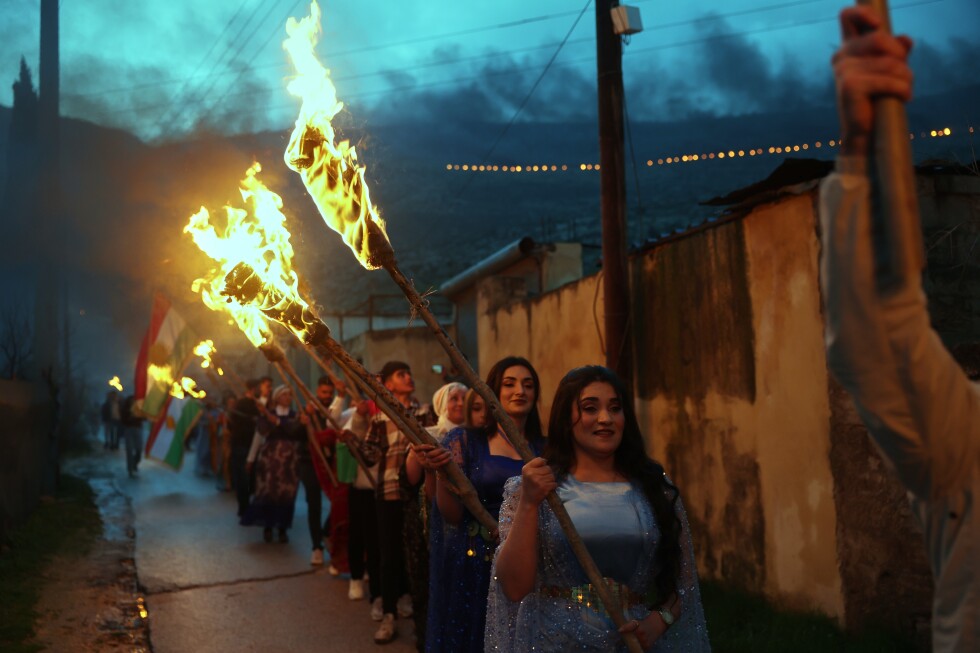
“This is the first time I go to the mountain and light the flame and I’m not afraid,” Omar said, describing the traditional torch-bearing procession into the hills above the village of al-Basouta. “Of course it’s a feeling of joy that I, as a Kurd, am celebrating my holiday and speaking in my own tongue without being afraid.”
The 3,000-year-old Nowruz festival, rooted in Zoroastrianism, is widely celebrated across the Middle East, particularly by Kurds in Syria, Turkey, Iraq, and Iran. The celebration typically features colorful street festivals, traditional line dances, and nighttime processions with torches.
During Friday’s festivities, participants spelled out “raperin” – meaning “uprising” in Kurdish – with flames as they hoisted torches and Kurdish flags in a symbolic display of cultural resilience.
The return of Kurdish families to Afrin follows a significant shift in Syria’s political landscape. In January, fighting erupted between government forces and the Kurdish-led Syrian Democratic Forces (SDF) in Aleppo’s Sheikh Maqsoud neighborhood, where Omar had been living in exile. This conflict, followed by a government offensive that seized territory from the SDF, ultimately led to a peace agreement.
The deal outlines the integration of Kurdish forces into Syria’s national army and the return of key northeastern institutions to central government control. Crucially for displaced Kurds, it also facilitates their return to Afrin, including a recent convoy of 400 families who left SDF-controlled Hassakeh province.
Since Turkey’s 2018 military operation against Kurdish fighters, Afrin has been controlled by Turkish forces and allied Syrian opposition groups. The operation displaced thousands of Kurdish civilians, with many unable to return as their homes were occupied by Arab Syrians displaced from other regions by the civil war. Those Kurds who remained in Afrin reported discrimination and human rights abuses.
Syria’s interim President Ahmad al-Sharaa has taken significant steps to appeal to the Kurdish minority. During ceasefire negotiations with the SDF in January, al-Sharaa issued a decree strengthening Kurdish rights – making Kurdish an official language alongside Arabic, adopting Nowruz as a national holiday, and restoring citizenship to tens of thousands of Kurds who had been stripped of it during a 1962 census.
These changes represent a stark departure from the policies of the Assad dynasty, which ruled Syria for 50 years until former President Bashar Assad was ousted in December 2024. Under the Assads, Kurds faced marginalization and public Nowruz celebrations were banned, with participants often pursued by security forces.
For returnees like Omar, the homecoming evokes mixed emotions. “When a person is away from his home for eight years, of course he misses and longs for it,” he said. “There’s a feeling of emptiness, but at the same time, you’ve returned to your own house, you’ve seen the atmosphere of your own village and your memories come back.”
The initially peaceful holiday celebrations were marred by tensions on Saturday, however, after images circulated on social media showing a man removing the Syrian flag during Nowruz festivities in the northeastern city of Kobani. The incident triggered retaliatory violence in parts of Afrin, where mobs reportedly vandalized cars and shops in Kurdish areas, prompting authorities to impose an evening curfew.
In SDF-controlled Qamishli, residents attacked a government-affiliated security post and damaged vehicles. Officials are now working to identify the person who removed the flag, while Sipan Hamo, an SDF commander recently appointed deputy minister of defense as part of the integration deal, called for calm.
“Those who lowered the Syrian flag in Kobani and those who insult the Kurdish people and their symbols share the same mentality that aims to create division and discord,” Hamo stated on social media.
Despite these tensions, the Kurdish return to Afrin and the official recognition of Nowruz represent significant steps toward reconciliation in a region long divided by ethnic conflict and civil war.
Fact Checker
Verify the accuracy of this article using The Disinformation Commission analysis and real-time sources.

8 Comments
It’s heartening to see the Kurdish families returning to their homes in Afrin to celebrate Nowruz after years of exile. This festival has deep cultural roots and it must be meaningful for them to observe it freely in their ancestral lands.
While the situation remains complex, the return of these Kurdish families and the official recognition of Nowruz as a national holiday in Syria is a positive development worth highlighting. It’s a reminder of the diversity and resilience of the local populations.
The ability to freely celebrate Nowruz is an important milestone for the Kurdish community in Syria. It’s a testament to their perseverance and the progress being made, even if challenges remain. Hopefully this signals a new chapter of greater stability and inclusion.
The agreement between Kurdish forces and the Syrian government to facilitate the return of these families is an encouraging sign of progress. Celebrations like Nowruz can help heal wounds and rebuild a sense of community.
Absolutely, the ability to celebrate their cultural heritage without fear is a significant milestone. Hopefully this marks the start of a more stable and peaceful future for the region.
The 3,000-year-old Nowruz festival has deep meaning for the Kurdish people. It’s wonderful to see them able to observe this tradition in their own villages after so many years in exile. This must be a profoundly emotional moment for the returning families.
Witnessing the Kurdish families return home to observe Nowruz is a poignant reminder of the human stories behind the conflict in Syria. While the path ahead may be uncertain, these celebrations represent a glimmer of hope and resilience.
Well said. Reclaiming their cultural traditions is a powerful act of resilience in the face of adversity. It’s a hopeful sign that the region may be moving towards a more stable and inclusive future.