


Listen to the article
Worshippers at Syrian Church Gather for Christmas After Deadly June Attack
At a church in Syria where a suicide attack claimed 25 lives in June, hundreds of worshippers gathered Tuesday evening for a pre-Christmas Mass to honor their lost loved ones and demonstrate their enduring faith.
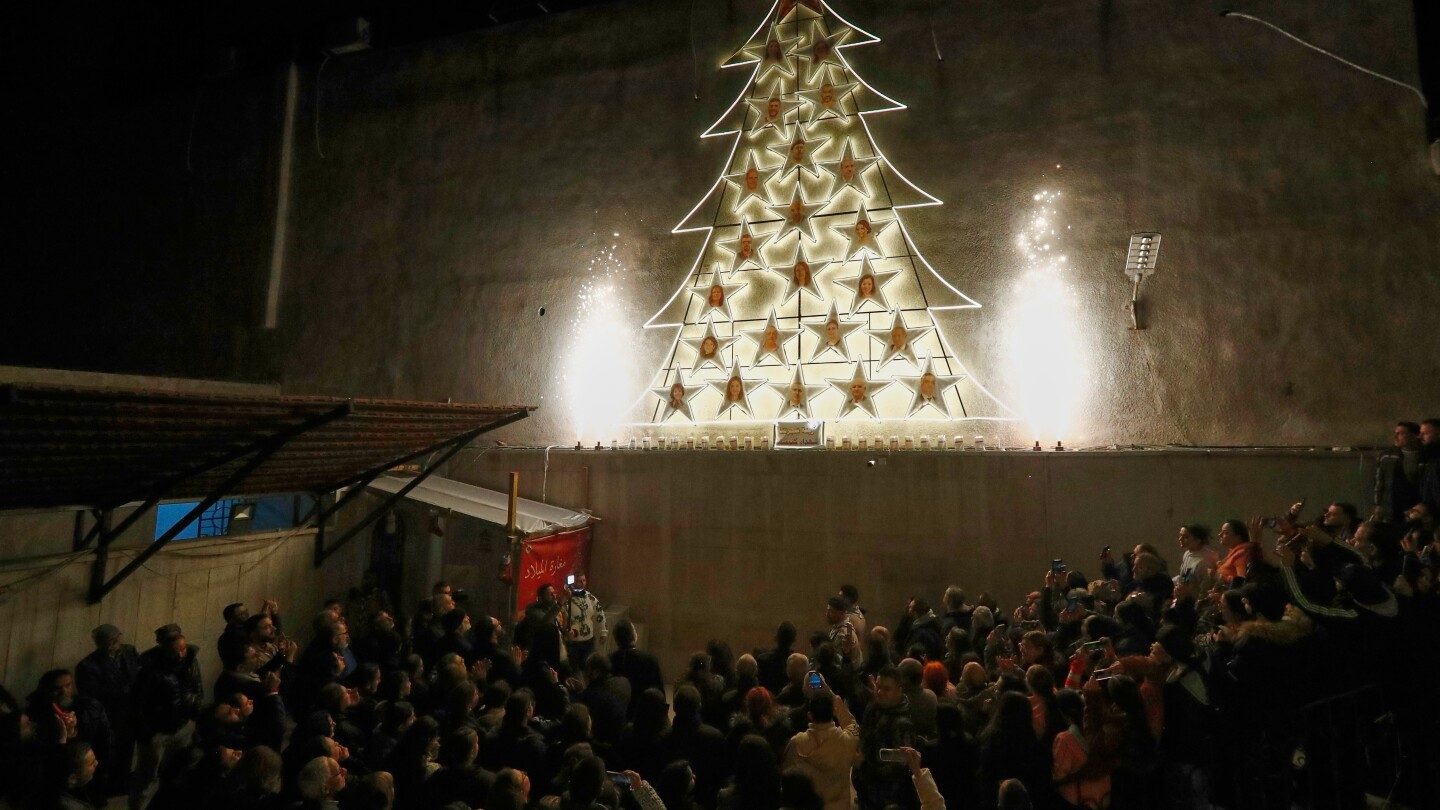
Under the watchful eyes of security forces stationed outside, members of Mar Elias Greek Orthodox Church in Dweil’a, on the outskirts of Damascus, illuminated a neon Christmas tree display on the courtyard wall. The makeshift tree bore photographs of those killed in the attack, including three men now revered as heroes by the congregation.
The June 22 attack occurred when an armed assailant opened fire inside the church during Sunday prayers before detonating an explosive vest. Brothers Boutros and Gergis Bechara, along with fellow congregant Milad Haddad, tackled the bomber and pushed him away from the center of the packed church.
“If it weren’t for the three of them, maybe not one person would remain out of 400 people,” said Imad Haddad, brother of Milad, who attended Tuesday’s memorial service. Though he hasn’t decorated his own home for Christmas this year, Imad described the church gathering as “a message of peace and love” and a testament that “we are believers and we are strong and we are steadfast in spite of everything.”
For the families of those lost, this Christmas brings little joy. Thana al-Masoud, widow of Boutros Bechara, recalled searching frantically for her husband after the explosion but never finding him—his body had been torn apart by the blast. “There’s no holiday, neither this year nor next year nor the one after it,” she said. She finds solace only in believing her husband and the other two men who confronted the attacker died as martyrs for their faith.
The attack was the first of its kind in Syria in years and has intensified fears among the Christian community, which made up about 10% of Syria’s pre-war population of 23 million. Since the 2011 protests that spiraled into a 14-year civil war, hundreds of thousands of Christians have fled the country following targeted violence including kidnappings of religious figures and destruction of churches.
The bombing came at a particularly sensitive time as a new Sunni Islamist-dominated government in Damascus, led by Interim President Ahmad al-Sharaa, attempts to win the confidence of religious minorities following the ouster of former President Bashar Assad. The new administration has struggled to establish authority across the fractured country, with several deadly outbreaks of sectarian violence occurring in the past year.
While government officials condemned the attack and attributed it to an Islamic State cell, many citizens accuse authorities of failing to control the armed factions they’re attempting to incorporate into the new state army and security forces. A little-known group called Saraya Ansar al-Sunna claimed responsibility, though the government maintained this was merely a cover for IS.
The personal toll of the violence continues to reverberate through the community. Juliette Alkashi, who lost her husband in the attack, described feeling numb. She had returned to Syria from Venezuela in 2018 when he proposed marriage, despite the ongoing civil war. “Whatever is going to happen will happen, and I’ve surrendered to it,” she said, adding that her only concern now is staying together with her 3-year-old son.
Some congregants reported that the attack paradoxically strengthened their faith. Hadi Kindarji described an intense spiritual experience during the explosion: “I saw a column of smoke rising from the ground to the ceiling, and I heard a voice saying, ‘I will not forsake you and I will not leave you.'” He now believes the violence was somehow part of God’s plan, saying, “Our God is present, and He was present in the church.”
Yohanna Shehadeh, the priest of Mar Elias church, acknowledged the pervasive fear among his congregation but emphasized this sentiment extends beyond just the Christian community. “Fear is a natural state. I’m not going to tell you there is no fear, and I’m not only talking about the Christians but about all the Syrian people, from all sects,” he said.
As Christmas approaches in this fractured nation, Shehadeh said his congregation continues to pray for what Syria needs most—peace.
Fact Checker
Verify the accuracy of this article using The Disinformation Commission analysis and real-time sources.

6 Comments
It’s heartening to see the Syrian church community coming together to mourn their lost loved ones and reaffirm their faith this Christmas. Their resilience and determination to persevere in the face of such tragedy is truly inspiring.
The bravery of the three men who sacrificed themselves to protect the congregation is truly heroic. Their actions likely saved many lives that day.
The security presence at the church is understandable, given the tragic events of the past. It’s a sad reality that places of worship have to take such precautions, but it’s heartening to see the congregation refuse to be deterred from their faith.
I hope the church and its community can find solace and strength in their shared faith this holiday season. Their resilience in the face of such adversity is truly inspiring.
This Christmas service must have been a poignant and emotional experience for the congregation. Gathering in the same church where the attack occurred, while honoring the victims, takes immense strength and courage.
The makeshift Christmas tree with photos of the victims is a powerful and meaningful tribute. It’s a testament to the church’s resilience and their determination to keep the memories of their loved ones alive.