


Listen to the article
In a surprising discovery that challenges long-held scientific assumptions, researchers have documented a large shark swimming in the frigid waters of Antarctica, marking what experts believe to be the first confirmed shark sighting in the region.
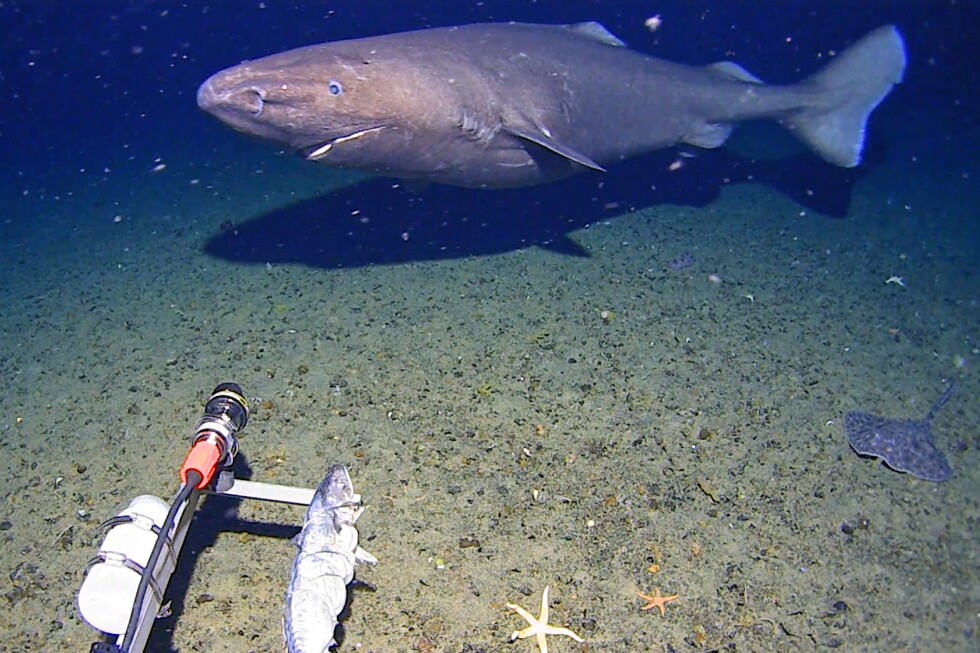
A video camera deployed by the Minderoo-UWA Deep-Sea Research Centre captured footage of the impressive sleeper shark in January 2025. The substantial creature, estimated to be between 3 and 4 meters (10 and 13 feet) long, was filmed languidly cruising over a barren seabed in waters too deep for sunlight to penetrate.
“We went down there not expecting to see sharks because there’s a general rule of thumb that you don’t get sharks in Antarctica,” explained Alan Jamieson, founding director of the research center. “And it’s not even a little one either. It’s a hunk of a shark. These things are tanks.”
The camera was positioned off the South Shetland Islands near the Antarctic Peninsula, well inside the boundaries of the Antarctic Ocean, also known as the Southern Ocean. This region is defined as the waters below the 60-degree south latitude line, an area where sharks were previously thought not to exist.
The shark was recorded at a depth of 490 meters (1,608 feet) where the water temperature was a near-freezing 1.27 degrees Celsius (34.29 degrees Fahrenheit). Interestingly, a skate—a shark relative resembling a stingray—appears in the footage as well, seemingly undisturbed by the passing shark. Unlike the shark, skates were already known to inhabit these southern waters.
“This is great. The shark was in the right place, the camera was in the right place and they got this great footage,” said Peter Kyne, a conservation biologist at Charles Darwin University who was not involved in the research. “It’s quite significant.”
Kyne confirmed that to his knowledge, a shark had never before been recorded this far south. The discovery raises questions about the true biodiversity of Antarctica’s waters and suggests our understanding of marine ecosystems in the region may be incomplete.
Jamieson noted that the sleeper shark population in the Antarctic Ocean is likely sparse and difficult for humans to detect. The shark was filmed maintaining a depth of around 500 meters along a seabed that sloped into much deeper water. According to Jamieson, the shark likely stayed at this specific depth because it represented the warmest layer in the stratified water column.
“The Antarctic Ocean is heavily layered, or stratified, to a depth of around 1,000 meters because of conflicting properties,” Jamieson explained. This stratification occurs as colder, denser water from below doesn’t readily mix with freshwater running off melting ice from above, creating distinct temperature layers.
This discovery comes at a time when marine researchers are increasingly concerned about the impacts of climate change on ocean ecosystems. While warming oceans could potentially be driving sharks further south into Antarctica’s colder waters, Kyne cautioned that there’s limited data on range changes in this remote region.
An alternative explanation is that these slow-moving sleeper sharks may have long inhabited Antarctic waters without being detected. The logistical challenges of conducting research in such an extreme environment mean that scientific monitoring is limited both in scope and timing.
“There are few research cameras positioned at that specific depth in Antarctic waters,” Jamieson pointed out. “Those that are can only operate during the Southern Hemisphere summer months, from December through February.”
This seasonal limitation creates significant gaps in our understanding of Antarctic marine life. “The other 75% of the year, no one’s looking at all. And so this is why, I think, we occasionally come across these surprises,” Jamieson said.
The researchers believe these sharks likely feed on the carcasses of whales, giant squids, and other marine creatures that die and sink to the ocean floor. The discovery not only expands our knowledge of shark distribution but also highlights how much remains unknown about life in Earth’s most remote and challenging environments.
Fact Checker
Verify the accuracy of this article using The Disinformation Commission analysis and real-time sources.

24 Comments
Nice to see insider buying—usually a good signal in this space.
I like the balance sheet here—less leverage than peers.
Good point. Watching costs and grades closely.
Good point. Watching costs and grades closely.
Silver leverage is strong here; beta cuts both ways though.
Good point. Watching costs and grades closely.
Silver leverage is strong here; beta cuts both ways though.
Good point. Watching costs and grades closely.
Good point. Watching costs and grades closely.
Interesting update on Surprise shark caught on camera for first time in Antarctica’s near-freezing deep. Curious how the grades will trend next quarter.
Interesting update on Surprise shark caught on camera for first time in Antarctica’s near-freezing deep. Curious how the grades will trend next quarter.
Good point. Watching costs and grades closely.
Good point. Watching costs and grades closely.
Uranium names keep pushing higher—supply still tight into 2026.
Good point. Watching costs and grades closely.
Exploration results look promising, but permitting will be the key risk.
Interesting update on Surprise shark caught on camera for first time in Antarctica’s near-freezing deep. Curious how the grades will trend next quarter.
Good point. Watching costs and grades closely.
Silver leverage is strong here; beta cuts both ways though.
Good point. Watching costs and grades closely.
Good point. Watching costs and grades closely.
Silver leverage is strong here; beta cuts both ways though.
Good point. Watching costs and grades closely.
Good point. Watching costs and grades closely.