


Listen to the article
Paris Fashion Week Showcases New Design Directions Amid Global Uncertainty
The star-studded Paris Fashion Week has concluded with major fashion houses presenting collections that reflect a deeper response to today’s challenging global landscape. While celebrities like Oprah Winfrey, Naomi Watts, Rooney Mara, and Chappell Roan graced the front rows, designers focused on answering a critical question: How do you dress people in a world that feels increasingly dark, loud, and unstable?
Three distinct trends emerged throughout the nine-day event, signaling significant shifts in the fashion industry’s direction.
First came clothing designed as protection. At Balenciaga, designer Pierpaolo Piccioli collaborated with “Euphoria” creator Sam Levinson to present a collection centered around darkness and the search for light. The runway featured balloon bombers, cocoon backs, portrait collars, and face-framing necklines that created a sense of guardedness – even softer draped dresses maintained this protective quality.
Sarah Burton’s third show for Givenchy resonated with a similar theme but approached it from a more personal angle. Rather than presenting one idealized woman, Burton showcased diverse expressions of feminine strength through precise tailoring, substantial coats, peplum details, and evening wear grounded in reality. The collection spoke to how women reconstruct themselves in challenging times, offering polish without detachment from real-world concerns.
Junya Watanabe pushed protective fashion to its limits, transforming gloves, motorcycle gear, and emergency blankets into couture-like forms. Meanwhile, at McQueen, Seán McGirr addressed themes of paranoia and the pressure of constant visibility with slashed leather trousers, low-slung minis, and chainmail textures that simultaneously suggested vulnerability and defense.
The second major trend marked a significant shift in silhouette. After years dominated by voluminous, oversized clothing, Paris designers are moving back toward more defined body lines.
Celine’s Michael Rider presented his third collection with a clear vision of wearable clothing that sits closer to the body. His coats and suits featured a closer fit to the torso, trousers kicked out in cropped flares, and menswear appeared in long, narrow overcoats that looked crisp rather than inflated. Rider’s approach maintained ease without sacrificing character, suggesting the potential end of oversized fashion’s long dominance.
This new emphasis on sharper lines appeared throughout the week. Burton relaxed the strict hourglass she established earlier at Givenchy but maintained definition. Piccioli used structural elements to frame rather than obscure the figure. McQueen’s low-rise minis and fitted boots pointed toward the same conclusion: after years of volume, Paris is calling for something more defined and exposed.
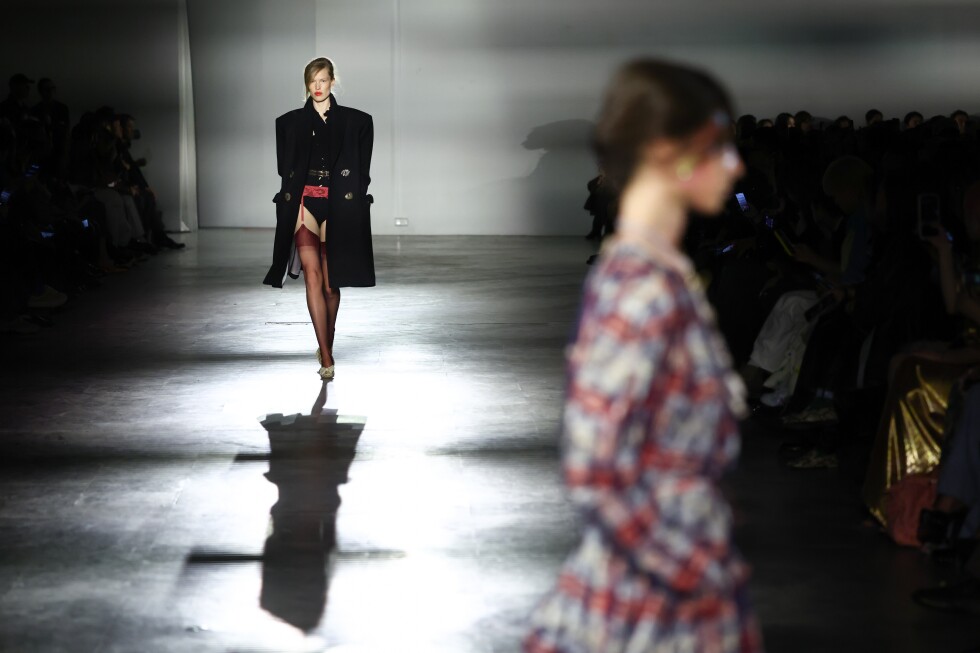
The third notable trend was a deliberate move away from polished perfection. At Vivienne Westwood, Andreas Kronthaler created a collection that embraced grief, eroticism, and disorder simultaneously. Speaking openly about loss while celebrating pleasure, the runway featured rough seams, smudged makeup, lingerie references, eccentric hats, and an intentionally unfinished bridal look – collectively appearing messy yet vibrantly alive.
This appetite for imperfection resonated throughout the week. Rider evoked the complex inner lives beneath beautiful exteriors. Piccioli employed shadow to maintain darkness as a presence. Burton populated Givenchy with distinct female characters rather than uniform ideals.
Collectively, Paris Fashion Week rejected sterile luxury in favor of resilience. The strongest collections didn’t attempt to make the world’s problems disappear but instead sought to equip wearers to face them. This represents a significant evolution for an industry often criticized for detachment from reality.
As the fashion calendar continues with Chanel and Louis Vuitton closing the season, it’s clear that the industry’s creative leaders are responding to contemporary anxieties with designs that acknowledge complexity rather than escaping it. Their collections offer not just beauty, but armor for navigating uncertain times – suggesting that fashion’s role extends beyond aesthetics to emotional and psychological support in challenging circumstances.
Fact Checker
Verify the accuracy of this article using The Disinformation Commission analysis and real-time sources.

22 Comments
Fashion can be a powerful way to express our collective mood and priorities. It’s encouraging to see designers focusing on real-life needs rather than pure fantasy.
Absolutely, fashion shouldn’t exist in a vacuum – it needs to connect with the realities people are facing.
Balenciaga’s collaboration with ‘Euphoria’ creator Sam Levinson is an intriguing pairing. I wonder what insights that brought to the design process and the final collection.
Good question. Bringing in an outside creative voice like Levinson could inject some fresh perspective and resonance.
It will be interesting to see if this shift towards more grounded, functional fashion continues or if it’s just a temporary blip. The industry has a history of quickly returning to excess and escapism.
That’s a fair point. The fashion world can be fickle, so sustaining this more pragmatic approach may prove challenging.
While the presence of stars like Oprah and Rooney Mara grabbed headlines, the true story here seems to be the fashion industry’s response to the challenges of our time. That feels much more important.
Absolutely, the substance behind the shows is far more meaningful than the celebrity attendance.
While the runway shows were the main draw, I’m more curious about how these design trends will filter down to everyday fashion. That’s where the real impact will be felt.
Agreed, the true test will be how these ideas manifest in the clothes people actually wear, not just on the catwalk.
The idea of ‘dressing for hard times and real life’ is a compelling one. It suggests a move towards thoughtfulness and purpose in an industry that has often been accused of frivolity.
Exactly, this could represent an important pivot towards greater social consciousness in the fashion world.
Overall, this seems like an interesting shift in the fashion industry, one that could have lasting implications if designers continue to prioritize function and meaning over pure spectacle.
Absolutely, it will be fascinating to see if this represents a more durable change in the industry’s priorities and values.
I wonder if this marks a more enduring change in the fashion industry, or if it’s just a temporary response to current events. It will be interesting to see how trends evolve over the next few seasons.
Good point. The long-term impact remains to be seen, but this shift could signal a more substantive rethinking of the industry’s priorities.
It’s refreshing to see designers move beyond just showcasing celebrity culture and instead focus on addressing real human needs and concerns. This feels more meaningful and impactful.
Yes, the emphasis on practicality over pure spectacle is a welcome change of pace in the fashion world.
Interesting to see how fashion designers are responding to the global uncertainty and instability. Protective, practical designs that make people feel secure in these challenging times seem like a smart move.
Yes, the shift towards more functional yet stylish clothing reflects the need for comfort and resilience in a turbulent world.
The runway featured some intriguing protective elements like balloon bombers and face-framing necklines. I’m curious to see how these design details translate to mainstream fashion.
Agreed, the more avant-garde runway pieces often end up influencing mass market trends in unexpected ways.