


Listen to the article
South Korea’s parliament passed controversial legislation Wednesday that could impose heavy financial penalties on news organizations and online media for publishing “false or fabricated information,” despite significant opposition from press freedom advocates and civil liberties groups.
The bill, championed by President Lee Jae Myung’s Democratic Party, allows courts to award punitive damages up to five times the proven losses against media outlets that disseminate information deemed false or fabricated with the intent to cause harm or seek profit. For losses difficult to quantify, damages could reach up to 50 million won ($34,200).
Additionally, South Korea’s media regulator would gain authority to fine outlets up to 1 billion won ($684,000) for repeatedly distributing court-confirmed false information.
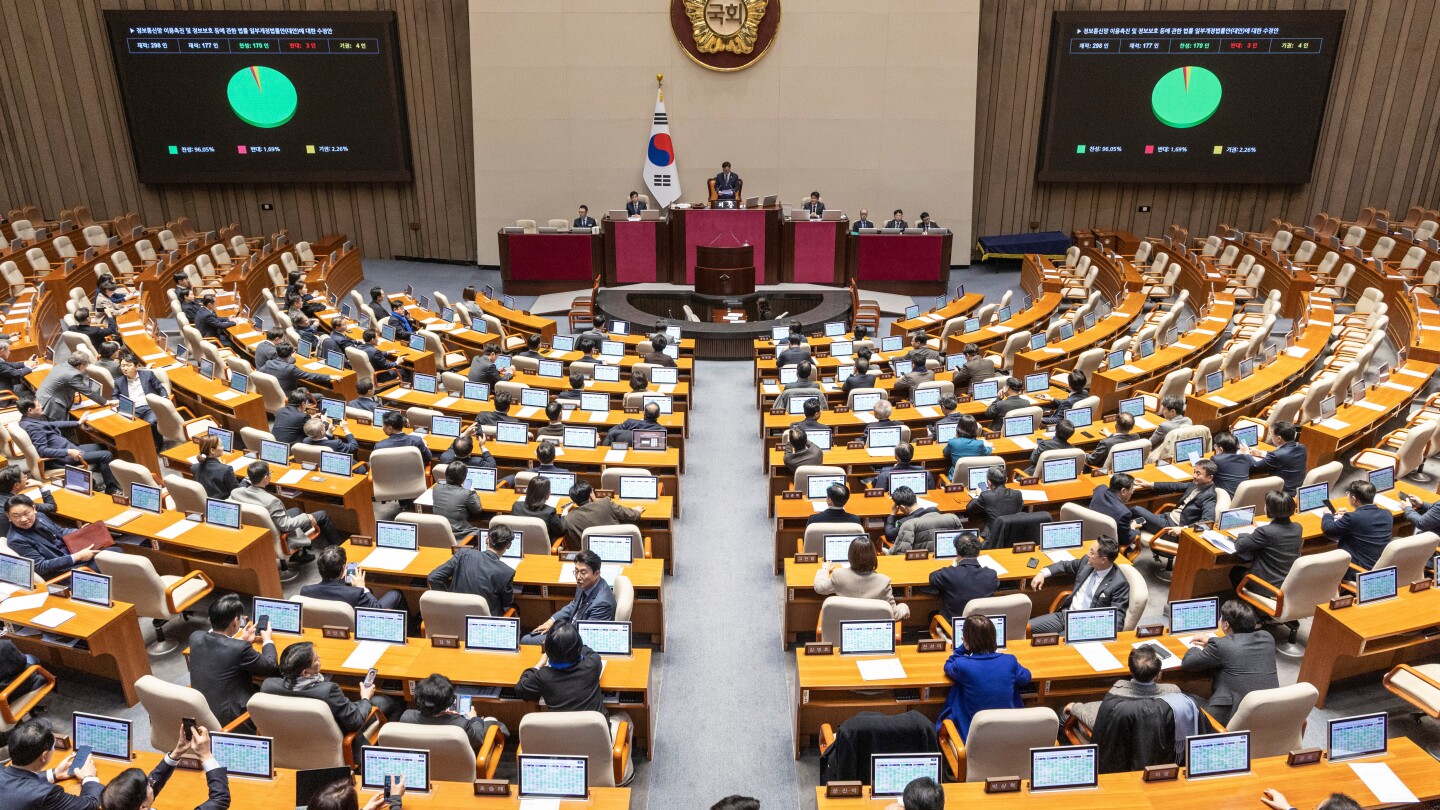
The Democratic Party, which holds a majority in the National Assembly, passed the bill with a 170-3 vote, with four abstentions. Many lawmakers from the conservative People’s Power Party boycotted the vote after unsuccessfully attempting to block the legislation with a 24-hour filibuster.
Proponents argue the legislation addresses growing concerns about misinformation undermining democratic processes in South Korea. The information landscape has been particularly fraught following former President Yoon Suk Yeol’s short-lived martial law declaration, during which he promoted unsubstantiated election fraud theories on YouTube.
“What the law targets is not legitimate criticism but the malicious and deliberate dissemination of false information,” Democratic Party spokesperson Park Soo-hyun said, emphasizing that the bill exempts satire and parody while protecting criticism conducted in the public interest.
However, journalist organizations and civil liberty advocates have raised serious concerns about the legislation’s potential chilling effect on press freedom. They point to vague definitions within the bill that could allow powerful interests to intimidate media with lawsuit threats.
During the filibuster, People’s Power Party lawmaker Choi Soo-jin warned that the legislation fails to define the degree of inaccuracy required for information to be banned, potentially exposing content with minor errors to severe penalties.
The People’s Solidarity for Participatory Democracy, one of South Korea’s most prominent civic organizations, has called on President Lee to veto the bill, arguing it threatens democracy by potentially restricting freedom of expression and the public’s right to information. The group expressed concerns that the legislation could empower both government regulators and private platforms like YouTube to excessively remove content.
“Criminal complaints and indiscriminate lawsuits will be filed over expression that people in power deem unfavorable, while news organizations will be silenced or pressured into avoiding contentious issues,” the group stated.
The National Union of Media Workers joined other journalist associations in urging the government to clearly limit the law’s application to genuinely harmful misinformation. They called for careful definition of the law’s scope in upcoming enforcement ordinances.
Han Sang-hie, law professor at Seoul’s Konkuk University, suggested the legislation might initially impact YouTube channels accused of spreading misinformation for profit more than traditional media outlets. Nevertheless, he expressed concern about relying heavily on punitive measures to address media-related problems.
The legislation represents the latest development in ongoing global debates about balancing press freedom with accountability for harmful misinformation. While supporters maintain the law targets only deliberate falsehoods, critics fear its implementation could have broader implications for South Korea’s democratic discourse and media independence.
Fact Checker
Verify the accuracy of this article using The Disinformation Commission analysis and real-time sources.

10 Comments
This legislation seems well-intentioned, but I worry it could open the door to censorship and limit press freedom. Fact-checking and media accountability are important, but the penalties seem quite harsh. I hope there are robust safeguards in place to prevent abuse.
You raise a fair point. Striking the right balance between addressing misinformation and protecting free speech will be crucial. The details of implementation will be key here.
While I understand the motivation behind this law, the harsh penalties and broad authority given to regulators make me uneasy. Misinformation is a serious problem, but I worry these measures could do more harm than good in the long run.
That’s a fair assessment. The unintended consequences of this legislation could outweigh the intended benefits if not implemented very carefully. Vigilance will be required to prevent it from being abused.
Tackling the spread of false information is certainly a worthwhile goal, but this law appears to give the government significant power over media outlets. I’m concerned about the potential for misuse and the chilling effect it could have on reporting.
I agree, the potential for abuse is concerning. Robust checks and balances will be essential to ensure this law is not used to suppress legitimate journalism and public discourse.
This is a complex issue without easy solutions. I can see the need to address the spread of false information, but the proposed law seems to give the government a lot of power over media outlets. I hope there are strong safeguards in place to protect press freedom.
Agreed, the balance between addressing misinformation and preserving free speech is a delicate one. The details of how this law is implemented will be crucial in determining whether it achieves its goals without unduly restricting the media.
Misinformation is a serious problem, but I’m not sure this law is the right approach. The heavy penalties and broad regulatory powers seem to risk stifling legitimate journalism and public discourse. I hope there is robust debate and oversight to ensure it doesn’t go too far.
That’s a valid concern. Any measures to address misinformation need to be carefully balanced against the fundamental principles of press freedom and free speech. The potential for abuse is worrying and must be closely monitored.