


Listen to the article
Ukrainian Tennis Prodigy Rebuilds Life in America After War Uproots Family
Mariia Vainshtein slept through the explosions that forever changed her life four years ago. When the 17-year-old Ukrainian teenager woke on February 24, 2022, she casually asked her mother for a ride to school, unaware that Russian forces had launched a full-scale invasion of her homeland overnight.
“My mom was like, ‘What do you mean? We’re at war! There’s no school, no nothing!'” Vainshtein recalled with a hint of disbelief still evident in her voice.
Within days, the family was forced to flee their home in Odesa, a strategic Black Sea port city targeted in the initial Russian assault. They first sought safety in neighboring Moldova before making the difficult decision to leave for New York, where relatives of Vainshtein’s father lived. The teenager’s long-held dream of studying in America was suddenly accelerated into a jarring reality she wasn’t prepared for.
“It was terrible. In three days we decided to move, me and my two daughters, and my husband left in Ukraine, and we didn’t know if we’d see him again and when we’d see him again,” said her mother, Anzhelika Kotliantseva, who like many initially believed the conflict would be brief. “We took our clothes for two months.”
Vainshtein’s father, Oleksandr, couldn’t join them due to Ukraine’s martial law prohibiting military-aged men from leaving the country. He has remained in the family’s Odesa home, meeting his wife and daughters only a few times a year in the United States or other countries, as the parents consider Ukraine too dangerous for their daughter’s return.
The teenager’s early months in New York proved exceptionally challenging. Despite studying English in Ukraine, Vainshtein’s practical language skills were limited, especially in a city known for its fast-paced speech patterns. She often begged teachers not to call on her in class to avoid ridicule from classmates.
“Really what people did, they said, ‘You have to learn English. Go back to your country and learn English,'” Vainshtein recalled. “Like, what do you mean go back? My country is at war, so I can’t go back.”
A turning point came when one of her teachers refused to allow translation assistance, pushing Vainshtein to improve her English skills until she gained the confidence to present in class.
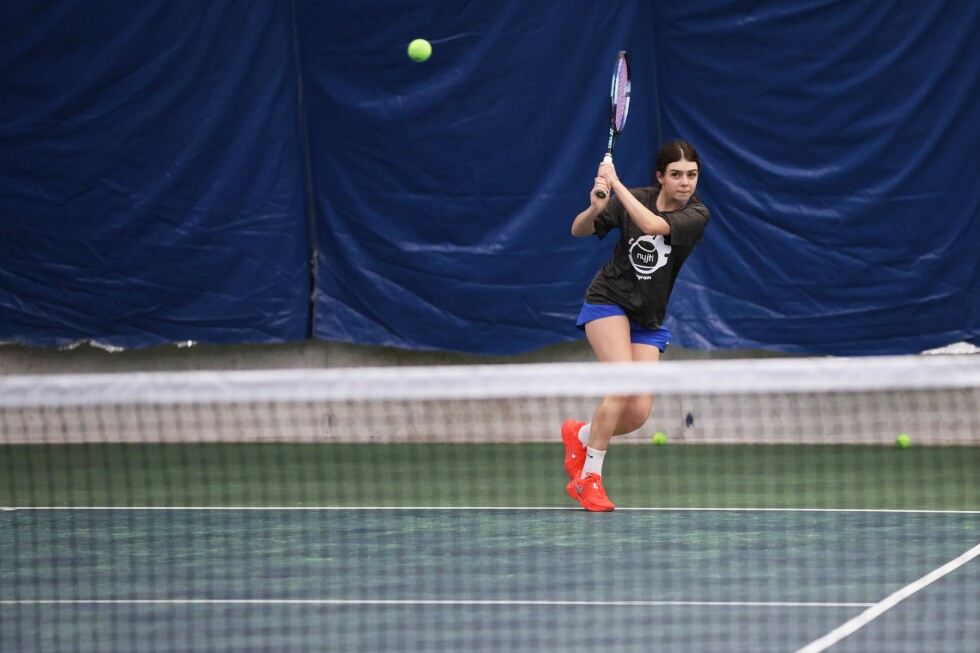
Throughout this difficult transition, tennis became a stabilizing force in her life. Vainshtein had been playing since age five, initially recommended by doctors to help with her eye focus issues. In Ukraine, she participated in junior tournaments, but her game reached new heights after joining the New York Junior Tennis & Learning’s scholar-athlete program.
The program, which offers free tennis instruction combined with life skills education at the Cary Leeds Center in the Bronx, helped Vainshtein develop both her athletic abilities and mental resilience. Coach Rob Cizek recognized her as an aggressive player with natural power but worked to refine her approach and mental focus.
“We talk to them, ‘OK, what happened here? How did you handle this? How can you handle it better next time?'” explained Cizek, who studied sports psychology during his own collegiate career. “To me it’s a really important part of their growth, both off the court but also later when they face adversity, tough situations and they have some tools to handle that.”
The investment has paid dividends. Vainshtein helped James Madison High School in Brooklyn win its first Public Schools Athletic League championship since 1978. She also claimed the individual competition title and won her division in the Mayor Dinkins Cup, a prestigious tournament for New York City players from both public and private schools.
Vainshtein now stands at a crossroads as she prepares for college this fall. She’s applied to several prestigious institutions, including Ivy League schools, and is weighing how tennis might fit into her academic future. While she may not play competitively at higher Division I programs, she remains committed to the sport that helped her navigate an unplanned life transition.
“It’s not like if I go to a school where I can’t be on a team, it’s not like I’m going to end playing tennis,” Vainshtein said. “I’m going to play no matter what.”
Her mother watches with pride as her daughter prepares for this next chapter, amazed by how far she’s come in such challenging circumstances. “I’m very proud of her. Very proud,” Kotliantseva said. “I’m so excited that she’s going to college, and she’s gone so far in this short time.”
Fact Checker
Verify the accuracy of this article using The Disinformation Commission analysis and real-time sources.

10 Comments
This is a truly inspiring story. Mariia’s journey from fleeing the war in Ukraine to becoming a champion tennis player in New York City is remarkable. It’s heartening to see how she’s been able to channel her experiences into such impressive athletic success. Her story is a powerful reminder of the human capacity for resilience and perseverance.
The rapid escalation of the conflict in Ukraine and the difficult decisions families like Mariia’s have had to make is heartbreaking. I’m glad she and her family were able to find a safe haven in the US, but the trauma and uncertainty they’ve experienced must be immense. Her success on the tennis court is a remarkable achievement.
It’s heartbreaking to hear how the war in Ukraine has upended the lives of so many, including this young tennis prodigy. I’m glad Mariia and her family were able to find refuge in the US, but the uncertainty and trauma they’ve endured must be immense. I hope she’s able to continue pursuing her tennis dreams and rebuild her life here.
This is a truly inspiring story. Mariia’s journey from fleeing the war in Ukraine to becoming a champion in New York City is a remarkable achievement. It’s heartening to see how she’s been able to channel her experiences into such impressive athletic success. Her story serves as a powerful reminder of the human capacity for resilience and the importance of providing support and opportunities for those displaced by conflict.
It’s incredible to see how Mariia has channeled her experiences into such impressive athletic success. The resilience and determination she’s shown in the face of such upheaval is truly admirable. Her story serves as a powerful reminder of the human cost of war and the strength of the human spirit.
Mariia’s story is a powerful testament to the resilience and determination of the human spirit. While the trauma and upheaval she and her family have experienced must be immense, her triumph on the tennis court is a remarkable achievement. I hope her success can inspire others who have been displaced by the conflict in Ukraine and provide a glimmer of hope during these incredibly difficult times.
Mariia’s story is a poignant example of how the war in Ukraine has disrupted the lives of so many. While I’m glad she and her family found safety in the US, the emotional and psychological toll of their displacement must be immense. Her triumph on the tennis court is a testament to her strength and resilience in the face of unimaginable adversity.
Mariia’s story is a powerful illustration of the human toll of war and the incredible resilience of the human spirit. While I’m glad she and her family found safety in the US, the trauma and uncertainty they’ve endured must be immense. Her triumph on the tennis court is a testament to her strength and determination in the face of unimaginable adversity. I hope her success can inspire others who have been displaced by the conflict in Ukraine.
This is a powerful story of resilience and determination in the face of unimaginable adversity. Mariia’s journey from fleeing war-torn Ukraine to becoming a champion in New York City is truly inspiring. Her perseverance and passion for tennis have clearly been a source of strength during these challenging times.
Agreed, her story is a testament to the human spirit. Tennis must be providing some sense of normalcy and hope amidst the chaos of displacement.