


Listen to the article
Serbians Celebrate Traditional Orthodox New Year Amid Mixed Reactions
Nearly two weeks after the global New Year celebrations, many Serbians marked the occasion once again on Tuesday evening, this time following the ancient Orthodox Christian tradition. The celebration, known locally as “Serbian New Year,” represents the cultural divide between different calendar systems still observed across the Orthodox world.
Eastern Orthodox churches in several countries, including Serbia, Russia, and parts of Ukraine, continue to follow the Julian calendar for religious observances. This calendar, which predates the more widely used Gregorian calendar, runs 13 days behind the modern calendar used by most of the secular world and Western Christian denominations.
In Belgrade, the capital’s commercial pedestrian zones buzzed with activity as Christmas and New Year decorations remained prominently displayed. The festive atmosphere attracted many residents seeking to extend the holiday season with traditional celebrations.
“I celebrate the Serbian New Year,” said Belgrade resident Zoran Todorovic, who planned to enjoy the evening with typical seasonal traditions. “We’re going out. We’ll take a walk, drink mulled wine, eat traditional sweets, and then we’ll go home and treat ourselves to a meal. I feel lovely.”
However, reactions to the celebration were mixed among locals. Some residents, like Jovan Brkic, expressed skepticism about the authenticity of the observance. “I don’t celebrate Serbian New Year. I don’t give it much attention,” Brkic remarked. “I think it’s the same as the non-Serbian one, the usual, commercial New Year. It’s just an economic trick to get people to spend a bit more money, to give them a reason to be cheerful.”
The dual calendar system creates an interesting cultural phenomenon in Serbia and other Orthodox countries, where people effectively get to experience two New Year celebrations. For businesses, particularly in the hospitality and retail sectors, this extension of the holiday season provides additional economic opportunities during what would typically be a post-holiday slump in other countries.
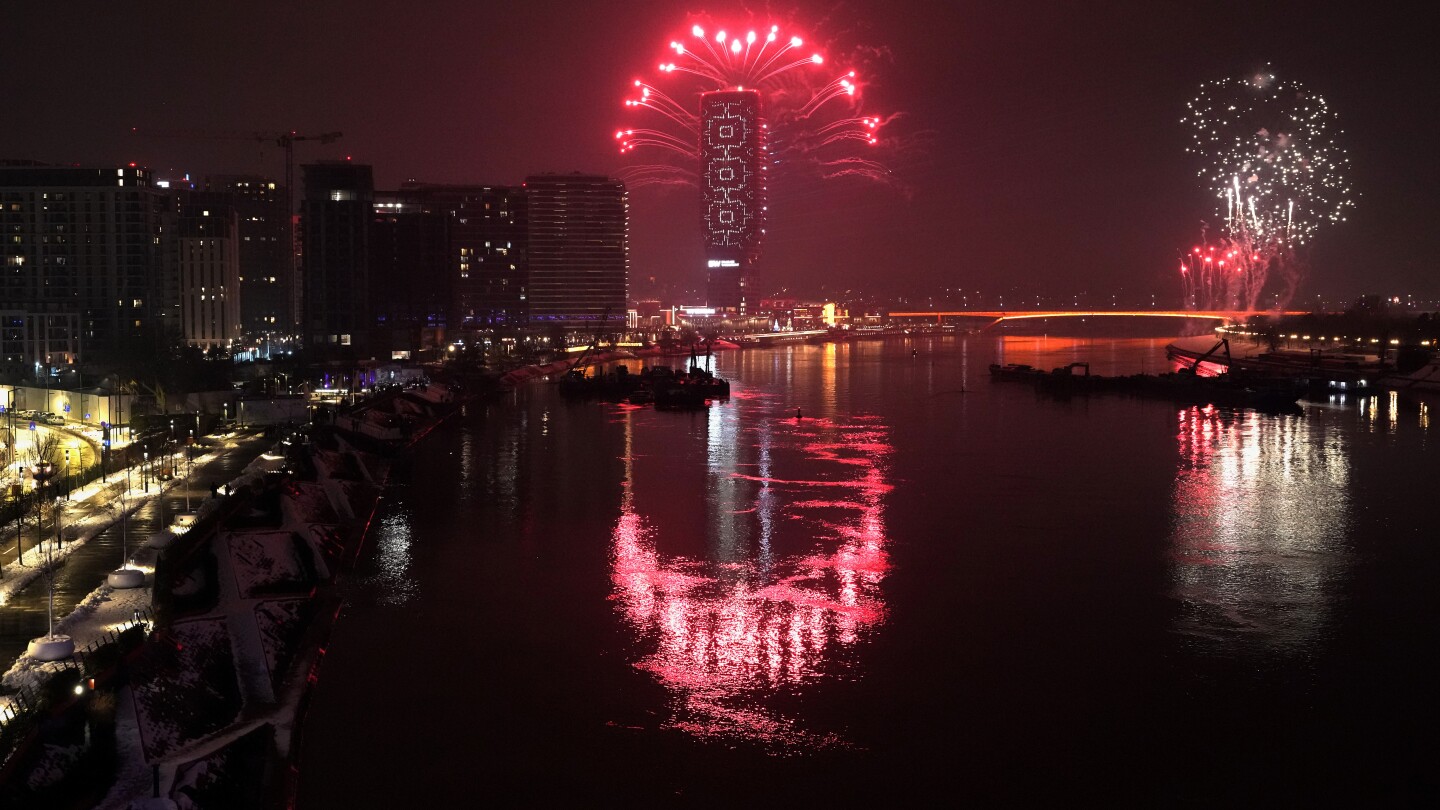
At midnight, Belgrade’s skyline lit up with an elaborate fireworks and drone show centered at a controversial new residential development along the Sava River. The housing complex has drawn criticism from opposition groups but enjoys strong backing from Serbia’s populist President Aleksandar Vucic, who has made the development a showcase of his administration’s urban renewal efforts.
Not all celebrations went smoothly across the country. In the central Serbian town of Cacak, tensions flared when protesters pelted a folk singer with snowballs during a performance at the main square. According to N1 regional television, the demonstrators expressed anger over local authorities using public funds for the celebrations amid ongoing economic challenges facing many Serbians.
The incident reflects broader political tensions that have simmered in Serbia throughout the past year. President Vucic has faced persistent street protests challenging what critics describe as his increasingly autocratic leadership style. These demonstrations gained significant momentum following a November 2023 train station disaster in northern Serbia that claimed 16 lives and raised questions about infrastructure safety and government accountability.
The Serbian New Year celebrations come at a time when the country continues to navigate complex political and economic realities, balancing traditional cultural practices with modernization efforts. While many embrace these dual celebrations as part of their cultural heritage, others view them through a more critical lens, seeing the extended holiday season as either a welcome tradition or an unnecessary commercial extension.
As Serbia moves further into 2024, the contrasting views on this traditional celebration highlight the ongoing dialogue between cultural preservation and contemporary pragmatism in a nation still defining its modern identity while honoring its Orthodox heritage.
Fact Checker
Verify the accuracy of this article using The Disinformation Commission analysis and real-time sources.

9 Comments
The Serbian New Year celebrations highlight the enduring role of religion in shaping cultural identity. While calendars may differ, the spirit of the holidays seems to unite the community. It’s a nice example of how tradition can thrive alongside modernization.
The continued observance of the Serbian New Year is a testament to the resilience of cultural identity. Even as the world becomes more interconnected, communities can still find ways to preserve their unique traditions and heritage. It’s an inspiring example of diversity.
Absolutely. Maintaining these ancient practices is important for Serbia to retain its distinct cultural identity. It’s heartening to see the community embrace the Serbian New Year celebrations with such enthusiasm.
Interesting to see Serbia maintain its Orthodox Christian calendar and traditions. It’s a reminder of the cultural diversity across Europe and the continued importance of religious observances, even as the world becomes more globalized.
The Serbian New Year celebrations are a fascinating example of how religious and cultural identity can shape a country’s traditions. It’s admirable that Serbia continues to observe these ancient customs, even as the rest of the world follows the Gregorian calendar. This diversity is what makes our world so rich and vibrant.
I appreciate Serbia’s commitment to preserving its cultural heritage. Keeping alive ancient traditions is valuable, even as societies modernize. The festive atmosphere in Belgrade sounds wonderful.
Agreed. Celebrating the Serbian New Year is a way for the people to stay connected to their roots and identity. It’s admirable that they continue these customs despite the Gregorian calendar’s widespread use.
I’m curious to learn more about the origins and significance of the Serbian New Year traditions. How do they differ from the global New Year celebrations, and what do they mean to the Serbian people? It’s fascinating to see these ancient customs still being observed.
It’s wonderful to see Serbia honoring its Orthodox Christian roots through the Serbian New Year celebrations. Preserving long-standing traditions is crucial, especially in an increasingly globalized world. This event seems to bring the community together in a meaningful way.