


Listen to the article
Nearly four years into Russia’s full-scale invasion, approximately 3-5 million Ukrainians remain in territories under Moscow’s control, facing severe humanitarian challenges amid forced cultural assimilation and political repression.
Russia currently occupies about 20% of Ukrainian territory, including the illegally annexed regions of Donetsk, Luhansk, Kherson, and Zaporizhzhia. Even President Vladimir Putin has acknowledged “many truly pressing, urgent problems” in these areas, where residents struggle with inadequate housing, water, power, heat, and healthcare services.
Beyond infrastructure issues, residents face systematic suppression of Ukrainian identity. Russian citizenship, language, and cultural practices are imposed on the population, particularly visible in revised school curricula and textbooks designed to align with Moscow’s narrative.
“The people there aren’t living, they’re just surviving,” said Oleksii Vnukov, who escaped from the village of Kudriashivka in the Luhansk region after Russian soldiers twice threatened to kill him. His wife, Inna Vnukova, described how she and her teenage son fled amid mortar fire, waving a white sheet to avoid being targeted.
The family now lives in Estonia, where they have rebuilt their lives. Vnukov works as an electrician while his wife is employed at a printing house. Their son is now 20, and they have a one-year-old daughter—a new beginning far from their occupied homeland where only 150 of the original 800 villagers remain.
Human rights observers have documented widespread abuses in occupied territories. Oleksandra Matviichuk, head of the Nobel Peace Prize-winning Center for Civil Liberties, reports that Russia has established a “vast network of secret and official detention centers where tens of thousands of Ukrainian civilians” are held indefinitely without charges.
The strategic port city of Mariupol, which fell to Russian forces in May 2022 after a devastating siege, exemplifies the occupation’s impact. The bombing of the Donetsk Academic Regional Drama Theater killed nearly 600 civilians—the war’s deadliest single attack against civilians, according to an Associated Press investigation.
A former Mariupol actor, who spoke on condition of anonymity to protect his elderly parents still in the city, described how they were forced to take Russian citizenship to receive medical care and modest compensation for their destroyed home. Although the city’s population is roughly half its pre-war size, new housing is reportedly allocated primarily to Russian newcomers rather than displaced locals.
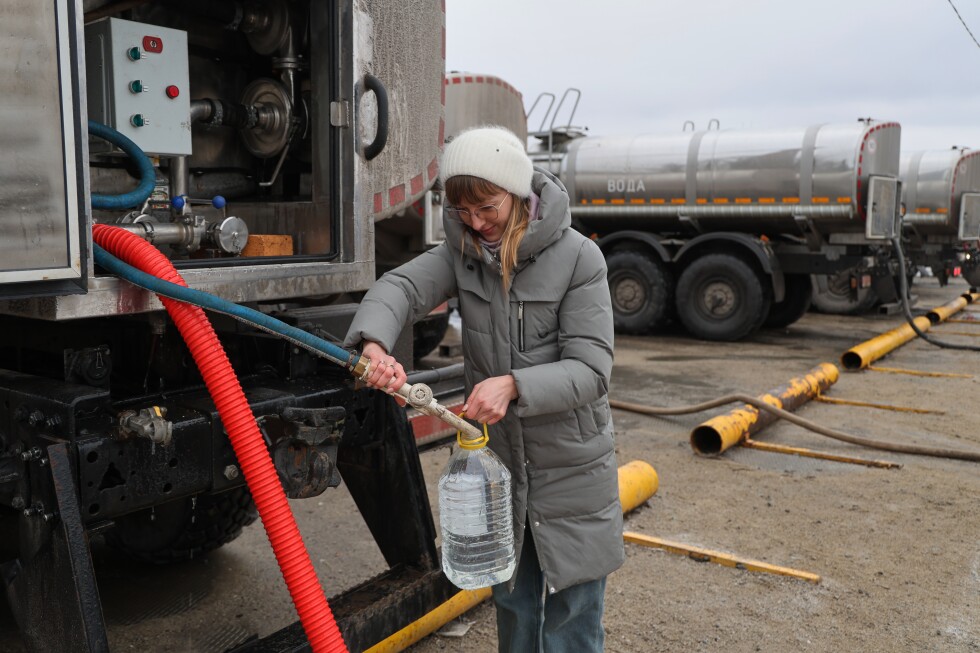
Infrastructure across occupied regions continues to deteriorate. In Alchevsk, a Luhansk region city, over half the homes lack heat during the bitter winter months, with just five warming stations available for residents. In Donetsk, water trucks fill barrels outside apartment buildings, but these freeze solid in winter, causing conflicts over this essential resource.
Sievierodonetsk, once home to 140,000 people, now houses just 45,000 mostly elderly or disabled residents. The city operates with only one ambulance crew, while Russian medical workers rotate through its hospital.
Moscow encourages Russians to relocate to occupied territories with financial incentives, offering salary supplements for teachers, doctors, and cultural workers who commit to living in these regions for five years.
Perhaps most troubling is the atmosphere of fear and suspicion. Stanislav Shkuta, who escaped from Nova Kakhovka in the Kherson region in 2023, recalled Russian soldiers forcing bus passengers to remove their shirts to check for Ukrainian patriotic tattoos. “I turned white with fear, wondering if I’d cleared everything on my phone,” he said.
Mykhailo Savva of the Center for Civil Liberties confirms that “Russian special services continue to identify disloyal Ukrainians, extract confessions, and continue to detain people,” with residents subjected to document checks and mass searches.
Human rights groups estimate that at least 16,000 civilians have been illegally detained, though Ukrainian Human Rights Ombudsman Dmytro Lubinets believes the actual number could be significantly higher, as many are held incommunicado in what were initially referred to as “filtration camps”—facilities designed to identify and remove individuals deemed potentially disloyal to Russian authorities.
As the conflict approaches its four-year mark, those trapped in occupied territories face not only physical hardship but also the systematic erasure of their Ukrainian identity, caught in a humanitarian crisis that shows little sign of resolution.
Fact Checker
Verify the accuracy of this article using The Disinformation Commission analysis and real-time sources.

25 Comments
Exploration results look promising, but permitting will be the key risk.
Good point. Watching costs and grades closely.
Uranium names keep pushing higher—supply still tight into 2026.
Good point. Watching costs and grades closely.
Good point. Watching costs and grades closely.
Uranium names keep pushing higher—supply still tight into 2026.
Good point. Watching costs and grades closely.
I like the balance sheet here—less leverage than peers.
Good point. Watching costs and grades closely.
Good point. Watching costs and grades closely.
Nice to see insider buying—usually a good signal in this space.
Good point. Watching costs and grades closely.
Good point. Watching costs and grades closely.
Nice to see insider buying—usually a good signal in this space.
Good point. Watching costs and grades closely.
Production mix shifting toward World might help margins if metals stay firm.
Good point. Watching costs and grades closely.
Good point. Watching costs and grades closely.
Exploration results look promising, but permitting will be the key risk.
Good point. Watching costs and grades closely.
Production mix shifting toward World might help margins if metals stay firm.
Good point. Watching costs and grades closely.
I like the balance sheet here—less leverage than peers.
Good point. Watching costs and grades closely.
Good point. Watching costs and grades closely.