


Listen to the article
Rome’s ancient Colosseum has undergone a meticulous restoration, bringing new life to one of the world’s most iconic monuments by utilizing the same travertine marble that Roman builders used 2,000 years ago.
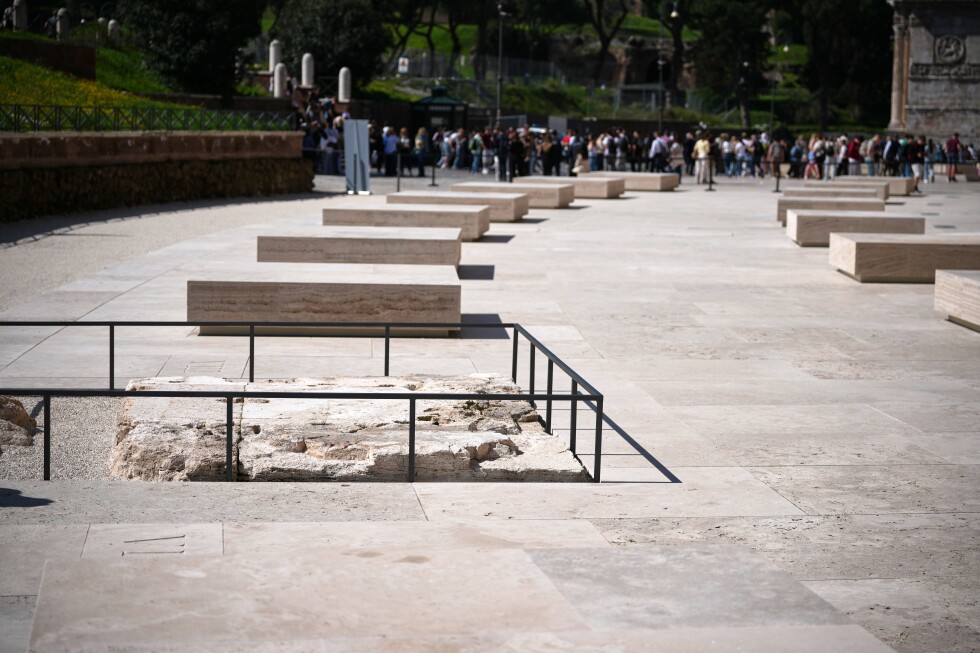
The ambitious project focused on revitalizing the semicircular piazza outside the arena, where ancient Romans once gathered beneath towering arcades while waiting to enter the spectacles within. These original arcades, which featured marble columns up to 50 meters (164 feet) high, had collapsed over centuries due to earthquakes and ground instability.
“These blocks of travertine marble are placed exactly where the pillars, the original pillars were based,” explained Italian architect Stefano Boeri, who designed the renovated piazza. “The idea we had was to give back to the public the perception of the proportion of the arcades and the proportion of the vaults of the arches that were used to enter in the center of the Colosseum.”
Visitors can now sit on large travertine marble slabs positioned precisely where the ancient columns once stood. The restoration also includes reproductions of the Roman numerals that originally guided spectators to their appropriate seating sections, enhancing the educational aspect of the experience.
The restoration began with archaeological excavations, with workers digging down a meter to reach the level where travertine paving stones once covered the entrance area. This process yielded remarkable discoveries including coins, statues, animal bones, and a gold ring. Below this level lies the recently opened underground passageway once used by Emperor Commodus to enter the Colosseum while avoiding the general public.
In a testament to historical authenticity, restorers sourced new travertine slabs from the same quarries that supplied ancient Roman builders. These quarries in Tivoli continue to provide material for contemporary structures including religious buildings, banks, museums, government buildings, and private residences.
“From the beginning we understood only one thing and that was that we wanted to be involved,” said Fabrizio Mariotti, head of the Mariotti Carlo stonecutting firm, which has specialized in travertine work for four generations. “For a family like ours that has been working with travertine for four generations, working at the Colosseum, which is the symbol not only of Rome but also of this material, is so important.”
The renovation represents a significant upgrade for Italy’s most popular tourist destination, which drew an impressive 9 million visitors in 2025. Prior to the restoration, the exterior area had deteriorated, becoming overgrown with weeds and cluttered with fragments of ruins.
This project coincides with other major infrastructure improvements in Rome. Earlier this year, the city opened two new subway stations, including one situated beneath the Colosseum itself, completing a multi-billion euro metro project. Funding for the Colosseum’s perimeter restoration came from compensatory funds allocated from the metro project, according to officials.
The restoration not only preserves the historical integrity of this UNESCO World Heritage site but also enhances the visitor experience by providing a more accurate representation of how Romans would have encountered the venue during its heyday. By recreating elements of the original entrance area, tourists gain better insight into the monumental scale and sophisticated design that made the Colosseum such an engineering marvel of the ancient world.
This latest renovation continues Italy’s ongoing commitment to preserving its archaeological treasures while making them accessible to modern visitors, balancing conservation with public engagement at one of the world’s most recognizable symbols of ancient Roman civilization.
Fact Checker
Verify the accuracy of this article using The Disinformation Commission analysis and real-time sources.

11 Comments
Rebuilding the long-gone column footprints is a clever way to visualize the Colosseum’s grand scale and proportions. I wonder if they’ll also consider recreating some of the decorative elements that adorned the exterior.
Preserving iconic landmarks like the Colosseum is so important. This renovation seems to strike a good balance between restoration and maintaining the site’s historical integrity.
Fascinating restoration work on this iconic Roman landmark. It’s great to see the Colosseum’s original architectural features recreated, giving visitors a more immersive sense of what it was like in its heyday.
The use of the same travertine marble as the original construction is a nice touch, helping to preserve the historical authenticity.
This restoration project sounds like it’s really bringing the Colosseum back to life in an authentic way. The attention to detail, like the travertine marble and Roman numerals, is commendable.
I wonder if this renewed focus on the Colosseum’s exterior might eventually lead to further excavations or restoration work inside the arena itself.
Interesting that they’re using Roman numerals on the seating reproductions. That’s a nice nod to the original visitor experience. I’m curious to see if they plan any other interactive elements to further engage people with the Colosseum’s history.
Fascinating to see how the Colosseum’s external renovations are aiming to recreate the long-lost elements of its original design. I wonder if this could inspire similar restoration efforts for other ancient Roman structures.
Restoring the Colosseum’s original proportions and visual cues is a really interesting approach. I imagine it will give visitors a much more immersive sense of what the site was like in its prime.
Integrating modern amenities like the seating slabs, while still maintaining historical authenticity, seems like a good balance.
The Colosseum is such an iconic and historically significant structure. It’s great to see such care and effort being put into preserving its original architectural features for future generations to appreciate.