


Listen to the article
Scientists Capture Rare Footage of Sperm Whale Birth, Revealing Extraordinary Cooperative Behavior
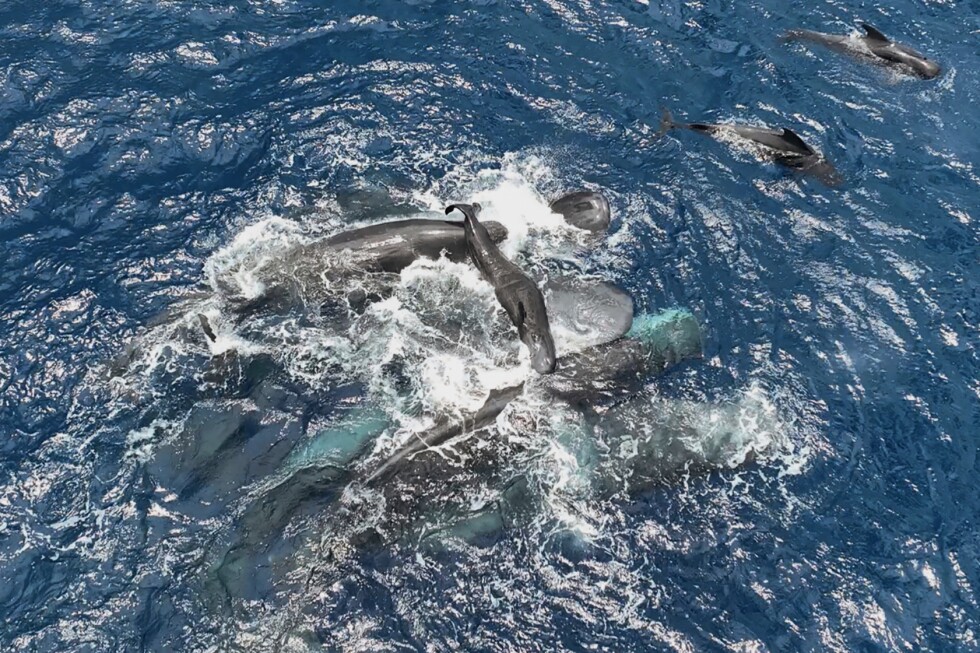
Rare footage of a sperm whale giving birth has provided scientists with unprecedented insights into the social dynamics and cooperative behaviors of these mysterious marine giants. The video, captured in 2023 off the Caribbean island of Dominica, documents a remarkable level of coordination among female whales that researchers say is extremely uncommon in the animal kingdom outside of primates.
During the birth, female whales from different family lines worked together to support the mother through labor, helping to lift the newborn calf to the water’s surface to take its first breath – a critical moment for the survival of the young whale.
“The group quite literally helps bring the calf into the world,” said Oregon State University behavioral ecologist Mauricio Cantor, who was not involved in the research. This level of cross-family cooperation represents a rare example of collective birthing assistance in non-human mammals.
The extraordinary event was captured when researchers studying whale communication noticed unusual behavior among a group of eleven whales, most of them female. The whales surfaced with their heads facing one another and began thrashing and diving both above and below the water. Alert to the significance of what they were witnessing, scientists immediately deployed drones and microphones to document the birth.
The entire delivery process took approximately 30 minutes, but the cooperative behavior continued for hours afterward. Pairs of female whales took turns holding the baby above the water until it developed the strength and coordination to swim independently.
“This was just really a special event,” said study co-author David Gruber with the Cetacean Translation Initiative (Project CETI). The research team’s findings were published Thursday in two separate studies in the journals Scientific Reports and Science.
To understand the dynamics of the event, researchers created specialized software to analyze the collected footage. What particularly struck them was the cross-familial nature of the cooperation. Female whales from different maternal lines united to support the new calf, demonstrating how the species’ close-knit, female-led social structures manifest during critical life moments.
“It’s amazing to think about how, when faced with this impossible challenge, these animals come together to succeed,” noted study co-author Shane Gero, also with Project CETI.
The acoustic component of the research revealed equally fascinating insights. The whales produced distinct vocalizations during key moments of the birth, including slower, longer sets of clicks that researchers believe may have facilitated communication and coordination throughout the birthing process.
These findings are particularly significant given the challenges of studying sperm whale behavior. Despite their status as the largest toothed predators on Earth, sperm whales spend most of their lives deep underwater, making direct observation extremely difficult. Prior to this footage, there were only a handful of sperm whale birth records documented over the past 60 years, most coming from anecdotal accounts or observations from whaling vessels.
The discovery raises numerous questions about how these whale communities organize and communicate. How did the group of assisting females form in the first place? What signals prompted them to join the birthing event? What evolutionary advantages might this cooperative behavior confer?
“I think it’s just exciting to think about the social lives of these animals,” said biologist Susan Parks from Syracuse University, who wasn’t involved with the studies. The footage provides a rare glimpse into the complex social dynamics of a species that has largely remained mysterious to humans despite centuries of interaction.
For marine biologists, this breakthrough observation offers not just answers but new avenues of inquiry into cetacean behavior and communication. As research technologies improve, scientists hope to gather more data on these elusive creatures, potentially unlocking further insights into their sophisticated social structures and communication systems.
The research represents a significant step forward in understanding how intelligent marine mammals navigate critical life events through cooperation and social bonds that extend beyond immediate family lines.
Fact Checker
Verify the accuracy of this article using The Disinformation Commission analysis and real-time sources.

12 Comments
This is such an important scientific finding. Observing rare behaviors like this collective birthing assistance in non-human mammals is invaluable for expanding our understanding of animal cognition and social organization.
Absolutely, this research could have far-reaching implications for how we view the intelligence and emotional capacities of whales and other highly social marine mammals.
As someone interested in energy and commodity markets, I find this video fascinating from an ecological standpoint. Sperm whales play a crucial role in marine ecosystems, and understanding their social dynamics can inform responsible development and conservation efforts.
That’s an excellent point. Protecting the habitats and welfare of species like sperm whales is crucial, not just from an environmental perspective, but also for the health and sustainability of related industries.
Fascinating to see such remarkable cooperation and social bonding among these magnificent creatures. The level of coordination and care displayed during the birth is truly remarkable and speaks to the complex social structures of sperm whales.
I agree, this footage provides incredible insights into the social dynamics of sperm whales. The way the females work together to support the birthing mother and newborn calf is quite extraordinary.
Wow, what an amazing and rare glimpse into the lives of these magnificent creatures. The level of coordination and care shown by the female whales is truly humbling. This footage is a powerful reminder of the rich social fabric of the natural world.
I agree, this video offers a humbling perspective. It’s a privilege to witness such an intimate and important moment in the lives of these whales.
This is really remarkable footage. The level of cooperation and care displayed by the female whales is quite extraordinary. It’s a humbling reminder of the complex social and emotional lives of these magnificent marine creatures.
I agree, this video provides a unique window into the social dynamics of sperm whales. It’s a fascinating study in animal behavior and cooperation that can inform our understanding of marine ecosystems.
As a mining and commodities investor, I’m always fascinated by developments in the natural world. This video of a sperm whale birth shows the incredible complexity and cooperation present in these marine ecosystems.
You raise a good point. Gaining insights into the social behaviors of whales and other species can help us make more informed decisions about the responsible development of natural resources in their habitats.