


Listen to the article
Angry protesters stormed and set fire to the offices of Bangladesh’s two leading newspapers late Thursday following the death of Sharif Osman Hadi, a prominent activist from last year’s political uprising. The attacks trapped journalists and staff inside the buildings for hours before they were safely evacuated early Friday morning.
Hadi, a spokesperson for the cultural group Inqilab Moncho, died in a Singapore hospital Thursday evening after being shot in Dhaka last Friday. According to authorities, two men on a motorcycle followed Hadi while he was riding in a rickshaw before one shot him and fled the scene. Despite initial treatment in Dhaka, Hadi was airlifted to Singapore in critical condition but succumbed to his injuries.
Bangladesh officials claim to have identified the suspects and suggested the shooter likely escaped to India—allegations that sparked a diplomatic row between the neighboring countries. India summoned Bangladesh’s envoy to express condemnation over the accusations, while Bangladesh reciprocated by summoning the Indian representative to Dhaka seeking clarification.
Hadi was known as a fierce critic of both India and former Prime Minister Sheikh Hasina, whose 15-year rule ended during last year’s uprising. He had planned to run as an independent candidate in a major Dhaka constituency in the upcoming national elections scheduled for February by the interim government.
The Inqilab Moncho group, formed after Hasina’s ouster, has been actively organizing street protests against Hasina and India. Many of Bangladesh’s Islamists and opposition groups have accused Hasina’s former government of subservience to India during her tenure.
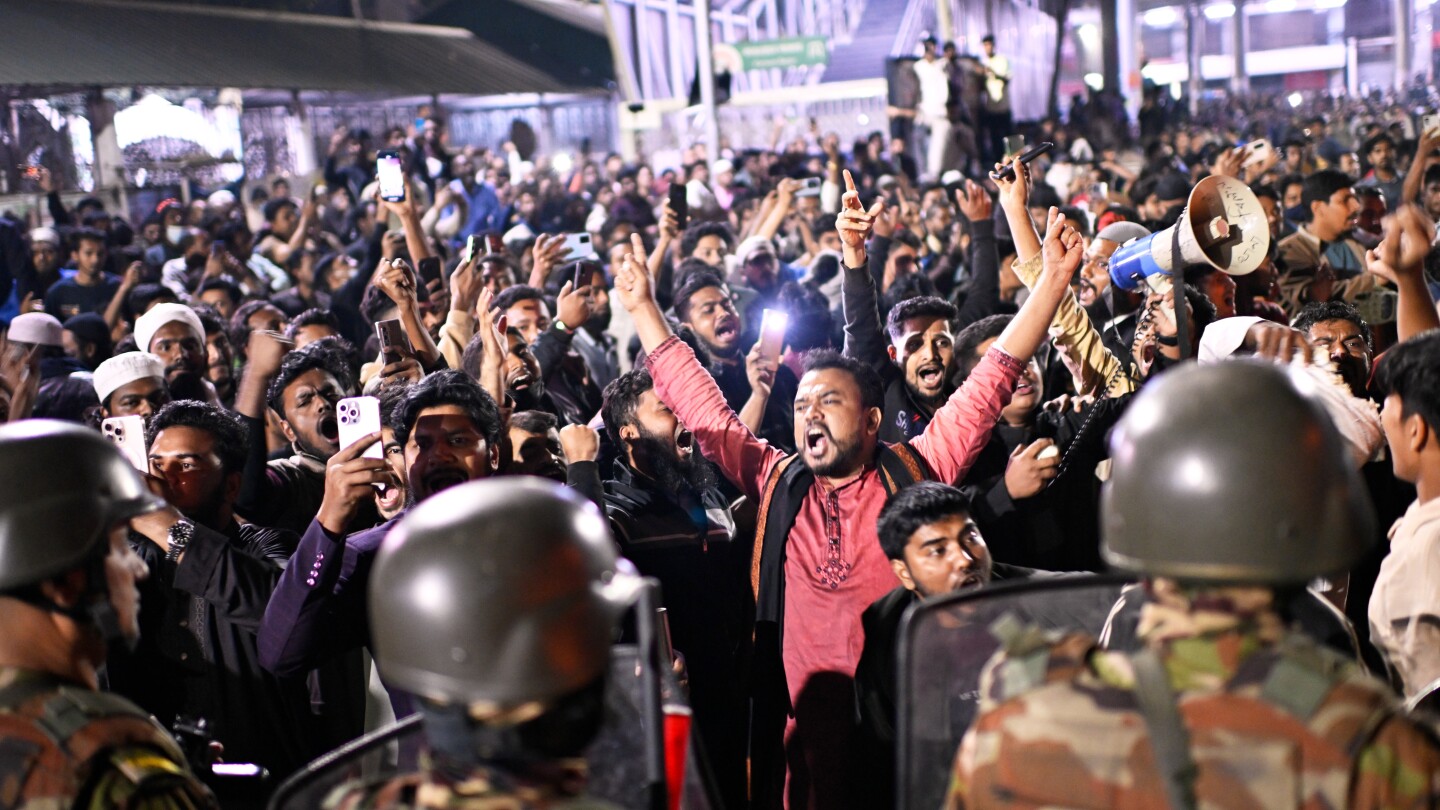
News of Hadi’s death triggered immediate protests across Bangladesh. Hundreds gathered at Shahbagh Square near Dhaka University, with many chanting “Allahu Akbar” (God is great). The demonstrations soon escalated as protesters converged on the headquarters of Prothom Alo, the country’s leading Bengali-language daily, in Dhaka’s Karwan Bazar area. They vandalized and set fire to the building.
A separate group of protesters simultaneously attacked the nearby offices of The Daily Star, Bangladesh’s premier English-language newspaper. The editors of both publications are reportedly closely connected to Nobel Peace Prize laureate Muhammad Yunus, the country’s interim leader. Previous demonstrations by Islamist groups had accused these newspapers of maintaining alleged links with India.
Despite the presence of soldiers and paramilitary border guards outside both buildings, security forces did not disperse the protesters but attempted to convince them to leave peacefully as firefighters arrived. The blazes trapped staff working inside, with Daily Star journalist Zyma Islam posting on Facebook, “I can’t breathe anymore. There’s too much smoke.” By early Friday, the fires were contained, but both newspapers suspended their online updates and did not publish print editions on Friday.
Protesters also targeted Chhayanaut, a respected liberal cultural institution in Dhaka’s Dhanmondi neighborhood. As of Friday morning, dozens remained at Shahbagh, vowing to continue their demonstrations. Hadi’s body is expected to arrive in Dhaka from Singapore on Friday evening.
Interim leader Yunus addressed the nation Thursday night, promising to bring Hadi’s killers to justice and declaring Saturday a day of national mourning. He urged citizens to remain calm amid the tensions.
Critics of Yunus and supporters of Hasina’s Awami League party have blamed the interim government for enabling the rise of Islamist influence in Bangladesh, which has a history of political violence despite being a parliamentary democracy. The interim government has banned all activities by Hasina’s party, including participation in the February elections. Last month, a Bangladesh court sentenced the exiled former prime minister to death for crimes against humanity related to last year’s uprising.
Anti-India sentiment has intensified in recent weeks. On Wednesday, protesters attempted to march toward the Indian High Commission in Dhaka, prompting the closure of its visa section. India had already suspended tourist visas for Bangladeshis after Hasina’s ouster, citing security concerns, though it continues providing medical visas. Similar protests occurred in Rajshahi, where demonstrators tried to approach a regional Indian diplomatic office before being stopped by police.
Human Rights Watch and Amnesty International have recently expressed concerns over human rights violations in Bangladesh as political tensions continue to mount in the lead-up to February’s elections.
Fact Checker
Verify the accuracy of this article using The Disinformation Commission analysis and real-time sources.

8 Comments
Tragic to hear of the activist’s death and the violent protests that followed. This reflects the ongoing political tensions and unrest in Bangladesh. I hope the authorities can investigate thoroughly and find a peaceful resolution to the situation.
Agreed, the escalating tensions and violence are very concerning. A full, impartial investigation is crucial to understand what happened and prevent further clashes.
The loss of life and subsequent unrest is deeply troubling. I hope the authorities can exercise restraint, protect the rights of all citizens, and find a way to address the underlying grievances through peaceful dialogue.
This incident highlights the complex political dynamics in Bangladesh, with tensions between the government, activists, and neighboring countries. I’m curious to see how the authorities respond and whether they can find a peaceful solution to de-escalate the situation.
Allegations of cross-border involvement are bound to further inflame regional tensions. A transparent, international investigation may be needed to resolve the diplomatic row and get to the bottom of what happened.
Agreed, an impartial, multinational inquiry could help determine the facts and ease the diplomatic tensions between Bangladesh and India.
The storming of newspaper offices is a troubling development, as it threatens press freedom and the ability to report on these sensitive events objectively. I hope the government can restore order while respecting the rights of journalists and protesters.
Protecting the media is essential, even in times of unrest. Resorting to violence against news outlets is a dangerous precedent that should be strongly condemned.