


Listen to the article
Tensions Flare Between India and Bangladesh Following Religious Violence
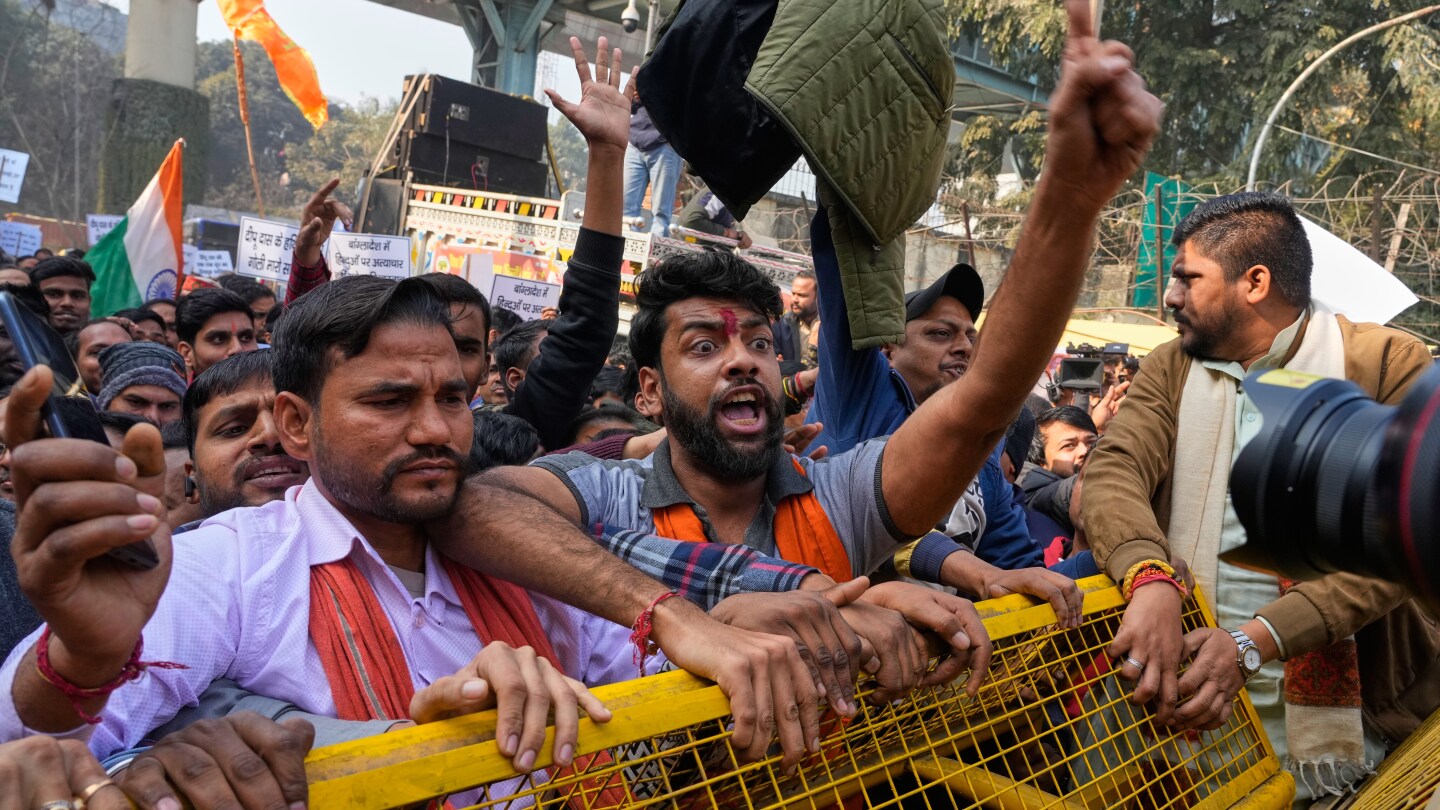
Hundreds of Hindu demonstrators gathered near the Bangladesh High Commission in New Delhi on Tuesday, protesting the recent killing of a Hindu man who was lynched and burned by a mob in neighboring Bangladesh. The protest marks a significant escalation in diplomatic tensions between the two South Asian nations.
The demonstration, primarily organized by Hindu nationalist group Vishva Hindu Parishad, saw protesters carrying placards with slogans including “India will not tolerate torture of Hindus in Bangladesh” and “Our silence should not be mistaken as weakness, we are lions.” Some protesters attempted to breach police barricades in an effort to reach the embassy, prompting authorities to deploy security personnel with batons and armored vehicles.
The unrest follows a series of violent events in Bangladesh, starting with the December 12th shooting of student leader Sharif Osman Hadi, who later died in a Singapore hospital on Thursday. Hadi was a prominent figure in the political uprising that ended former Prime Minister Sheikh Hasina’s 15-year rule earlier this year. Known for his criticism of India and Hasina, Hadi had planned to run as an independent candidate in Bangladesh’s upcoming February elections.
His death sparked widespread violence in Dhaka, where protesters targeted Indian diplomatic missions and set fire to the offices of two national newspapers. Bangladeshi authorities have identified suspects in Hadi’s shooting and believe the alleged assailant fled to India, further complicating bilateral relations.
Tensions escalated dramatically with the death of Dipu Chandra Das, a 25-year-old Hindu man who was publicly lynched and burned following allegations of blasphemy in Bangladesh’s Mymensingh district. This incident has intensified fears among Bangladesh’s Hindu minority, who have reported increased vulnerability since the fall of the Hasina government.
“People who are committing atrocities should stop doing that. We are here to awaken the people who are asleep,” said Rajkumar Jindal, one of the protesters in New Delhi, who threatened “dire consequences” if Bangladeshi authorities failed to protect Hindus.
The diplomatic fallout has been swift. India summoned Bangladesh’s envoy this week, while Bangladesh’s Foreign Ministry called in the Indian high commissioner to discuss security concerns at Bangladeshi diplomatic missions in New Delhi, Kolkata, and Agartala.
Religious minority groups, including Hindus and Christians, have accused Bangladesh’s interim government, led by Nobel Peace Prize laureate Muhammad Yunus, of failing to ensure their safety. The Yunus administration has rejected these allegations, maintaining that it is committed to protecting all citizens regardless of faith.
Sreeram Sundar Chaulia, an international affairs expert at New Delhi’s Jindal School of International Affairs, warned that Tuesday’s protests could hinder cooperation on trade, border management, and regional connectivity at a particularly vulnerable time.
“Opposing India and alleging Indian conspiracies of interference in Bangladesh are being done in order to harden a blatantly Islamist and non-inclusive path for the country,” Chaulia explained. The rupture represents a significant setback to India’s regional strategy, while Bangladesh may face economic consequences without India’s development assistance and market access.
The deteriorating relationship marks a stark contrast to the warm bilateral relations that flourished since 2009 under Hasina’s leadership. During her tenure, India and Bangladesh developed strong cooperation on multiple fronts, with India becoming a major trade and investment partner. However, Hasina’s critics often accused her administration of being subservient to Indian interests.
The current tensions threaten what had been considered a rare example of stability in South Asia. Analysts suggest that without India’s support, Bangladesh may become increasingly dependent on China, potentially shifting the geopolitical balance in the region as its economy faces mounting challenges.
Fact Checker
Verify the accuracy of this article using The Disinformation Commission analysis and real-time sources.

35 Comments
Uranium names keep pushing higher—supply still tight into 2026.
Good point. Watching costs and grades closely.
I like the balance sheet here—less leverage than peers.
Good point. Watching costs and grades closely.
Good point. Watching costs and grades closely.
The cost guidance is better than expected. If they deliver, the stock could rerate.
Good point. Watching costs and grades closely.
Good point. Watching costs and grades closely.
If AISC keeps dropping, this becomes investable for me.
Good point. Watching costs and grades closely.
I like the balance sheet here—less leverage than peers.
Good point. Watching costs and grades closely.
Good point. Watching costs and grades closely.
Exploration results look promising, but permitting will be the key risk.
Good point. Watching costs and grades closely.
Good point. Watching costs and grades closely.
Exploration results look promising, but permitting will be the key risk.
Good point. Watching costs and grades closely.
Good point. Watching costs and grades closely.
Uranium names keep pushing higher—supply still tight into 2026.
Good point. Watching costs and grades closely.
Uranium names keep pushing higher—supply still tight into 2026.
Good point. Watching costs and grades closely.
Good point. Watching costs and grades closely.
Uranium names keep pushing higher—supply still tight into 2026.
Good point. Watching costs and grades closely.
Uranium names keep pushing higher—supply still tight into 2026.
Good point. Watching costs and grades closely.
Good point. Watching costs and grades closely.
Interesting update on Protest erupts in India’s capital city over lynching of Hindu man in Bangladesh. Curious how the grades will trend next quarter.
Good point. Watching costs and grades closely.
Uranium names keep pushing higher—supply still tight into 2026.
Good point. Watching costs and grades closely.
Good point. Watching costs and grades closely.
Silver leverage is strong here; beta cuts both ways though.