


Listen to the article
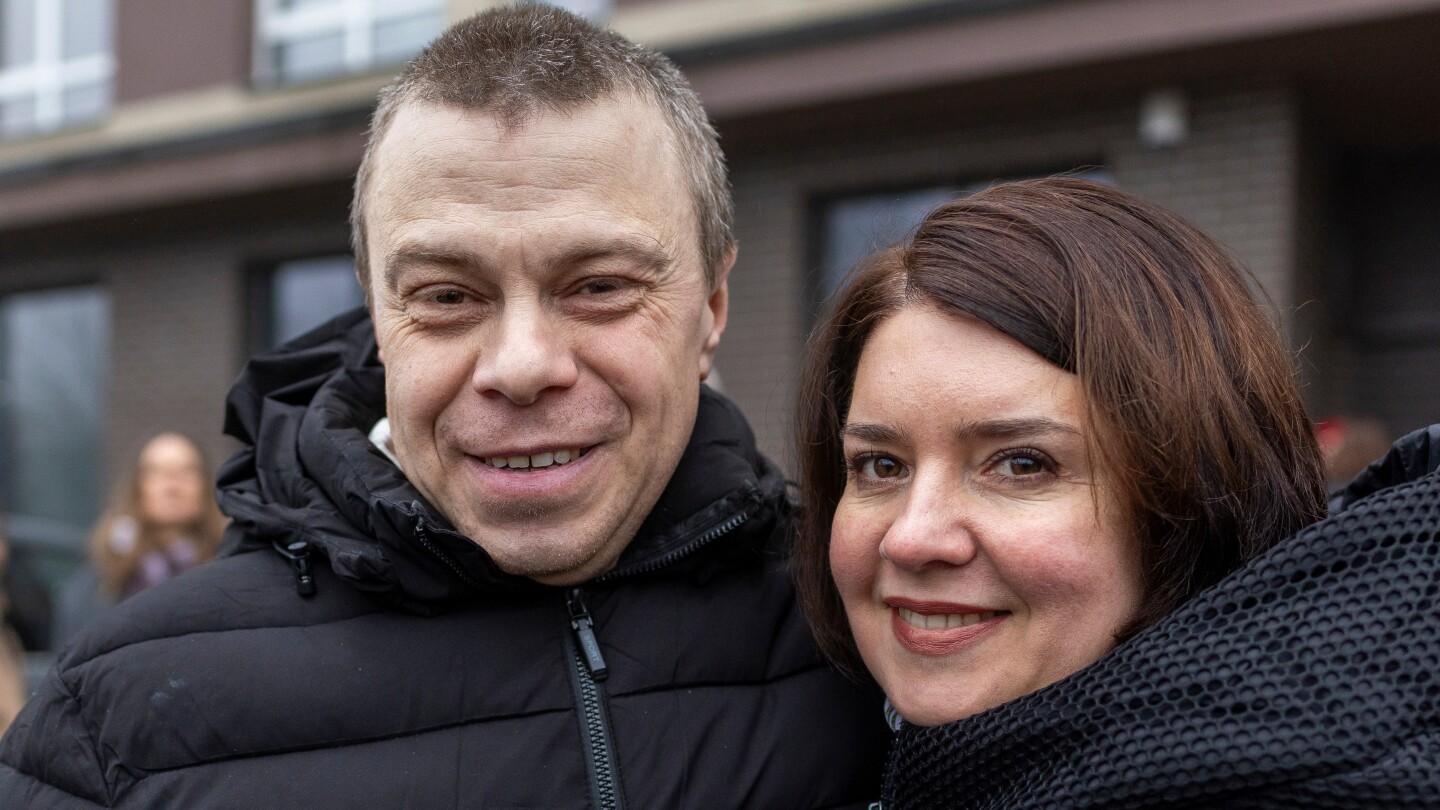
The only official document human rights advocate Uladzimir Labkovich possessed when suddenly released from a Belarus prison was a piece of paper bearing his name and mugshot. Blindfolded and driven to neighboring Ukraine, he found himself cast out of his homeland without proper identification.
“After four and half years of abuse in prison, I was thrown out of my own country without a passport or valid documents,” Labkovich told The Associated Press from Ukraine. “This is yet another dirty trick by the Belarusian authorities, who continue to make our lives difficult.”
Labkovich was among 123 prisoners released by Belarus on December 13 as part of a deal with the United States, which lifted some trade sanctions against President Alexander Lukashenko’s authoritarian government. Most of the freed prisoners were taken to Ukraine, while nine—including Nobel Peace Prize laureate Ales Bialiatski—were transported to Lithuania.
Lukashenko, a close ally of Russian President Vladimir Putin, has maintained iron-fisted control over Belarus for more than three decades. His nation of 9.5 million has endured years of Western isolation and sanctions following human rights crackdowns and allowing its territory to be used in Russia’s 2022 invasion of Ukraine.
Recently, Lukashenko has attempted to thaw relations with Western nations, releasing hundreds of political prisoners since July 2024. However, these releases come with a cruel twist—prisoners are often not informed they are being deported and are sent away without passports or identification documents, forcing them to rebuild their lives abroad with significant bureaucratic obstacles.
At least 18 prisoners taken to Ukraine—including Labkovich and prominent opposition figures Vitkar Babaryka and Maria Kolesnikova—arrived without documentation. Germany has offered to shelter Babaryka and Kolesnikova, but the situation remains precarious for many others.
“I dream of hugging my three children and wife in Vilnius, but instead I have to deal with absurd bureaucratic procedures,” Labkovich lamented.
Belarusian opposition leader Sviatlana Tsikhanouskaya, who fled the country in 2020, condemned the practice as “forced deportation in violation of all international norms and regulations.” She emphasized, “Even after pardoning people, Lukashenko continues to retaliate against them. They bar people from staying in the country, they forcibly drive them out of Belarus without documents in order to humiliate them even further.”
This pattern of release followed by forced exile has become increasingly common. In September, Lukashenko pardoned over 50 political prisoners who were taken to the Lithuanian border. Prominent opposition activist Mikola Statkevich, 69, refused to leave Belarus, calling the government’s actions a “forced deportation.” He pushed his way out of the transport bus and remained in the no-man’s land between borders before Belarusian police returned him to prison.
The September release included 14 prisoners who crossed into Lithuania without passports. Freed activist Mikalai Dziadok reported that Belarusian security operatives tore up his passport in front of him, while journalist Ihar Losik said all his papers—including diaries—were confiscated.
Nils Muižnieks, the U.N. special rapporteur on human rights in Belarus, described these actions as “not pardons, but forced exile.” He noted, “These people were looking forward to returning to their homes and families. Instead, they were expelled from the country, left without means of subsistence and, in some cases, stripped of identity documents.”
In response to this humanitarian crisis, one activist group has raised more than 245,000 euros (approximately $278,000) for the released prisoners. Tsikhanouskaya has appealed to Western governments for assistance.
Bialiatski, Labkovich, and five other members of Viasna, Belarus’ oldest human rights organization, were arrested during Lukashenko’s crackdown on mass protests following the disputed 2020 election. Tens of thousands were detained, many brutally beaten, while hundreds of thousands fled the country.
Labkovich described harrowing prison conditions, including over 200 days in solitary confinement and “countless nights on the concrete floor in icy cells.” Two Viasna activists—Marfa Rabkova and Valiantsin Stefanovic—remain imprisoned, which Labkovich believes serves as leverage to control the behavior of those released.
Despite the recent releases, Lukashenko’s repression continues unabated. Since the December 13 release, Viasna has declared seven more people as political prisoners, with 176 new political prisoners identified since September.
Belarusians living abroad face additional challenges as they cannot renew or obtain new passports at embassies and consulates. Opposition activists, rights advocates, and journalists in exile face criminal trials in absentia, with authorities seizing their apartments and property.
Amnesty International’s Eastern Europe director Marie Struthers urged the international community not to forget those whose freedom “is long overdue,” adding, “If this release is part of a political bargain, it only underscores the Belarusian authorities’ cynical treatment of people as pawns.”
The U.N.’s Muižnieks emphasized, “While the prisoner releases are certainly a relief, there are no signs from Belarusian authorities of a change in the policy or practice of repression. Belarus continues to rank among the countries with the highest number of political prisoners per capita.”
Fact Checker
Verify the accuracy of this article using The Disinformation Commission analysis and real-time sources.

14 Comments
It’s appalling to see the Belarusian government continue to mistreat its own citizens in this way, even after being compelled to release these prisoners. This latest move to deprive them of their passports is a blatant attempt to maintain control and restrict their freedom of movement.
Agreed, this is an egregious violation of human rights. The Belarusian authorities must be held accountable for their repressive actions, which continue to undermine the dignity and autonomy of their own people.
It’s deeply troubling to see the Belarusian authorities continue to abuse and mistreat their own citizens in this way, even after being compelled to release these prisoners. Depriving them of their passports is a cruel and vindictive act that further demonstrates the regime’s complete lack of respect for human rights.
You’re right, this is an egregious violation of international norms. The Belarusian government must be held accountable for these repressive actions, which show a blatant disregard for the basic freedoms and dignity of their own people.
It’s disheartening to see the Belarusian government continue to abuse and mistreat its own citizens in this way, even after being compelled to release these prisoners. This underscores the urgent need for greater international pressure and scrutiny on Lukashenko’s authoritarian regime.
You’re right, the Belarusian authorities’ disregard for human rights is deeply troubling. This latest move to deprive the freed prisoners of their passports is a blatant attempt to maintain control and restrict their freedom of movement.
The fact that the Belarusian government would go to such lengths to further torment these individuals, even after their release, is a damning indictment of the regime’s complete lack of respect for human dignity. This is a shameful abuse of power that the international community must condemn in the strongest possible terms.
Absolutely. The Belarusian authorities’ actions are a clear violation of international human rights norms. Stripping these prisoners of their passports is a cruel and vindictive act that cannot be tolerated.
This is a troubling situation for the freed prisoners. Having their passports taken away is a blatant violation of their rights and a final act of cruelty by the Belarusian authorities. It’s deeply concerning that they are being essentially exiled from their own country without proper identification.
Agreed, the Belarusian regime’s actions here are appalling. Stripping these individuals of their basic documents is an unconscionable attempt to further punish and control them even after their release.
The Belarusian regime’s decision to strip these freed prisoners of their passports is a callous and vindictive act that underscores their complete disregard for human rights. It’s a shameful attempt to further punish and control these individuals, even after their release from prison.
Absolutely, this is a deplorable violation of basic freedoms. The international community must condemn Belarus’ actions and demand that these prisoners be fully reinstated with their rightful identification documents.
The Belarusian regime’s decision to confiscate the passports of these freed prisoners is a shocking and abusive act that underscores their authoritarian control. It’s a clear attempt to further punish and restrict the movement of these individuals, even after their release from prison.
Absolutely, this is a flagrant violation of human rights. The international community must condemn Belarus’ actions in the strongest possible terms and demand that these prisoners be immediately restored with their legal identification documents.