


Listen to the article
Political tensions have eased as the Iranian women’s soccer team returned home, leaving behind two players who chose to remain in Australia seeking asylum, in what critics describe as a diplomatic tussle that prioritized politics over personal welfare.
The controversial saga began when seven Iranian team members initially accepted asylum in Australia, but five later reversed their decisions and rejoined their team for undisclosed reasons. The situation drew international attention after team members declined to sing the Iranian national anthem during their first match at the Women’s Asian Cup on Australia’s Gold Coast on March 2.
“We ended up with an outcome that is certainly far from ideal,” said Graham Thom, advocacy coordinator for the Refugee Council of Australia. “Hopefully the two who are remaining get the protection they need, but we just hope that those who have returned are also safe.”
Iran has claimed victory in the public relations battle that intensified after Australian Immigration Minister Tony Burke released a photo of himself with five unveiled Iranian women who had accepted protection visas. The unusual public disclosure alarmed refugee advocates, who questioned whether women raised under Iran’s regime could reasonably challenge the Australian government’s media approach.
Kylie Moore-Gilbert, a political scientist at Sydney’s Macquarie University who spent over two years imprisoned in Iran on espionage charges, criticized the handling of the situation. “Had these women quietly sought asylum without that publicity around them, it’s possible that the Islamic Republic officials might have, as they have in the cases of other Iranian sportspeople in the past who’ve defected, simply allowed that to happen,” she told Australian Broadcasting Corporation.
The situation escalated when U.S. President Donald Trump publicly called for asylum to be granted to the team and personally contacted Australian Prime Minister Anthony Albanese on the matter. Albanese confirmed that four players and a team manager had accepted humanitarian visas.
“It quickly turned into a political dispute and political theater between Iran and the U.S. and Australia,” explained Shahram Akbarzadeh, professor of Middle East politics at Deakin University. “The Iranians responded accordingly. They couldn’t be seen to be embarrassed by their failure.”
The gesture of not singing the anthem attracted global attention, particularly after Iranian sports commentator Mohammad Reza Shahbazi labeled the women “wartime traitors” in a television broadcast. The team sang the anthem in their next match, suggesting mounting pressure.
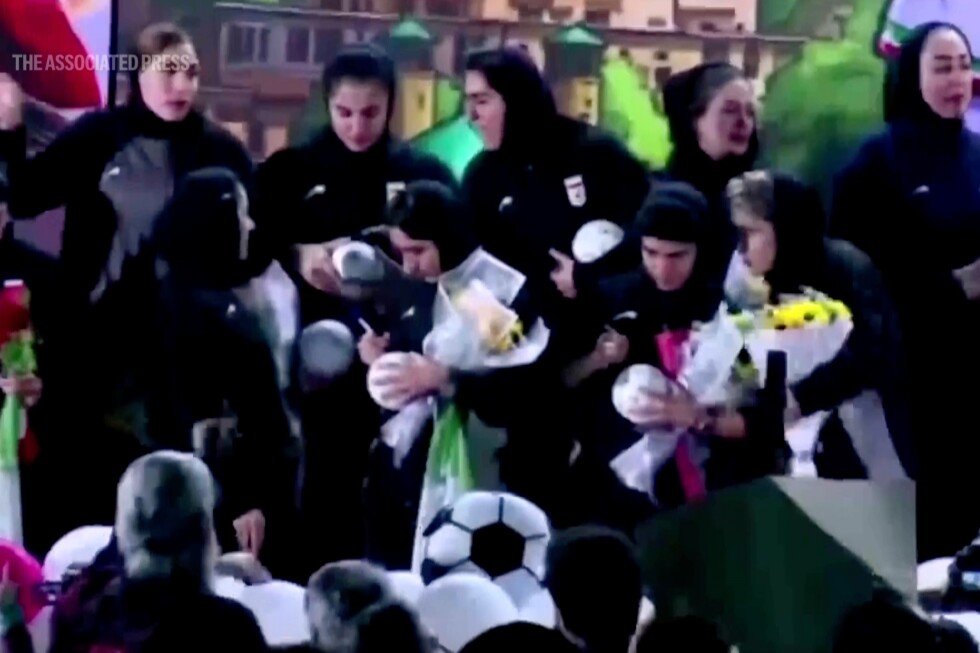
Following their tournament elimination, all but two women who had initially accepted asylum rejoined the team in Kuala Lumpur before the squad continued to Oman and eventually returned to Iran. Iranian state media showed the returning players being welcomed home with ceremony.
“We are so happy to be in Iran, because Iran is our homeland,” midfielder Fatemeh Shaban told a flag-waving crowd upon their return.
While reasons for the players’ change of heart remain undisclosed, there were widespread concerns about potential threats to family members remaining in Iran. Shiva Amini, a former Iranian national soccer player who received asylum in Switzerland in 2017, said she had been in contact with both the players who remained in Australia—Fatemeh Pasandideh and Atefeh Ramezanisadeh—and some who returned to Iran.
“This is beyond sad that they couldn’t stay, because even if you get back to Iran, they’re gonna threaten your family,” Amini told The Associated Press. She claimed the regime pressured at least one player by threatening harm to the player’s mother, though she declined to provide specifics out of safety concerns.
Iranian Foreign Ministry spokesman Esmaeil Baghaei denied that any pressure had been applied to the women who returned, instead accusing Australian officials of coercing the players. “They didn’t seek asylum. They were forced to. They were coerced to. They didn’t do it voluntarily,” Baghaei told ABC. He alleged that Australian officials had initially approached the women under the pretext of drug testing before asking them to sign visa papers and pose for photos with Burke.
Australian Assistant Immigration Minister Matt Thistlethwaite described the situation as “very complex” after the fifth refugee rejoined her team. “These are deeply personal decisions, and the government respects the decisions of those that have chosen to return. And we continue to offer support to the two that are remaining,” he said.
Australia has traditionally handled asylum cases with discretion, recognizing that public attention can increase risks to refugees and their families. Critics suggest the outcome might have differed had the women received independent legal advice earlier and had the process not been conducted so publicly.
Fact Checker
Verify the accuracy of this article using The Disinformation Commission analysis and real-time sources.

23 Comments
It’s concerning to see the Iranian government allegedly pressuring its women’s soccer team. Asylum seekers deserve protection, not repatriation against their will.
Absolutely. The government’s actions appear to prioritize optics over the human rights of the players. Troubling development.
The Iranian government’s treatment of these women athletes is yet another example of their systematic oppression of women. Deeply troubling situation.
Agreed. The players who sought asylum deserve protection, not coercion to return home. Hoping they can find safety in Australia.
This case underscores the challenges female athletes face, especially in repressive regimes. I hope the two players who remained in Australia are able to find safety.
Yes, the pressure on these women must have been immense. Kudos to the Australian government for offering them asylum.
This saga highlights the ongoing struggle for women’s rights in Iran. The players who sought asylum deserve protection, not coercion to return home.
The Iranian regime’s handling of this situation is yet another example of their disregard for human rights, especially when it comes to women. Shameful.
This saga highlights the ongoing struggle for women’s rights in Iran. The regime’s heavy-handed response is a shameful abuse of power.
The Iranian government’s handling of this situation is deeply concerning. Forcing athletes to return against their will is a blatant violation of human rights.
While the details are murky, the politicization of this case is deeply troubling. Asylum seekers should be afforded safety and dignity, not used as bargaining chips.
Agreed. The Iranian government’s heavy-handed response is unacceptable. Hoping the remaining players can find refuge in Australia.
It’s troubling to see the Iranian regime using its women’s soccer team as political pawns. The welfare of the players should be the top priority, not nationalist posturing.
Exactly. Forcing athletes to return home against their will is a shameful abuse of power. Hoping the asylum seekers can find safety.
While the details are complex, it’s clear the Iranian regime is using these players as political pawns. Shameful disregard for their basic human rights.
While the details are murky, it’s clear this situation has become highly politicized. Hopefully the players who sought asylum can get the protection they need.
This saga highlights the complex geopolitical tensions that often surround international sports events. The welfare of the athletes should be the top priority, not political grandstanding.
Agreed. The focus should be on ensuring the safety and wellbeing of the players, not using them as political pawns.
This saga underscores the ongoing repression of women’s rights in Iran. The players who sought asylum should be commended for their bravery.
Absolutely. The Iranian government’s strong-arm tactics are unacceptable. Hoping the asylum seekers can find the protection they need.
While the details are murky, it’s clear the Iranian government is prioritizing politics over the welfare of these athletes. Unacceptable behavior.
Exactly. The players who sought asylum should be commended for their courage. Hoping they can find the protection they need.
The Iranian regime’s handling of this situation is yet another example of their disregard for human rights, especially when it comes to women. Shameful.