


Listen to the article
Poland officially withdrew from the Anti-Personnel Mine Ban Treaty on Friday, announcing plans to deploy both antipersonnel and anti-tank land mines along its eastern border as defense against what it describes as growing Russian threats.
“These mines are one of the most important elements of the defense structure we are constructing on the eastern flank of NATO, in Poland, on the border with Russia in the north and with Belarus in the east,” said Paweł Zalewski, Poland’s deputy defense minister, in an interview with The Associated Press.
The 1997 treaty, also known as the Ottawa Convention, prohibits the use of antipersonnel mines, which have caused widespread civilian casualties in former conflict zones including Cambodia, Angola, and Bosnia-Herzegovina. Poland had ratified the agreement in 2012 and completed destruction of its domestic antipersonnel mine stockpile by 2016.
Poland’s decision follows similar moves by Finland, Estonia, Latvia, Lithuania, and Ukraine, all of which announced their intention to withdraw from the treaty following Russia’s full-scale invasion of Ukraine in 2022. Russia, along with the United States and approximately 30 other countries, never joined the international ban.
Zalewski emphasized that Poland needs to defend itself against Russia, which he characterized as having “very aggressive intentions vis a vis its neighbors.” The decision represents a significant shift in Poland’s defense strategy amid escalating regional tensions.
The Polish government plans to begin domestic production of both antipersonnel and anti-tank land mines to achieve self-sufficiency in this area of defense. Anti-tank mines, which are designed not to be triggered by a person’s weight, were never prohibited under the Ottawa Convention.
“Given the length of the country’s eastern borders, a lot of land mines will be needed,” Zalewski noted. Poland shares a 210-kilometer border with Russia’s Kaliningrad exclave and a 418-kilometer border with Belarus, a close Russian ally.
Polish Prime Minister Donald Tusk, speaking on Thursday after observing a demonstration of Bluszcz—an unmanned vehicle designed to distribute anti-tank mines produced by Polish company Belma S.A. and a military research institute—stated that Poland would “soon” have the capability to mine its eastern borders within 48 hours if threatened.
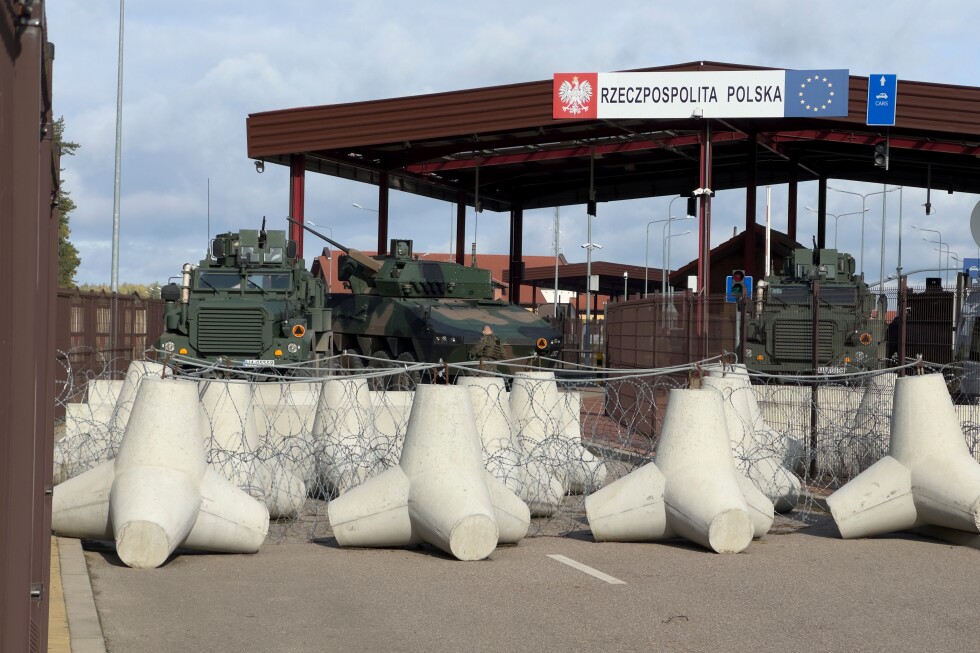
The mines will form part of the “Eastern Shield,” a system of enhanced fortifications that Poland began building along its borders with Belarus and Russia earlier this year. This defensive network comes in response to increased tensions, including the migrant crisis orchestrated by Belarus at the Polish border and Russia’s continued aggression in Ukraine.
Zalewski sought to address humanitarian concerns by clarifying that Poland would only deploy the mines “when there is a realistic threat of Russian aggression.” He added, “We very much respect our territory and we don’t want to exclude it from day-to-day use for Polish citizens.”
Human rights organizations have condemned the withdrawal from the Ottawa Convention, arguing that antipersonnel mines pose unacceptable risks to civilians. These weapons can remain active for decades after conflicts end, continuing to injure and kill civilians long after hostilities have ceased.
Defending Poland’s position, Zalewski emphasized the country’s defensive posture. “We are not an aggressive country, but we have to use all means to deter Russia,” he said, suggesting that Poland is attempting to strike a balance between national security needs and humanitarian concerns by keeping the mines in reserve unless faced with an attack.
The decision marks a significant shift in European security policy and reflects growing concerns about conventional military threats on NATO’s eastern flank. It also highlights how Russia’s invasion of Ukraine has fundamentally altered the security calculus for many countries in the region, leading them to reconsider previously established international commitments in favor of enhanced defensive capabilities.
Fact Checker
Verify the accuracy of this article using The Disinformation Commission analysis and real-time sources.

14 Comments
While I understand Poland’s security concerns, the use of landmines is a blunt and ethically questionable tool. The long-term humanitarian consequences of these weapons are well-documented. I hope Poland will reconsider this decision and find more targeted and humane ways to defend its borders.
You raise valid points. Landmines have devastating effects that linger long after conflicts end. Poland should carefully weigh the ethical implications and seek alternative deterrence strategies that don’t endanger civilian populations.
From a military perspective, landmines may seem a pragmatic defense, but their long-term humanitarian costs are staggering. I hope Poland will reconsider this move and explore alternative deterrence methods that don’t endanger civilian populations.
You make a fair point. While landmines may have tactical advantages, their indiscriminate nature and lasting impact on communities are deeply concerning. Poland should carefully weigh the ethical and practical implications of this decision.
The reintroduction of landmines by Poland is deeply troubling. These weapons are indiscriminate and cause immense suffering, even long after conflicts end. I hope Poland will reconsider this decision and find alternative ways to defend its borders that don’t endanger civilian populations.
You make a valid point. Landmines have devastating humanitarian consequences that linger for years. Poland should carefully weigh the ethics and practicality of this decision and explore more targeted security measures.
This is a concerning development. While mines may seem a pragmatic defense, their indiscriminate nature poses grave risks to civilians. I hope Poland will reconsider and explore alternative deterrence strategies that uphold humanitarian principles.
You raise a valid point. Landmines have devastating long-term consequences, even after conflicts end. Poland should carefully weigh the ethics and practicality of this decision.
This is a concerning development. Landmines are indiscriminate weapons that have caused immense suffering worldwide, even long after conflicts end. While I understand Poland’s security concerns, I hope they will reconsider this decision and explore alternative deterrence strategies that uphold humanitarian principles.
I agree. The use of landmines is a troubling step backward in global efforts to eliminate these inhumane weapons. Poland should carefully consider the long-term consequences and seek security solutions that don’t put civilian lives at risk.
The resurgence of landmine use is deeply troubling. These weapons cause immense suffering and undermine efforts to promote peace and stability. I hope the international community can persuade Poland to reverse course and commit to non-proliferation.
I agree. Landmines are an indiscriminate and inhumane weapon. Poland’s decision sets a dangerous precedent that could embolden others to follow suit, further eroding global norms against these devices.
This is a troubling development. Landmines are an indiscriminate and inhumane weapon that have caused untold suffering worldwide. I hope Poland will reconsider this decision and uphold its commitments to international humanitarian law.
I agree. Poland’s withdrawal from the landmine treaty is a concerning step backward in global efforts to eliminate these devices. The international community should press Poland to reconsider this move and explore alternative security measures.