


Listen to the article
Life in Nuuk Unchanged as U.S. Pursues Greenland Acquisition
Residents of Nuuk, Greenland’s capital city, continue their daily routines amid growing international attention as U.S. President Donald Trump pushes for American control of the Danish territory.
On the streets of this coastal Arctic city, local life proceeds with apparent normalcy. Fishermen load their boats and return to harbor with their daily catch, a vital part of Greenland’s economy where fishing accounts for over 90% of the country’s exports.
At the local market, vendors prepare traditional seal meat, a staple food source for many Greenlanders that connects residents to their indigenous heritage. The practice of hunting marine mammals remains culturally significant in Greenlandic society, though it has faced criticism from international environmental groups in recent years.
The American presence in Greenland is already visible through the U.S. consulate in Nuuk, where an American flag prominently flies outside the building. The United States has maintained strategic interests in Greenland since World War II, when it established military bases to counter German submarine operations in the North Atlantic.
Today, the U.S. operates Thule Air Base in northern Greenland, America’s northernmost military installation and a critical component of its early-warning missile defense system. The base represents the existing strategic partnership between the United States and Denmark regarding Greenland.
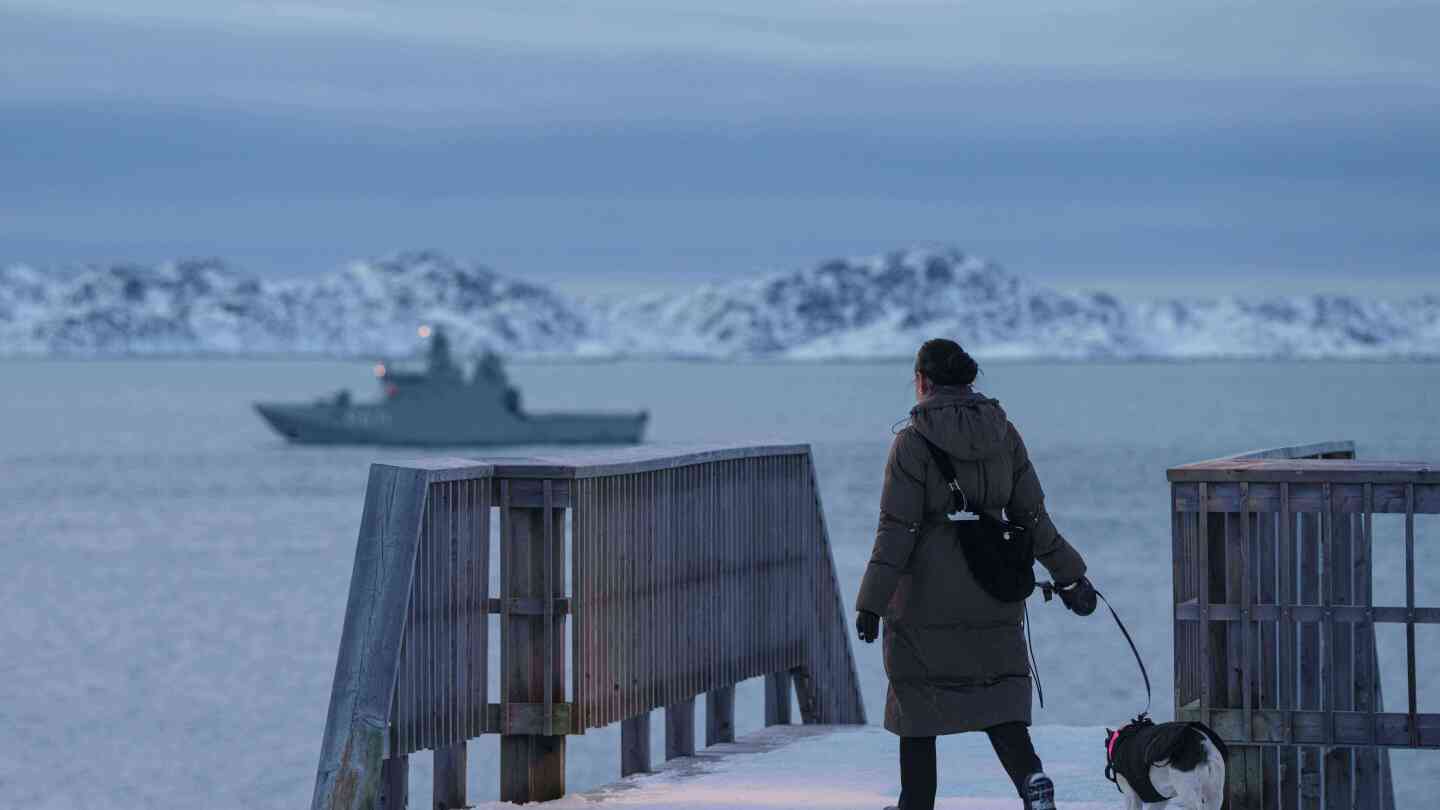
Meanwhile, Danish military vessels like the HDMS Knud Rasmussen continue regular patrols of Greenland’s waters, symbolizing Denmark’s sovereignty over the world’s largest island. The Kingdom of Denmark has maintained control of Greenland since 1814, though the territory has increasingly gained autonomy through self-government since 1979.
Greenland’s strategic importance has grown dramatically in recent years due to climate change. As Arctic ice melts at unprecedented rates, new shipping routes are opening, and previously inaccessible natural resources are becoming available. The island is believed to contain significant deposits of rare earth minerals, uranium, and oil – resources that are critical to both economic development and national security.
Cross-country skiers can be seen training in the snow-covered landscape around Nuuk, highlighting how residents maintain traditional activities despite the political turbulence surrounding their homeland. Local churches also remain active community hubs, reflecting the Christian faith introduced by Danish missionaries in the 18th century.
The Trump administration’s interest in purchasing Greenland represents a significant geopolitical shift in the Arctic region. China has also shown growing interest in Greenland through proposed investments in mining operations and airport infrastructure, creating a potential three-way competition between the U.S., Denmark, and China for influence over the resource-rich island.
For Greenland’s 56,000 residents, many of whom are Inuit, questions about their future governance remain complex. The territory has been moving toward greater independence from Denmark, but full sovereignty would require economic self-sufficiency – something that could potentially be accelerated by foreign investment in resource extraction.
As the diplomatic situation develops, Greenlanders continue their traditional ways of life against the backdrop of increasing international interest in their homeland’s strategic location and valuable natural resources.
Fact Checker
Verify the accuracy of this article using The Disinformation Commission analysis and real-time sources.

12 Comments
These photos really showcase the rugged beauty and resilience of Greenland’s communities. It’s clear the local culture and traditional livelihoods are deeply rooted in the land and sea. Any U.S. plans should proceed cautiously and with full respect for Greenland’s autonomy.
Well said. The Greenlandic people must have a strong voice in determining their own future, regardless of geopolitical interests.
The photos provide a fascinating window into the daily rhythms of life in Greenland. The seal hunting, fishing, and local markets seem integral to the culture and economy. Any U.S. involvement should be sensitive to preserving these traditions.
Agreed. Greenland’s unique identity and self-determination must be the top priority, not exploitation of its strategic location or natural resources.
Greenland’s indigenous culture and connection to the land are clearly strong. I hope any U.S. involvement respects that and doesn’t disrupt the traditional way of life. The photos show a resilient, self-sufficient community.
Absolutely. Greenland’s sovereignty and the will of its people must be the guiding principle, not geopolitical ambition or resource extraction.
The seal hunting and fishing industries seem vital to Greenland’s economy and cultural identity. I hope any U.S. involvement would preserve these traditional livelihoods rather than disrupt them. Nuuk looks like a vibrant, resilient community from the photos.
You make a good point. Greenland’s self-sufficiency and traditional practices should be the priority, not economic extraction or militarization by outside powers.
This is a fascinating glimpse into daily life in Greenland. The photos really capture the rugged natural beauty and cultural uniqueness of the place. I’m curious to learn more about how Greenlanders view the prospect of U.S. control or annexation.
Agreed, it would be important to understand the Greenlandic perspective on this issue. Their autonomy and right to self-determination should be paramount.
Fascinating look at daily life in Greenland. The photos capture the rugged beauty and cultural traditions of this remote Arctic region. It’s understandable why the U.S. sees strategic value in Greenland, but any acquisition should respect the sovereignty and self-determination of the Greenlandic people.
Agreed. Greenland’s indigenous culture and way of life must be protected, regardless of any geopolitical interests. The U.S. should tread carefully and prioritize the needs and wishes of Greenlanders.