


Listen to the article
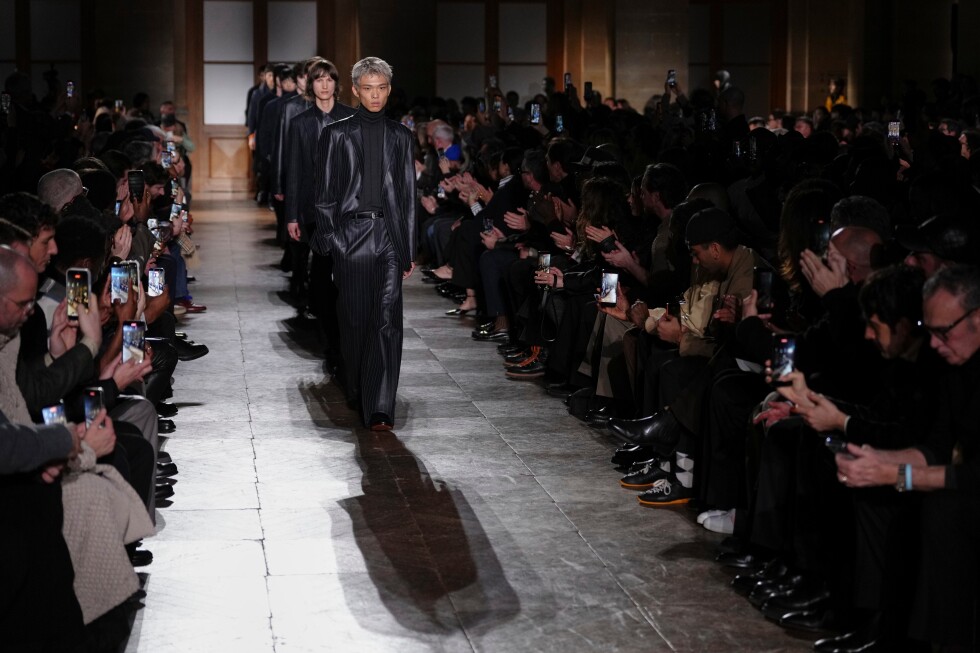
Paris Men’s Fashion Week concluded Sunday with designers delivering a consistent message: create sharp, enduring clothing. Throughout the final days of runway presentations, these values manifested in distinctive trends that are likely to influence menswear in the coming seasons.
The coat emerged as this season’s dominant garment, with designers presenting long, tailored pieces meant to make a statement. At Hermès, longtime designer Véronique Nichanian, who presented her final collection after 37 years with the French luxury house, closed her show with a dramatic dark crocodile leather coat. Her collection also featured aviation-inspired pieces, including shearling bombers with distinctive details like earflap caps and stand-up buckle collars, alongside shearling dyed in eye-catching coral-pink.
Japanese designer Junya Watanabe similarly emphasized coats, showcasing classic camel and navy styles that incorporated sportier elements—bomber backs, leather jacket fronts, and down-jacket quilting—to contemporize formal outerwear while maintaining its elegance.
Many designers reimagined classic tailoring by altering how garments sit on the body. At Sacai, Chitose Abe added new dimensions to jackets, trousers, and outerwear through extra panels, pockets, and quilted inserts, often using triangular motifs. While the collection incorporated tailored looks, workwear, and robust denim—including collaborations with American heritage brand Levi’s and French label A.P.C.—Abe maintained a clear vision: reshape silhouettes without sacrificing wearability.
Comme des Garçons Homme Plus, led by legendary designer Rei Kawakubo, took a more radical approach, strategically cutting into black suits and coats to modify lapels and hems. Later in the presentation, white versions appeared, signaling a shift from somber to bright. Despite the theatrical styling with wigs and masks, the collection emphasized tailoring as its foundation.
A parallel trend emerged in the form of restrained exteriors that concealed sophisticated construction. Kiko Kostadinov eliminated decorative elements to focus on structure: clean coats and jackets featuring folded panels, curved collars, and careful draping, predominantly in black and mineral tones. Even functional elements like buttons were hidden behind plackets, allowing the garments’ shape and movement to communicate their quality.
The week’s presentations generally leaned formal but with a hardened edge. Watanabe’s show maintained a serious atmosphere with its café-table setting, Miles Davis soundtrack, and somber casting. His sharply tailored black denim pieces from his ongoing Levi’s collaboration were styled as contemporary uniforms.
By contrast, Jacquemus interpreted formal dressing with a lighter touch, playing with black-tie conventions through playful tuxedo variations in a deliberately retro party atmosphere. Staged at the Picasso Museum, the show attracted celebrities including Elton John, Sophie Marceau, and Josh Hartnett, highlighting men’s tailoring’s dual role as both commercial product and theatrical spectacle.
Louis Gabriel Nouchi pushed boundaries further with a presentation in an underground car park featuring intense techno music and “Alien” thematic elements. He balanced sharp coats and dark tailoring with provocative body-conscious pieces and graphic references, creating clothing that functions in everyday contexts while maintaining an edgy sensibility.
In an industry defined by rapid change, several moments during the week advocated for a slower approach. At Hermès, Nichanian included designs from decades ago to demonstrate their enduring relevance, concluding her farewell with a simple message: “Slow down.” Similarly, White Mountaineering designer Yosuke Aizawa framed his final collection—featuring technical outerwear, bold colors, and meticulous pattern work—as the culmination of a 20-year journey rather than a response to fleeting trends.
As the fashion industry continues to navigate tensions between commercial demands and creative expression, Paris Men’s Fashion Week reinforced the value of investing in precisely crafted, thoughtfully designed garments built to transcend seasonal cycles.
Fact Checker
Verify the accuracy of this article using The Disinformation Commission analysis and real-time sources.

11 Comments
Paris fashion week is always an exciting time to see the latest trends and innovations in menswear. I’m intrigued by the focus on coats and reimagined tailoring – it speaks to a desire for timeless, functional style.
Absolutely, the incorporation of sportier elements into tailored outerwear seems like a smart way to make classic silhouettes feel more contemporary and wearable.
The evolution of traditional tailoring is fascinating. Designers are finding creative ways to update formal garments like coats and suits, blending in more casual, functional details. It will be interesting to see how these trends filter down to mainstream menswear.
The evolution of tailored outerwear is a fascinating trend. Designers are finding innovative ways to update classic coats and jackets with modern, functional details. I’m curious to see how these looks translate to real-world wardrobes.
I’m curious to see how the focus on sharp, statement-making outerwear will influence street style and everyday menswear in the coming seasons. The mix of formal and sporty elements seems like a versatile, modern approach.
It’s great to see designers pushing the boundaries of traditional menswear silhouettes. The idea of creating sharp, enduring garments that can adapt to different contexts is really appealing, especially as sustainability becomes a greater priority.
Enduring, versatile style is always in demand. It’s encouraging to see Paris fashion week showcasing designers who are rethinking traditional menswear with an eye toward quality and longevity.
Clothes built to last are always appealing, especially as sustainability becomes a bigger priority in fashion. I’m glad to see designers emphasizing quality, enduring design over disposable trends.
Junya Watanabe’s take on reimagined outerwear is really intriguing. Blending formal and casual elements in a cohesive way is a true design challenge, but the results look striking and wearable.
Interesting to see how fashion designers are reworking traditional menswear silhouettes and materials to create more modern, versatile pieces. The emphasis on enduring quality and craftsmanship is refreshing in an era of fast fashion.
Paris fashion week always sets the tone for what’s to come in men’s style. The emphasis on rebuilt tailoring and clothes built to last is an encouraging sign that the industry may be moving away from fast fashion towards more thoughtful, durable design.