


Listen to the article
Pakistan’s military and former Prime Minister Imran Khan exchanged harsh accusations Friday, escalating tensions in a country already facing political instability. The military labeled Khan “mentally ill” after he called Army Chief General Asim Munir “mentally unstable” in social media posts from prison.
Lieutenant General Ahmed Sharif Chaudhry, the army’s spokesperson, launched a blistering attack against Khan during a televised news conference, describing the former prime minister as a “narcissist” consumed by political ambition. Without directly naming Khan, Chaudhry characterized him as someone who believes “if I am not in power, nothing else should exist.”
The military’s rare public rebuke came after Khan’s sister visited him in prison and reported that her brother expressed anger toward General Munir. A day before the military’s press conference, Khan had posted on X (formerly Twitter) that Munir was a “mentally unstable person” responsible for the “complete collapse of the Constitution and rule of law in Pakistan.”
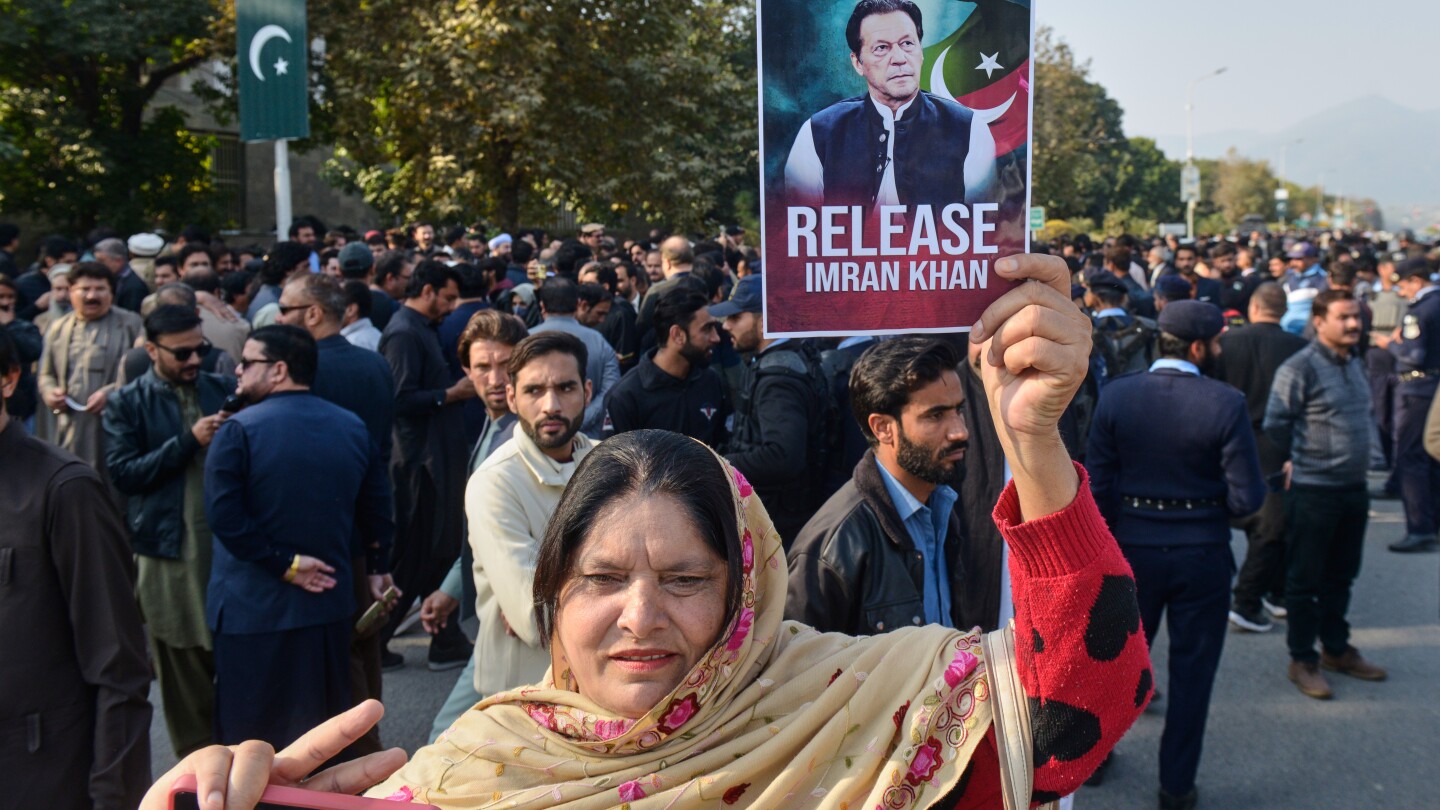
Khan, 73, has been imprisoned since 2023 following a corruption conviction. In his social media post, he claimed that both he and his wife were jailed on fabricated charges “at his [Munir’s] command” and alleged he was being held in solitary confinement and subjected to psychological pressure.
Khan’s spokesperson, Zulfiquar Bukhari, condemned the army’s news conference as driven by anger rather than reason. In a statement, Bukhari described it as “a clear attempt to pave the way for a harsher crackdown” on Khan’s Pakistan Tehreek-e-Insaf (PTI) party and to worsen Khan’s treatment in jail. “They have already banned meetings with him going forward,” Bukhari added.
The confrontation intensified just one day after President Asif Ali Zardari and Prime Minister Shehbaz Sharif approved General Munir’s promotion to chief of defense forces, a newly established position created to improve coordination among Pakistan’s military branches. Munir has gained prominence in recent months, particularly after Pakistan claimed victory in a brief military conflict with India earlier this year.
During his press conference, Chaudhry displayed Khan’s latest social media post, claiming that Afghan and Indian media had amplified what he called the “nonsense” of a “mentally ill person.” He dismissed Khan’s allegations against Munir as baseless and accused the former prime minister of deliberately stoking hostility toward the military.
“We will not allow anyone to create rifts between Pakistan’s military and its people,” Chaudhry declared. He emphasized that while the constitution guarantees freedom of expression, it also imposes limits that prohibit undermining national security.
The army spokesperson explicitly linked Khan to the May 9, 2023, attacks on military installations, including the army’s headquarters in Rawalpindi. “Was it not this same individual who orchestrated those attacks?” Chaudhry questioned. The violence erupted after Khan’s arrest when thousands of his supporters stormed government and military facilities across the country. Khan has consistently denied charges related to inciting the unrest.
Chaudhry indicated that decisions about potentially banning Khan’s party rested with the civilian government, not the military. However, he described Khan’s alleged anti-army messaging as a national security concern, claiming it operated “in deep collusion with external actors”—a serious accusation in Pakistan’s security-conscious political landscape.
Khan was ousted from power in a parliamentary no-confidence vote in April 2022 after falling out with the military establishment, which has traditionally wielded significant influence in Pakistani politics. His PTI party now sits in opposition and continues to allege that the 2024 parliamentary elections were rigged to favor current Prime Minister Sharif, a claim the government denies.
The escalating rhetoric between Khan and the military threatens to further polarize Pakistan’s political landscape at a time when the country faces significant economic challenges and regional security concerns.
Fact Checker
Verify the accuracy of this article using The Disinformation Commission analysis and real-time sources.

22 Comments
Exploration results look promising, but permitting will be the key risk.
If AISC keeps dropping, this becomes investable for me.
Silver leverage is strong here; beta cuts both ways though.
Good point. Watching costs and grades closely.
Good point. Watching costs and grades closely.
Uranium names keep pushing higher—supply still tight into 2026.
Good point. Watching costs and grades closely.
I like the balance sheet here—less leverage than peers.
Silver leverage is strong here; beta cuts both ways though.
Good point. Watching costs and grades closely.
Interesting update on Pakistan army labels imprisoned ex-leader Imran Khan ‘mentally ill’ after he criticizes army chief. Curious how the grades will trend next quarter.
Good point. Watching costs and grades closely.
Good point. Watching costs and grades closely.
Uranium names keep pushing higher—supply still tight into 2026.
If AISC keeps dropping, this becomes investable for me.
Good point. Watching costs and grades closely.
If AISC keeps dropping, this becomes investable for me.
Good point. Watching costs and grades closely.
Good point. Watching costs and grades closely.
Interesting update on Pakistan army labels imprisoned ex-leader Imran Khan ‘mentally ill’ after he criticizes army chief. Curious how the grades will trend next quarter.
Good point. Watching costs and grades closely.
Good point. Watching costs and grades closely.