


Listen to the article
Severe Storm Claims 15 Lives in Pakistan’s Largest City
Violent weather swept through Karachi overnight, leaving at least 15 people dead and numerous others injured as strong winds and heavy rainfall battered Pakistan’s most populous urban center, according to emergency services and hospital officials.
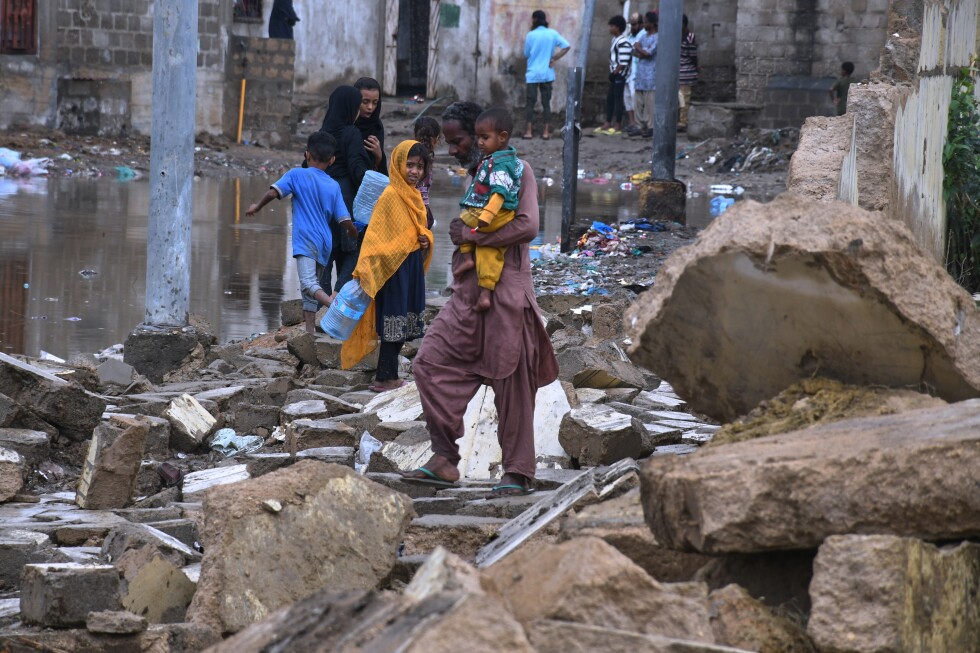
The powerful storm, which began Wednesday and intensified throughout the night, brought winds reaching speeds of 90 kilometers per hour (56 mph) that persisted for hours across the southern port city. The extreme weather caused widespread damage as walls and roofs collapsed at multiple locations throughout the metropolitan area.
Dr. Summaiya Tariq, the police surgeon, confirmed that 15 bodies had been brought to Karachi’s main hospital following the overnight disaster. More than two dozen additional residents sustained injuries in weather-related incidents and received medical treatment at local facilities.
“The situation is quite serious,” a hospital official said on condition of anonymity. “Many of the injuries we’re seeing are from falling debris and collapsed structures that couldn’t withstand the force of the winds.”
Karachi, home to over 20 million residents and Pakistan’s financial hub, saw significant disruption to its infrastructure. The powerful gusts uprooted numerous trees across the city, blocking roads and complicating emergency response efforts. Local authorities mobilized cleanup crews overnight, but the scale of debris created major traffic problems throughout the morning.
Murtaza Wahab, the mayor of Karachi, used social media and public announcements to urge residents to remain indoors and avoid unnecessary travel. “Many trees have fallen, and our teams are working to clear the roads,” Wahab stated, emphasizing the continuing dangers posed by unstable structures and fallen power lines.
The Pakistan Meteorological Department issued warnings that more severe weather could be imminent. Forecasters predicted additional rain and thunderstorms with strong winds would continue to affect Karachi and other parts of Sindh province as a westerly weather system moves across the region. Some areas may experience isolated hailstorms, further complicating recovery efforts.
The disaster highlights the vulnerability of Pakistan’s urban infrastructure to extreme weather events. Karachi, despite being the country’s economic powerhouse, has long struggled with inadequate drainage systems and building code enforcement. During monsoon season, which typically runs from June to September, the city frequently experiences flooding and property damage.
Climate experts have noted that Pakistan faces increasing threats from severe weather events. The country ranked among the ten nations most affected by climate change in the 2021 Global Climate Risk Index. Last year, catastrophic flooding affected over 33 million Pakistanis and caused damage estimated at more than $30 billion.
Emergency services reported that the severe weather system affected multiple regions across Pakistan, not just Sindh province. Northern areas including parts of Khyber Pakhtunkhwa and Punjab also experienced significant rainfall, though without the devastating wind damage seen in Karachi.
Local relief organizations have begun mobilizing assistance for affected families, particularly those in low-income neighborhoods where housing structures tend to be more vulnerable to extreme weather conditions.
City officials indicated they would be conducting safety inspections of buildings in the hardest-hit areas once the weather stabilizes. They advised residents to report any signs of structural damage to emergency services immediately and to avoid entering buildings that show visible damage until they can be properly assessed.
As cleanup operations continue throughout Karachi, authorities remain on high alert with emergency response teams positioned across the city to address any further incidents that may arise from the ongoing weather system.
Fact Checker
Verify the accuracy of this article using The Disinformation Commission analysis and real-time sources.

29 Comments
Nice to see insider buying—usually a good signal in this space.
Interesting update on Overnight storm in Pakistan’s largest city, Karachi, kills at least 15 people and injures several. Curious how the grades will trend next quarter.
Good point. Watching costs and grades closely.
Good point. Watching costs and grades closely.
Uranium names keep pushing higher—supply still tight into 2026.
Good point. Watching costs and grades closely.
Nice to see insider buying—usually a good signal in this space.
Good point. Watching costs and grades closely.
Good point. Watching costs and grades closely.
Exploration results look promising, but permitting will be the key risk.
Good point. Watching costs and grades closely.
Good point. Watching costs and grades closely.
The cost guidance is better than expected. If they deliver, the stock could rerate.
Good point. Watching costs and grades closely.
Good point. Watching costs and grades closely.
Interesting update on Overnight storm in Pakistan’s largest city, Karachi, kills at least 15 people and injures several. Curious how the grades will trend next quarter.
Uranium names keep pushing higher—supply still tight into 2026.
Good point. Watching costs and grades closely.
Nice to see insider buying—usually a good signal in this space.
Good point. Watching costs and grades closely.
Good point. Watching costs and grades closely.
Exploration results look promising, but permitting will be the key risk.
Nice to see insider buying—usually a good signal in this space.
Good point. Watching costs and grades closely.
The cost guidance is better than expected. If they deliver, the stock could rerate.
Nice to see insider buying—usually a good signal in this space.
Good point. Watching costs and grades closely.
Nice to see insider buying—usually a good signal in this space.
Good point. Watching costs and grades closely.