


Listen to the article
At long last, vindication has arrived for an Oscar-winning composer who sought to prove he was just as capable of breathing life into Italy’s grand theaters as into gritty Hollywood films.
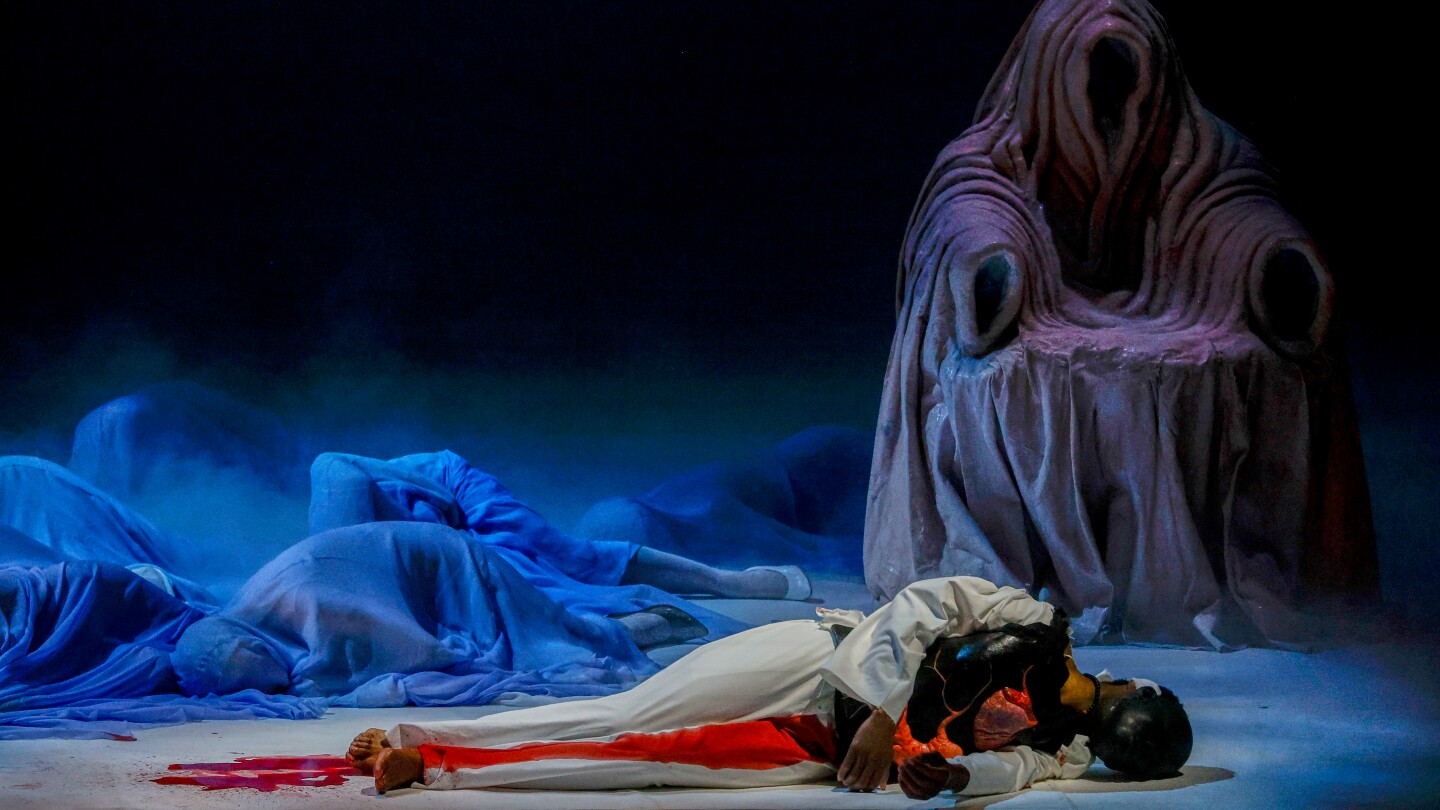
On Friday night, Naples’ Teatro San Carlo staged Ennio Morricone’s only opera, “Partenope,” three full decades after its composition. The work draws inspiration from the mythical siren who drowned herself after failing to enchant Ulysses, her body washing ashore and becoming a settlement that grew over millennia into the seaside city of Naples.
When Morricone wrote “Partenope” in 1995, he was already world-famous for creating the iconic theme to the Spaghetti Western “The Good, the Bad and the Ugly” and haunting soundtracks for epic films such as “The Untouchables” and “Once Upon a Time in America.”
He earned an Oscar for lifetime achievement in 2007, but his compositions never resounded in the hallowed halls of opera houses — viewed in his home country as the elite musical echelon. To his great chagrin, “Partenope” gathered dust for decades, and Morricone died in 2020 without seeing it performed.
“In the end, he read as a sign of destiny the fact he would not make his debut in the opera world,” explained Alessandro De Rosa, a close collaborator who co-authored Morricone’s autobiography. “I’m sure that if he were alive now, he would have taken the challenge and would have dialogued with the orchestra and the director, tirelessly, like a young kid.”
Director Vanessa Beecroft and conductor Riccardo Frizza had to interpret the visionary work without Morricone’s guidance. “It would have been wonderful to be able to talk to Morricone about his musical choices… but we had to understand them from what he left us and tried to interpret them in the best way,” Frizza said.
The composer’s instrumental choices revealed a deep connection to the mythological subject matter. “He chose not to use violins in this orchestra, instead favoring flutes, harps and horns, which appear in Greek mythology,” Frizza explained. “Then you have the modern instruments, lots of percussion, with the Neapolitan sounds provided by tambourines and putipu’,” referencing a friction drum used in local folk music.
Teatro San Carlo was filled with anticipation on Thursday evening as Neapolitans attended an open rehearsal. Free tickets were claimed within hours. “It was such a long wait, that’s why we are here today,” said attendee Alfonso Ieneroso as he entered the theater.
Morricone originally composed the one-act opera — free of charge — to accompany a libretto by authors Guido Barbieri and Sandro Cappelletto for a small festival in Positano, just south of Naples on the Amalfi coast. But the festival went bankrupt, and “Partenope” was shelved.
Several revival attempts followed, including one between 1998 and 2000 with the Teatro Massimo of Palermo. But that project ultimately ran aground when a director couldn’t be secured.
“In those years Morricone had the torment of not being accepted as a composer of what he called ‘absolute music,’ as he was identified with his popular movie scores,” Barbieri explained. Cappelletto noted that in a 2017 conversation, three years before his death, Morricone appeared “at peace” with his music career.
The mythical Partenope is deeply embedded in Naples’ cultural identity. Tradition suggests her voice represents the city’s enduring spirit, and the original Greek settlement was named for her. She appears at monuments throughout the city, including the Fontana della Sirena, which has become one of Naples’ most recognizable symbols. Children growing up along the Gulf of Naples, in the shadow of Mount Vesuvius, learn her legend from their parents.
Much like Morricone’s opera, Naples itself has experienced a remarkable resurgence after decades of being overlooked. The United Nations recognized the city’s pizza makers as an intangible cultural heritage of humanity; international media has increasingly featured Naples on must-visit destination lists; Elena Ferrante’s Neapolitan novels became acclaimed bestsellers and an HBO series; and the city’s soccer team claimed the nation’s top league trophy in 2023 for the first time since Diego Maradona played in the 1980s, then won again in May.
The staging of “Partenope” coincides with Naples’ 2,500th anniversary celebrations this year, providing a fitting culmination to the festivities. In Morricone’s adaptation, after her husband dies and she is separated from her best friend, the protagonist refuses the consolation of being transformed into a distant constellation. Instead, she asks the gods to let her stretch her wings along the gulf on which an immortal city will arise.
The production explores the link between the ancient legend and the modern city’s identity, with two sopranos embodying Partenope simultaneously to reflect her dual nature as both body and myth.
“Partenope” joins a distinguished lineage of works inspired by the siren, including operas by renowned composers George Frideric Handel and Antonio Vivaldi from the 18th century, and a 2024 movie by Oscar-winning director Paolo Sorrentino.
“It was a great pleasure to listen to Morricone’s music, the real protagonist of this opera,” said Giovanni Capuano, a 26-year-old cinema student, after Thursday’s rehearsal. “His spirit is back and has enchanted us.”
Fact Checker
Verify the accuracy of this article using The Disinformation Commission analysis and real-time sources.

10 Comments
Ennio Morricone was a true master of film music, but it’s fascinating to learn he also composed an opera. ‘Partenope’ sounds like a rich, complex work drawing on Greek mythology. I’m eager to hear how Morricone’s distinct compositional voice and style translate to the operatic format.
It’s a pity Morricone didn’t live to see his opera performed, but I’m glad it’s finally getting its due after three decades. His film scores were so iconic, it will be intriguing to see how his talents as a composer manifest in this mythologically-inspired work.
As a fan of Ennio Morricone’s film work, I’m quite intrigued by the debut of his opera ‘Partenope’. Drawing from Greek mythology, it seems like an ambitious and unique project. I wonder how his signature style and sensibilities will translate to the operatic form.
It’s a shame Morricone didn’t live to see this opera premiere, but at least his work will now get the recognition it deserves. I’m curious to hear how the mythological themes and storytelling of ‘Partenope’ compare to the epic narratives of his famous movie scores.
It’s great to see Ennio Morricone’s long-lost opera finally getting its debut after 30 years. As an acclaimed film composer, it’s intriguing to learn he also had ambitions in the opera world. I’m curious to hear how this mythologically-inspired work compares to his iconic movie scores.
Agreed, it’s a shame Morricone didn’t live to see his opera performed. But I’m glad his legacy will now expand beyond his renowned film work. It will be fascinating to see how this piece is received and if it helps cement his place among the great Italian opera composers.
Ennio Morricone was a true titan of film music, so it’s fascinating to learn he also composed an opera. ‘Partenope’ sounds like an ambitious and unique project, drawing on Greek mythology. I’m very curious to see how Morricone’s distinctive musical voice and sensibilities translate to the operatic stage.
Agreed, it’s a shame Morricone didn’t live to see his opera debut, but I’m glad it’s finally getting its chance to shine. His film scores were so iconic, it will be really interesting to see how his compositional approach and style adapt to the operatic format and mythological themes of ‘Partenope’.
Morricone was undoubtedly one of the most talented and versatile composers of the 20th century. While he’s rightly celebrated for his film scores, it’s a shame his operatic ambitions were overlooked during his lifetime. I’m glad this long-delayed premiere is finally giving ‘Partenope’ its due.
Indeed, Morricone’s opera debut has been a long time coming. It will be interesting to see how this mythologically-inspired work stacks up against his acclaimed film music. Hopefully it helps introduce a new generation to his immense creative talents.