


Listen to the article
Rival Political Forces Mobilize Ahead of Critical Hungarian Elections
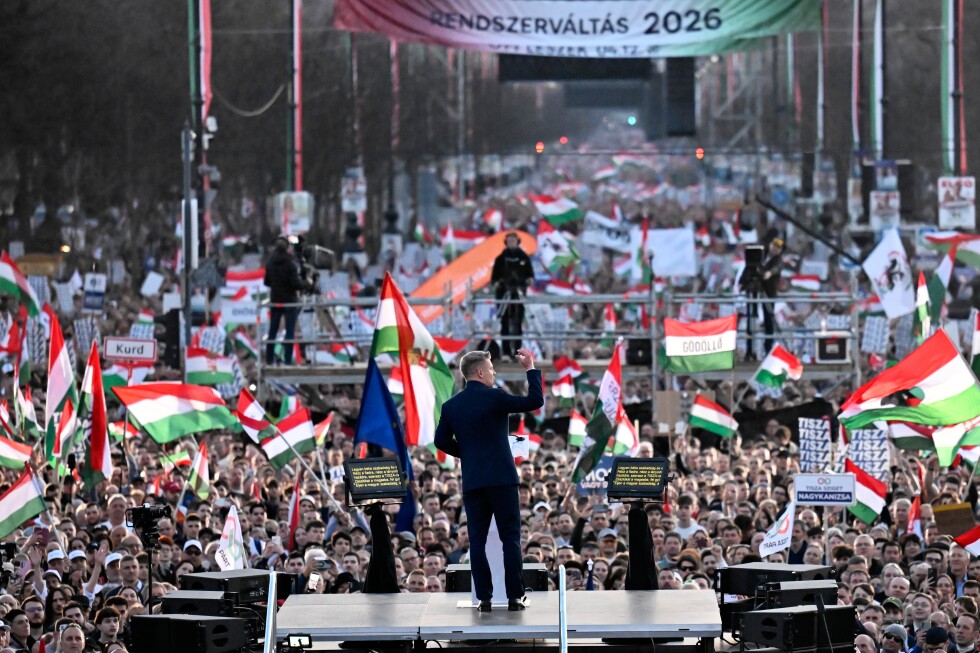
Hungarian Prime Minister Viktor Orbán and his emerging political challenger Péter Magyar each rallied massive crowds of supporters in Budapest on Sunday, showcasing their political strength just four weeks before a pivotal national election that could reshape Hungary’s political landscape.
The competing demonstrations, drawing hundreds of thousands to the capital’s streets, represent a crucial test of public sentiment as Hungary approaches what many analysts consider the most competitive election since Orbán’s Fidesz party came to power in 2010.
Orbán, 62, has maintained a firm grip on Hungary’s political apparatus for the past 14 years, but now faces an unprecedented challenge from Magyar, a 44-year-old lawyer and former Fidesz insider who broke with the party earlier this year.
Speaking to a crowd estimated at over 100,000 people at Budapest’s Heroes’ Square, Magyar accused Orbán’s government of deliberately dividing Hungarians and steering the country away from its natural place among Western democracies.
“Our homeland is part of the West, our homeland is part of the European community, our country is part of NATO. And not because of treaties or charters, but because it is written in our destiny,” Magyar declared. “Our ancestors left us the inheritance of where we belong. We’re not afraid. We have learned from our ancestors that nothing lasts forever.”
Magyar’s newly formed center-right Tisza party has rapidly gained momentum, focusing its message on improving conditions for ordinary Hungarians while promising to restore democratic institutions that critics say have eroded under Orbán’s increasingly autocratic rule.
Independent polling shows Magyar’s Tisza party with a substantial lead over Fidesz among decided voters. A February survey by pollster Medián published by news site HVG indicated a 20-percentage-point advantage for Tisza—a remarkable shift in a country where Orbán has dominated politics for over a decade.
Across town, tens of thousands of Orbán supporters marched across the Danube toward Hungary’s parliament, where the prime minister delivered a speech behind a banner reading, “We won’t be a Ukrainian colony!”
Orbán has intensified his anti-Ukraine rhetoric in recent months, claiming that Kyiv, the European Union, and Magyar’s Tisza party are conspiring to oust his government and install one that would financially support Ukraine and potentially send Hungarian soldiers to fight against Russia.
“We will be here even if hundreds of parachutists from Brussels fall from the sky,” Orbán told his supporters, referring to the EU’s headquarters in Belgium. “We will round them up, dust off their pants and send them back, some to Brussels and some to Kyiv.”
The prime minister has painted the upcoming election as a stark choice between peace and war, with his government positioned as the sole guarantor of Hungary’s security amid regional instability.
“Only this government is able to secure these three things for the future: God, homeland, family,” said Anikó Menyhárt, an Orbán supporter attending the rally.
Hungary’s economic challenges have created an opening for Magyar’s campaign. A stagnating economy, deteriorating public services, and rising living costs—combined with increasingly prominent corruption allegations against government officials—have fueled growing dissatisfaction with Orbán’s leadership.
While the prime minister has focused on external threats, Magyar has methodically campaigned throughout rural Hungary—traditionally an Orbán stronghold—promoting a message of domestic renewal and a return to Western partnerships instead of the government’s pro-Russia orientation.
“On April 12, we will achieve a victory that will be seen not only from the moon, but also from the Kremlin,” Magyar told his supporters, highlighting his intention to realign Hungary’s foreign policy.
The election outcome remains uncertain despite Tisza’s polling advantage. Fidesz maintains strong support in many rural areas and controls most broadcast media and a vast network of loyal news outlets to amplify its message. The government has also deployed controversial campaign tactics, including billboards featuring an AI-manipulated image of Ukrainian President Volodymyr Zelenskyy with the caption: “We won’t let Zelenskyy have the last laugh!”
One Tisza supporter, Attila Tóth, expressed hope that a Magyar victory would bring improvements to education, healthcare and transportation, while ending what he described as government propaganda. “(Tisza) won’t brainwash people, and you won’t feel sick when you walk down the street and see 15 posters every 100 meters telling you who the enemy is at the moment,” he said.
As the April 12 election approaches, both sides are intensifying efforts to mobilize their bases in what may become the most consequential vote in Hungary’s recent democratic history.
Fact Checker
Verify the accuracy of this article using The Disinformation Commission analysis and real-time sources.

12 Comments
Given the potential implications for Hungary’s geopolitical orientation and its place within the broader European community, this election is one that will be closely watched by observers both within the country and internationally.
The outcome could have far-reaching consequences, not just for Hungary but for the broader regional dynamics in Central Europe. It will be fascinating to see how the campaign unfolds and whether Orbán’s long-standing dominance can be challenged by the upstart Magyar.
The competing rallies in Budapest show the strength of political support on both sides. It will be interesting to see how the electorate responds and whether the challenger Magyar can make inroads against the entrenched Orbán regime.
Given the complex history and political landscape in Hungary, this election will certainly be one to watch closely. The outcome could have significant implications for the country’s geopolitical orientation and its place within the broader European community.
The competing rallies in Budapest highlight the deep political divisions within Hungary. Voters will have to weigh the merits of Orbán’s nationalist, Euroskeptic platform against Magyar’s pro-Western, reform-oriented vision for the country’s future.
With the economy and energy security likely to be key issues, the dynamics around mining, commodities, and energy policy could play an important role in swaying voter sentiment. Curious to see how the candidates position themselves on these critical sectors.
As someone with an interest in the mining and commodities space, I’ll be closely following how the candidates address issues like resource development, energy policy, and the economic implications for Hungary. These sectors could be a key battleground in this election.
The sheer scale of the rival rallies in Budapest underscores the high stakes involved in this election. Voters will have a clear choice between continuity under Orbán or a potential shift towards closer Western integration under challenger Magyar.
It will be fascinating to see how the campaign unfolds and whether Orbán’s long-standing dominance can be challenged by the upstart Magyar. The outcome could have far-reaching implications for Hungary’s future trajectory.
As someone with an interest in the mining and commodities space, I’ll be closely following how the candidates address issues like resource development, energy policy, and the economic implications for Hungary. These sectors could be a key battleground in this election.
With the economy and energy security likely to be key issues, the dynamics around mining, commodities, and energy policy could play an important role in swaying voter sentiment. Curious to see how the candidates position themselves on these critical sectors.
Fascinating to see the political dynamics in Hungary heating up ahead of the upcoming election. While the current PM Orbán has maintained power for over a decade, the emergence of a credible challenger in Magyar suggests a potentially close and pivotal race that could reshape the country’s future direction.