


Listen to the article
Milan officials have granted rare access to a hidden Leonardo da Vinci masterpiece in conjunction with the upcoming Winter Olympics, offering art enthusiasts a unique opportunity to witness both restoration work and a long-concealed treasure.
The expansive wall and ceiling painting, located in the Sala delle Asse within Milan’s historic Sforza Castle, depicts an intricate pergola covered with intertwined flowering branches. Historical records confirm Leonardo began the work in 1498 but left it unfinished when French forces invaded Milan, forcing him to flee.
“After that date it was covered over, hidden,” explained Luca Tosi, heritage curator at the Sforza Castle. The French military converted the castle into barracks and plastered over the artwork, effectively concealing it for centuries.
The masterpiece remained hidden until the early 20th century when restorers discovered it beneath layers of plaster. At that time, they attempted to complete the work by filling in colors to match Leonardo’s original vision. This well-intentioned intervention ultimately damaged the painting’s scholarly reputation.
“As a result, Leonardo scholars no longer recognized them as a true Leonardo, but rather as a repainted Leonardo, somewhat a fake, to use a popular term,” Tosi noted.
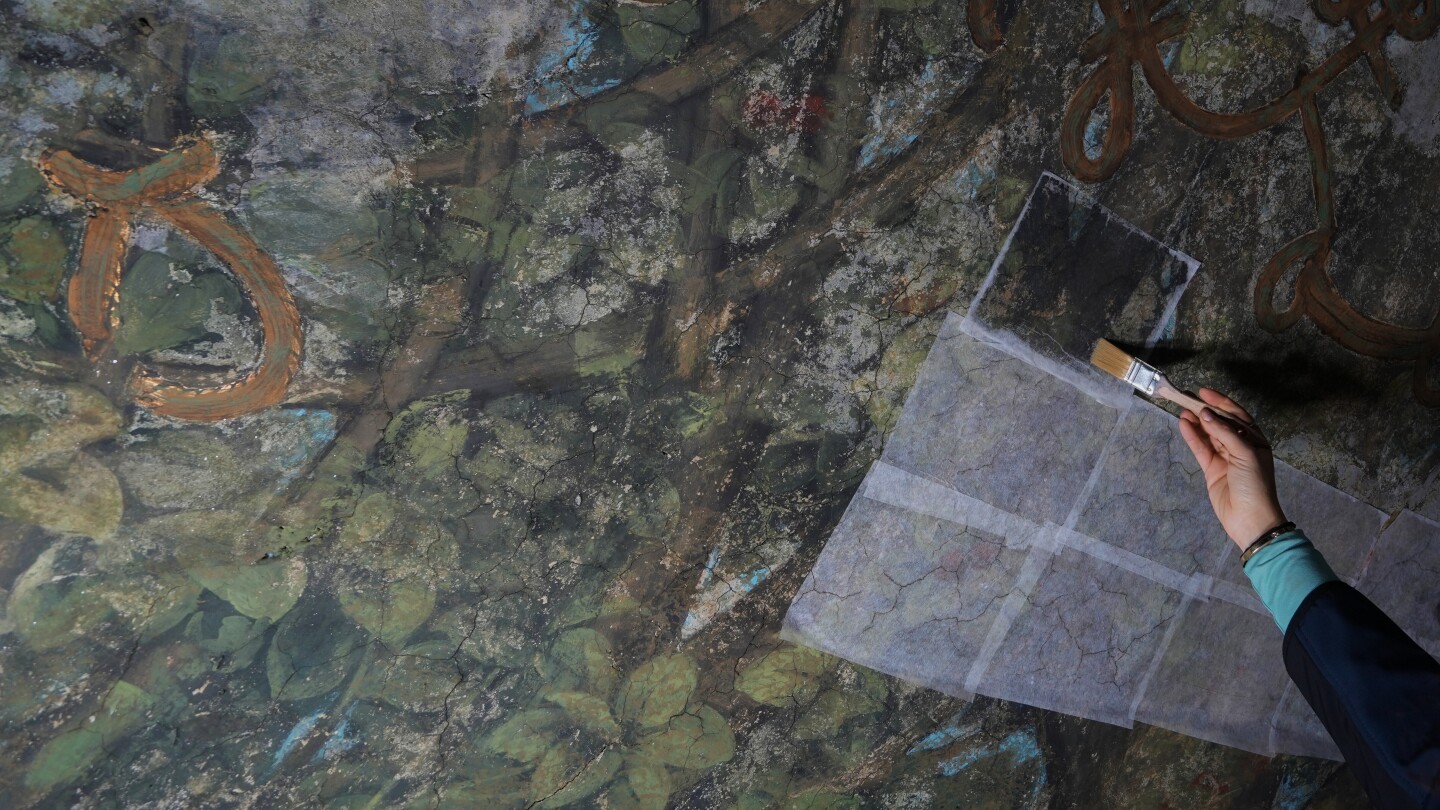
The current restoration represents a significant effort to address these past interventions and reveal Leonardo’s authentic work. Restorers are employing delicate techniques, including Japanese rice paper with demineralized water, to remove salt deposits that have seeped into the walls over centuries.
“The hardest part is that Leonardo’s painting is very delicate, there are some liftings, there are more fragile parts and therefore the work must be done centimeter by centimeter, with the utmost attention and care,” Tosi emphasized.
The painting itself provides valuable insight into Leonardo’s renowned scientific curiosity. The detailed study of leaves and plant species reflects his obsession with botanical accuracy and natural forms. Tomasso Sacchi, Milan’s top cultural official, described the experience as “a thrill to know another Leonardo and to experience this extraordinary dedication to various forms of knowledge by this fundamental figure in our history.”
The timing of this rare public access aligns with the Milan Cortina Winter Olympics, scheduled for February 6-22. The Sforza Castle holds particular significance for the Games, as it sits within the same Sempione Park where the Olympic flame will burn throughout the event. Adding another layer of connection, Olympic officials recently announced that the design of the Olympic cauldron itself draws inspiration from Leonardo’s geometric studies.
Visitors will have a brief window – from February 7 to March 14 – to climb the six-meter (nearly 20-foot) scaffolding and observe restorers at work. This unusual behind-the-scenes opportunity offers a glimpse into the painstaking conservation process rarely witnessed by the public.
After this limited viewing period, the painting will again be closed for approximately 18 months to complete the restoration work. This timeline suggests authorities are prioritizing proper conservation over extended public access, ensuring the delicate masterpiece receives the careful attention it requires.
The temporary exhibition is part of broader Leonardo da Vinci itineraries created within the Sforza Castle, highlighting Milan’s significant connection to the Renaissance polymath. These initiatives aim to showcase the city’s rich cultural heritage during the international spotlight of the Olympics, potentially attracting art lovers who might otherwise focus solely on sporting events.
For art historians and Renaissance enthusiasts, this fleeting opportunity represents a chance to witness a lesser-known aspect of Leonardo’s genius that has remained largely inaccessible for generations.
Fact Checker
Verify the accuracy of this article using The Disinformation Commission analysis and real-time sources.

26 Comments
The cost guidance is better than expected. If they deliver, the stock could rerate.
Good point. Watching costs and grades closely.
Good point. Watching costs and grades closely.
I like the balance sheet here—less leverage than peers.
Good point. Watching costs and grades closely.
I like the balance sheet here—less leverage than peers.
Good point. Watching costs and grades closely.
I like the balance sheet here—less leverage than peers.
Good point. Watching costs and grades closely.
Good point. Watching costs and grades closely.
Exploration results look promising, but permitting will be the key risk.
Production mix shifting toward World might help margins if metals stay firm.
Exploration results look promising, but permitting will be the key risk.
Good point. Watching costs and grades closely.
Good point. Watching costs and grades closely.
Interesting update on Olympic visitors to Milan get a rare chance to glimpse restoration of a long-hidden Leonardo gem. Curious how the grades will trend next quarter.
Good point. Watching costs and grades closely.
Good point. Watching costs and grades closely.
Silver leverage is strong here; beta cuts both ways though.
Good point. Watching costs and grades closely.
Good point. Watching costs and grades closely.
Uranium names keep pushing higher—supply still tight into 2026.
Good point. Watching costs and grades closely.
Good point. Watching costs and grades closely.
Silver leverage is strong here; beta cuts both ways though.
Good point. Watching costs and grades closely.