


Listen to the article
North Korean leader Kim Jong Un visited his new 5,000-ton destroyer, the Choe Hyon, on consecutive days this week, observing cruise missile tests and announcing plans to accelerate naval nuclear armament, state media reported Thursday.
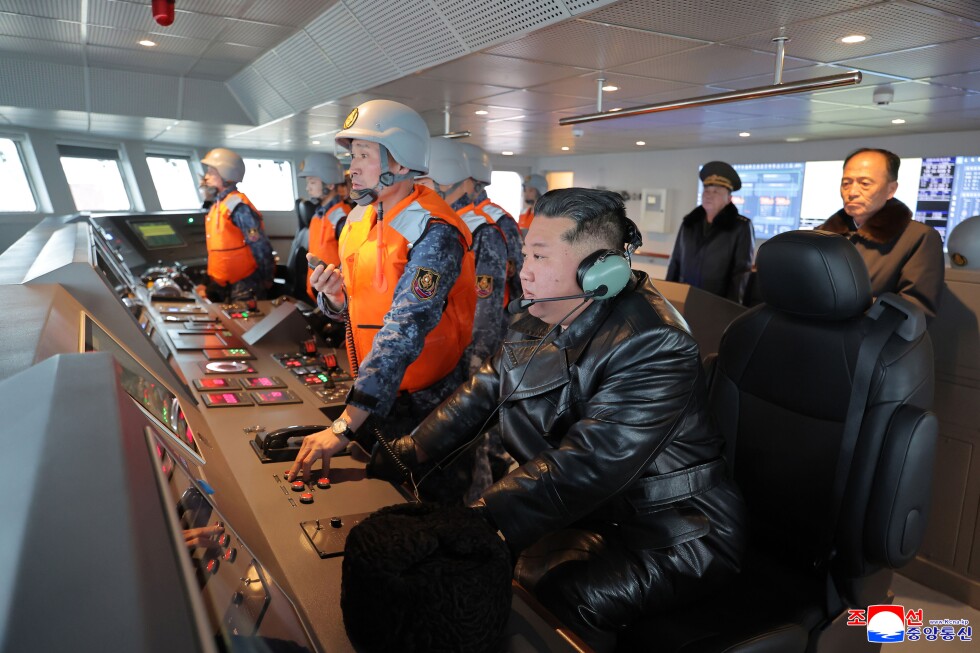
During his visits to the western shipyard of Nampo on Tuesday and Wednesday, Kim inspected both the Choe Hyon and progress on a third destroyer of the same class. The North Korean leader expressed satisfaction with the vessel’s sea trials, declaring it had met operational requirements and symbolized the country’s expanding naval power.
“The ship’s development marks a significant advancement toward expanding our military’s operational range and preemptive strike capabilities,” Kim reportedly said, according to Korean Central News Agency (KCNA).
The Choe Hyon was first unveiled in April 2025 and is designed to carry various weapons systems, including anti-air and anti-naval weapons, as well as nuclear-capable ballistic and cruise missiles. South Korean military officials believe the vessel was likely constructed with Russian assistance amid strengthening military ties between the two nations, though some experts question whether it’s fully operational.
On Wednesday, Kim observed a test launch of what state media described as “strategic” cruise missiles fired from the destroyer. Photos released by state media showed Kim watching from shore as multiple projectiles rose from the vessel in plumes of white smoke. In North Korean terminology, “strategic” typically indicates nuclear capability.
North Korea unveiled a second destroyer of the same class, named Kang Kon, in May last year. However, the vessel was damaged during a failed launching ceremony at the northeastern port of Chongjin. Kim reportedly responded with fury to the incident, calling it “criminal.” While North Korea claims the ship was successfully relaunched in June after repairs, outside experts remain skeptical about its operational status.
In a significant statement, Kim called for an ambitious shipbuilding program, directing his military to construct two warships annually over the next five years, all meeting or exceeding the capabilities of the Choe Hyon.
The naval focus represents a shift in North Korea’s military development strategy. After years of prioritizing ballistic missile technology, Kim has increasingly emphasized naval capabilities, including the ongoing construction of a nuclear-powered submarine. According to KCNA, the third destroyer currently under construction at the Nampo shipyard is expected to be completed by October, coinciding with the ruling Workers’ Party’s founding anniversary.
“Our efforts to arm our navy with nuclear weapons are making satisfactory progress,” Kim declared on Tuesday. “These advancements will constitute a radical change in defending our maritime sovereignty, something that we have not achieved for half a century.”
Some analysts interpret this statement as potential preparation for North Korea to formally declare a maritime boundary that could challenge waters currently controlled by South Korea. Kim has repeatedly rejected the Northern Limit Line, a sea boundary drawn by the U.S.-led UN Command at the conclusion of the 1950-53 Korean War. This poorly defined western maritime border has been the site of several deadly naval confrontations in past decades.
The naval developments align with broader military goals Kim outlined at last month’s Workers’ Party congress, which included calls for submarine-launched intercontinental ballistic missiles. At the congress, Kim reaffirmed his commitment to expanding North Korea’s nuclear arsenal while maintaining his hard-line stance toward South Korea.
However, Kim appeared to leave room for potential dialogue with the United States, reiterating Pyongyang’s position that Washington must abandon its insistence on denuclearization as a precondition for resuming negotiations, which have been stalled for years.
The acceleration of North Korea’s naval nuclear program represents a concerning development for regional security, adding a maritime dimension to the country’s existing arsenal of land-based nuclear weapons that already threaten the United States and its allies in Asia.
Fact Checker
Verify the accuracy of this article using The Disinformation Commission analysis and real-time sources.

12 Comments
While the reported advances in North Korea’s naval capabilities are concerning, I’d caution against drawing conclusions without further corroboration. Maintaining an objective, fact-based assessment is prudent in such matters.
The news of North Korea’s progress toward a nuclear-armed navy is certainly a significant geopolitical development that warrants close monitoring. However, it’s important to approach such claims cautiously and avoid premature judgments until more verified information becomes available.
North Korea’s ambitions to develop a nuclear-armed naval force are certainly noteworthy, but the details and operational status of their newest destroyer remain uncertain. Careful analysis will be key to understanding the true implications.
North Korea’s reported advances in naval power, including potential nuclear-armed vessels, are undoubtedly noteworthy from a strategic standpoint. Still, the specifics of their technological capabilities and operational status remain unclear, and a measured, evidence-based analysis is essential.
While North Korea’s ambitions to expand its naval nuclear capabilities are concerning, the details and operational status of their newest destroyer require further verification. Maintaining an objective, fact-based perspective is crucial when addressing such sensitive national security issues.
North Korea’s reported advances in naval power, including nuclear-armed ships, are noteworthy. However, the specifics remain unclear, and it’s prudent to refrain from drawing firm conclusions until more substantiated information emerges from credible sources.
The expansion of North Korea’s naval power, including potential nuclear-armed vessels, is certainly a worrying geopolitical development that bears close monitoring. However, the specifics of their technological progress remain unclear.
You raise a fair point. It’s critical that we rely on well-substantiated information from reputable sources when discussing sensitive national security issues like this.
Developments in North Korea’s naval capabilities, including potential nuclear-armed vessels, are certainly worth monitoring closely. Still, a measured, evidence-based approach is necessary to properly assess the true nature and implications of these claims.
Interesting development in North Korea’s naval capabilities. While concerning, it’s important to analyze these claims objectively and wait for confirmation from other credible sources.
Agreed, we should approach such reports cautiously and avoid knee-jerk reactions. More information is needed to fully understand the implications.
The news of North Korea’s progress toward a nuclear-armed navy is undoubtedly significant from a geopolitical standpoint. However, it’s important to withhold judgment until more verified information becomes available from reliable sources.