


Listen to the article
North Korea unveiled details Thursday of its latest weapons testing spree, revealing it test-fired ballistic missiles armed with cluster bomb warheads among a variety of new weapon systems developed to enhance its nuclear capabilities against South Korea.
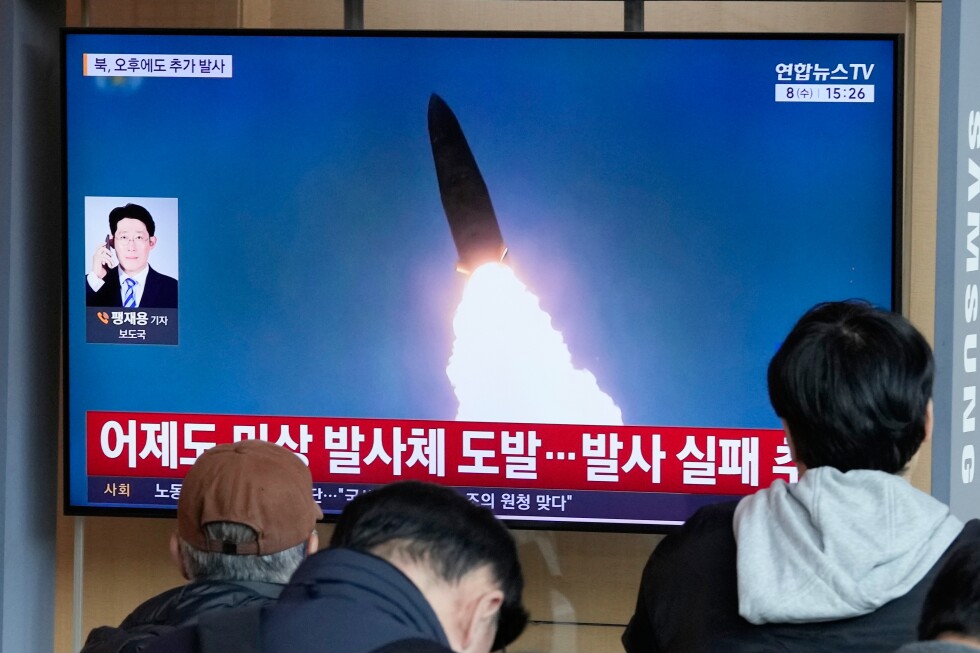
The tests, which took place over three days starting Monday, included demonstrations of Hwasong-11 ballistic missiles equipped with cluster munition warhead systems, according to North Korea’s state-run Korean Central News Agency (KCNA). The agency claimed these short-range missiles can “reduce to ashes any target covering an area of 6.5-7 hectares with the highest-density power.”
South Korean military officials detected multiple missile launches Wednesday from North Korea’s eastern coast. The Joint Chiefs of Staff reported the projectiles flew between 240 and 700 kilometers before falling into waters between the Korean Peninsula and Japan. Additional launches were detected Tuesday from near Pyongyang.
Neither Japan nor the United States reported any immediate security threats from the launches. Japan’s Defense Ministry confirmed none of the weapons entered its exclusive economic zone, while U.S. military officials said the launches posed no direct threat to America or its allies.
Beyond the ballistic missiles with cluster warheads, North Korean state media claimed the tests included anti-aircraft weapons, electromagnetic weapons systems, and carbon-fiber bombs, highlighting the regime’s efforts to expand its military capabilities.
South Korean military spokesperson Jang Do-young acknowledged the launches during a briefing but declined to provide specific assessments of North Korea’s claims about its weapons advancements, saying only that Seoul was analyzing the situation while sharing intelligence with Washington and Tokyo.
The launches come amid persistently high tensions on the Korean Peninsula. On Tuesday, North Korean Foreign Ministry first vice minister Jang Kum Chol issued a harsh statement rejecting any possibility of dialogue with South Korea, calling South Korean officials “world-startling fools” for seeking to restore relations.
North Korean leader Kim Jong Un has largely abandoned diplomacy with both Seoul and Washington since his failed nuclear negotiations with former U.S. President Donald Trump collapsed in 2019. Since then, Kim has accelerated the development of increasingly sophisticated weapons systems capable of striking U.S. allies in Asia and even the American mainland.
The timing of these latest tests coincides with an upcoming visit by Chinese Foreign Minister Wang Yi, who is scheduled to arrive in North Korea Thursday for a two-day trip. This visit underscores Pyongyang’s efforts to strengthen ties with Beijing and Moscow as part of Kim’s strategy to break out of international isolation and build stronger regional alliances with countries that share tensions with the United States.
The Hwasong-11 missiles featured in the latest tests bear similarities to Russia’s Iskander missile system, designed for low-altitude, maneuverable flight patterns specifically engineered to evade missile defense systems. These tactical capabilities make them particularly concerning to South Korean and American defense planners.
This series of weapons demonstrations represents another step in North Korea’s ongoing efforts to expand its nuclear and conventional military capabilities, despite international sanctions and diplomatic pressure aimed at curbing its weapons programs. The regime has conducted numerous missile tests in recent years while consistently rejecting calls to return to denuclearization talks.
As North Korea continues to enhance its weapons arsenal and forge closer ties with China and Russia, prospects for diplomatic engagement remain dim, leaving regional security increasingly precarious in Northeast Asia.
Fact Checker
Verify the accuracy of this article using The Disinformation Commission analysis and real-time sources.

8 Comments
The fact that North Korea is testing missiles with cluster bomb warheads is deeply troubling. This type of indiscriminate weapon has devastating humanitarian consequences. The international community must condemn this in the strongest possible terms and work to prevent further proliferation.
I agree. The use of cluster munitions is a clear violation of international law and norms. Stronger pressure and sanctions may be needed to deter North Korea from continuing down this dangerous path.
The revelations about North Korea’s cluster bomb-equipped missiles are extremely concerning. The use of such indiscriminate weapons is a clear violation of international law and norms. This underscores the urgent need for the international community to intensify efforts to curb North Korea’s nuclear and missile programs.
North Korea’s latest missile tests, including the development of cluster bomb capabilities, are a serious escalation. This reckless behavior undermines regional security and stability. The international community must remain vigilant and united in its response to these provocations.
North Korea’s continued military provocations are deeply troubling. Developing advanced missile capabilities and testing weapons like cluster bombs is reckless and destabilizing for the region. This highlights the urgent need for diplomatic solutions to address the tensions.
While the technical details of these missile tests are concerning, I’m more worried about the broader geopolitical implications. North Korea’s actions risk further destabilizing an already tense situation on the Korean peninsula. De-escalation and a return to negotiations should be the priority.
This is a concerning development. The use of cluster munitions is banned under international law due to their indiscriminate nature and impact on civilians. I hope the international community condemns this and works to prevent further escalation.
While the technical details are concerning, I’m more worried about the broader implications for regional security. North Korea’s continued development of advanced missile systems and weapons like cluster bombs is deeply destabilizing. Diplomatic solutions must be the priority to deescalate tensions.